




Has King Charles Softened Britain’s Christian Identity? Palace Wording Sparks Fierce Debate Over Faith, Islam and the Future of the Monarchy
 Editor's Desk
4 minutes read
Editor's Desk
4 minutes read
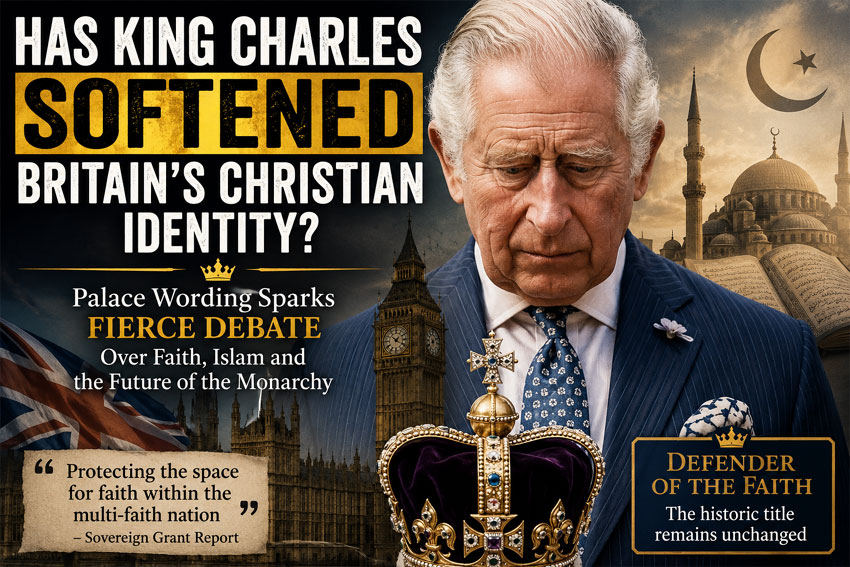
A fresh debate over the religious identity of the British monarchy has erupted after a recent Buckingham Palace publication described King Charles III’s constitutional role as protecting “the space for faith” in Britain’s increasingly diverse society. The wording has prompted praise from supporters of interfaith dialogue while drawing sharp criticism from conservative commentators, some of whom argue it signals a departure from centuries of Christian tradition.
The controversy gained momentum after social media users circulated an Instagram reel referencing an article by The Western Journal, claiming the King had effectively abandoned his historic role as “Defender of the Faith.” The post attracted widespread discussion, with some commentators alleging that the British monarchy was surrendering its Christian identity in favor of religious pluralism.
However, available evidence does not support claims that King Charles has changed his official royal title or embraced Islam.
What Actually Changed?
The discussion centers on language used in the Sovereign Grant Report, which describes one of the King’s constitutional responsibilities as protecting “the space for faith” within Britain’s multi-faith society.
Critics interpreted the wording as evidence that the monarchy is moving away from its historic Christian foundations. Others argue that the statement simply reflects modern Britain’s religious diversity while remaining consistent with the King’s long-standing commitment to promoting understanding between different faith communities.
Importantly, Buckingham Palace has not announced any legal or constitutional change to the monarch’s official title.
King Charles III continues to hold the historic title of “Defender of the Faith”, a designation held by British monarchs for centuries and linked to the sovereign’s role as Supreme Governor of the Church of England.
Why the Issue Has Become So Polarizing
King Charles has spent decades promoting dialogue among different religions. Even before becoming king, he often spoke about protecting the freedom of people from all faiths to practice their beliefs peacefully.
Supporters view this approach as appropriate for a modern Britain that includes Christians, Muslims, Jews, Hindus, Sikhs, Buddhists and people with no religious affiliation.
Critics, however, fear that emphasizing equal recognition of all religions could gradually weaken the monarchy’s historic Christian identity. Conservative publications and commentators argue that the Church of England occupies a unique constitutional position and should not be viewed as merely one faith among many.
The debate has therefore become less about a legal title and more about the symbolic direction of the monarchy.
Did King Charles “Bow to Islam”?
Despite widespread social media claims, there is no verified evidence that King Charles has converted to Islam, altered his constitutional role in favor of Islam, or replaced Christianity with another religion.
The wording in recent Palace publications refers to protecting religious freedom within the United Kingdom rather than changing the King’s personal faith or constitutional responsibilities.
While some opinion writers characterize this approach as a concession to multiculturalism, those descriptions represent editorial interpretation rather than confirmed fact.
An Islamic Perspective
From an Islamic viewpoint, justice, respect and peaceful coexistence with followers of other religions are well-established principles.
The Qur’an instructs Muslims to act with justice and fairness toward those who do not wage war against them, while also maintaining the distinct beliefs and teachings of Islam. Islamic scholarship has historically recognized that people of different faiths may live together under mutual respect without requiring political leaders outside the Muslim world to adopt Islam.
For many Muslim observers, King Charles’ statements promoting dialogue among religions are generally understood as support for religious harmony rather than an endorsement of Islamic theology.
At the same time, Islam maintains its own clear theological beliefs regarding monotheism, prophethood and revelation. Respecting followers of other religions does not imply that all religions are viewed as theologically identical.
A Debate That Is Likely to Continue
The discussion surrounding King Charles’ language reflects broader questions facing many Western societies: how historic religious institutions should respond to growing cultural and religious diversity while preserving their own traditions.
For supporters, the King’s emphasis on protecting people of all faiths represents inclusive leadership suited to a modern constitutional monarchy.
For critics, it raises concerns that Britain’s Christian heritage is gradually being diluted.
Regardless of where one stands in the debate, the available evidence shows that King Charles remains the constitutional head of the Church of England and continues to hold the official title “Defender of the Faith.” The current controversy stems from differing interpretations of the Palace’s language rather than any confirmed constitutional or religious change.
Sources: Buckingham Palace publications, constitutional records relating to the monarchy, and reporting by multiple British and international news organizations. Commentary referenced in public debate includes articles published by The Western Journal and reactions circulating across social media.
This is supervised, written, directed or edited at Our Office Desk.
Any issue or disagreement can be sent to the help desk, after thoroughly analyzing we will be open for any amicable solution.

 News Desk