


Enough Is Enough: India Must Stop Measuring Faith and Celebration in Decibels
 Editor's Desk
5 minutes read
Editor's Desk
5 minutes read
By Burning Topics Editorial
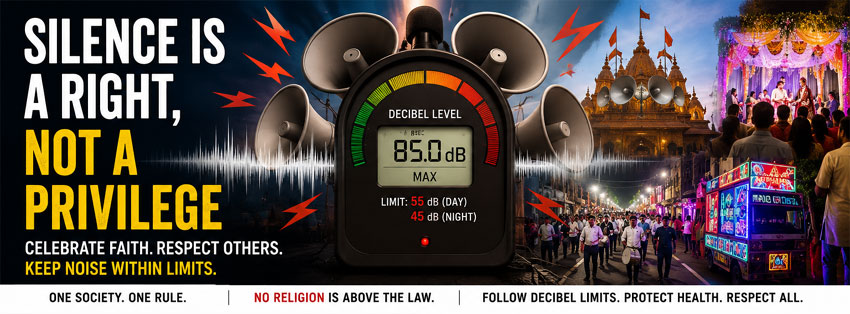
There is a dangerous misconception taking root in our public life—that if an issue touches religion or tradition, it cannot be questioned. Nothing could be further from the truth.
The right to pray is sacred. The right to celebrate is cherished. The right to preserve culture is protected. But none of these rights includes the freedom to deprive others of peace, sleep, health, or dignity.
India has become increasingly tolerant of something that should never have been normalized: excessive noise.
Every morning, every evening, every festival season, and almost every wedding season, countless neighbourhoods across the country are forced to endure blaring loudspeakers, deafening DJ systems, brass bands, amplified devotional music, political announcements, and processions that shake windows and rattle entire streets.
The source changes.
The disturbance does not.
One day it is a religious gathering. Another day it is a marriage procession. The next, a political rally. Then comes a festival, a street celebration, a local event, or a commercial function.
Every organizer believes their occasion is exceptional.
Every affected citizen is expected to remain silent.
This culture of unquestioned tolerance has come at a cost.
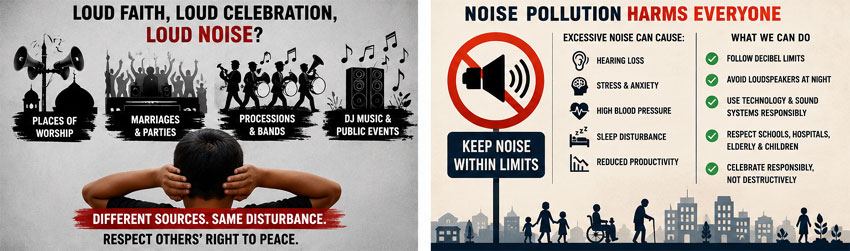
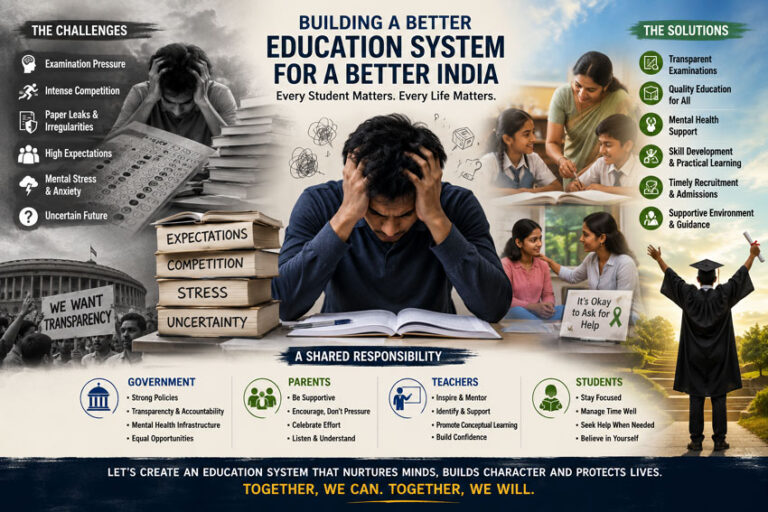
Somewhere, a student preparing for a life-changing examination struggles to concentrate. Somewhere, an elderly heart patient lies awake throughout the night. A newborn cries in discomfort. A doctor returning from a 24-hour shift cannot sleep. Someone recovering from surgery cannot rest. Families living beside marriage halls spend weekends trapped inside their own homes because music reverberates long after midnight.
These citizens are rarely seen in viral videos.
Their suffering is quiet.
And perhaps that is why it is ignored.
What makes the situation even more troubling is our selective outrage. When noise comes from one community, another protests. When the same conduct originates from their own community, it suddenly becomes a matter of tradition, faith, or culture.
This hypocrisy serves nobody.
Noise pollution has no religion.
Noise pollution has no caste.
Noise pollution has no political affiliation.
Excessive sound damages hearing regardless of who operates the loudspeaker.
The law, therefore, must also have no favourites.
Whether the sound originates from a temple, mosque, church, gurudwara, marriage hall, festival committee, political stage, DJ truck, brass band, or commercial event is legally and morally irrelevant.
Only one question matters.
Is the noise within permissible limits?
If it is, there is no problem.
If it is not, the law should intervene immediately.
Unfortunately, this is where India’s enforcement system often falters.
Authorities frequently hesitate.
Permissions become routine formalities. Violations are overlooked. Complaints are ignored until public anger reaches a tipping point. Enforcement sometimes appears influenced by political pressure, social sensitivity, or fear of controversy rather than by objective standards.
The result is predictable.
People lose confidence that the rules apply equally.
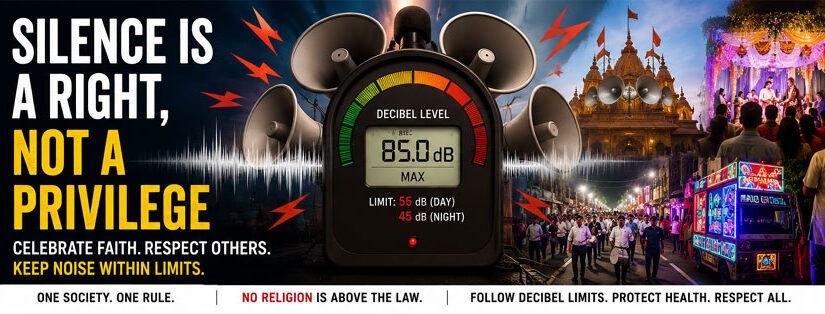
This is not a failure of legislation. India already has regulations governing environmental noise and restrictions on loudspeaker use, particularly during nighttime hours. The challenge is not the absence of laws—it is the absence of consistent enforcement.
A democracy cannot function on selective application of rules.
If decibel limits exist, they must apply to everyone.
If quiet hours exist, they must be respected by everyone.
If penalties exist, they must be imposed without exception.
Equal treatment is not discrimination.
It is justice.
Technology makes enforcement easier than ever. Portable sound-level meters can accurately measure violations. Permissions can require clear decibel caps, operating hours, and accountability. Repeat offenders—whether individuals, religious institutions, event organisers, political parties, or commercial venues—should face meaningful consequences.
The purpose is not to discourage celebration.
It is to encourage responsibility.
There is another uncomfortable truth we must confront.
Somewhere along the way, we began confusing volume with devotion.
As though louder prayers are more sincere.
As though larger speakers produce greater faith.
As though weddings become more memorable because nearby residents cannot sleep.
Faith requires no amplifier.
Respect requires no subwoofer.
Culture requires no assault on public peace.
The greatest religious teachings across traditions speak of compassion, discipline, humility, and consideration for others. None instruct followers to inconvenience entire communities in the name of devotion.
Likewise, weddings are meant to unite families—not divide neighbourhoods.
Celebration should leave behind joyful memories, not exhausted residents.
Perhaps it is time to ask a simple question.
What kind of society do we want to become?
One where everyone competes to own the loudest speaker?
Or one where every citizen, regardless of religion, language, or social status, can enjoy both freedom of worship and the simple luxury of a peaceful night’s sleep?
These are not competing ideals.
A mature democracy can protect both.
India’s strength has always been its ability to balance diversity with coexistence.
That balance is impossible if consideration for others disappears beneath the roar of loudspeakers.
Silence is not the enemy of faith.
Silence is not the enemy of celebration.
Silence is often where reflection begins.
The right to celebrate must never become the right to disturb.
The right to worship must never become the right to impose.
And the rule of law must never pause at the gates of a temple, the entrance of a mosque, the doors of a church, the precincts of a gurudwara, or the entrance to a marriage hall.
The Constitution protects every citizen equally.
It is time our sound systems did the same.
This is supervised, written, directed or edited at Our Office Desk.
Any issue or disagreement can be sent to the help desk, after thoroughly analyzing we will be open for any amicable solution.
 News Desk