


 Editor's Desk
An interview with filmmaker Azura Nasron about online grooming in Malaysia
The film âHai Anisâ has sparked a long overdue dialogue on this crucial topic
Originally published on Global Voices
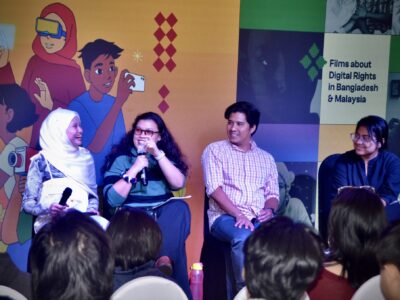
Azura Nasron (second from left) answers questions at the Tech Tales Youth Launch event held in Kuala Lumpur in January 2025. Photo from Engagemedia
This article by Izzah Dejavu was originally published by EngageMedia, a non-profit media, technology, and culture organization, and an edited version is republished here as part of a content-sharing agreement with Global Voices.
Cyber grooming remains buried beneath cultural silence in Malaysia. A new film by Azura Nasron, âHai Anis,â exposes this reality â how predators manipulate, isolate, and exploit young people. In this interview, Nasron speaks about the urgency of telling this story, the challenges of breaking the silence, and the impact of âHai Anisâ â because this is a conversation that can no longer wait.
Izzah Dejavu (ID): What inspired you to focus on online grooming in âHai Anisâ?
Azura Nasron (AN): I have seen and handled cases where teenagers were groomed, only to be failed by the very institutions meant to protect them. Schools dismissed them, families silenced them, and hospitals treated them like problems to be managed rather than survivors to be supported. The way these cases are handled is not just disappointing; it is devastating. Survivors are left unprotected, unheard, and often blamed. Thatâs what breaks me the most â not just the harm itself, but the failure of those who were supposed to help.
ID: âHai Anisâ exposes the tactics predators use to groom their victims. How did your experiences or observations shape this narrative?
AN: I have lived them. Iâve heard the stories. I have experienced being in that situation and know what itâs like to be that childâto fall into the trap, not out of naivety, but because the danger never looks like danger. It never announces itself. It never arrives with a warning. It starts with kindness. With attention. With validation. It begins with, âHow was your day?â and âI understand you.â It begins with someone making you feel seen in a way no one else has, and before you even realize it, you are trapped â emotionally entangled with someone who was never who they claimed to be.
This isnât a failure of intelligence. Itâs a failure of protection. A failure of education. A failure of the fact that we donât teach our youth what real love looks like versus what manipulation feels like. We warn them about bad people, but we donât explain that sometimes, bad people donât look bad at all. Sometimes, they arrive dressed as the very thing we crave â care, affection, understanding. To be honest, itâs not just them. We, as adults, struggle with this conversation too.
ID: This film touches on sensitive issues like digital exploitation and sex education in Malaysia. What are the challenges you face in developing this story?
AN: One of the biggest struggles I had during scripting was finding a way to balance the weight of the topic with moments that felt real and engaging. How do you tell a story like this without making it feel like a public service announcement (PSA)? How do you reach an audience that is growing up with an entirely different digital language? I spent time with Gen Alpha, immersing myself in their humor, their slang, and their world. I had to make sure that when they watched âHai Anis,â it wouldnât feel like a lecture â it would feel like something that understood them. Because if they donât feel seen, they wonât care. And if they donât care, nothing changes.
ID: What changes do you hope to see, especially among parents and educators, in tackling online exploitation?
AN: First, for parents â stop blaming children. Stop blaming survivors. Start holding perpetrators accountable. Besides, I also think that the most dangerous assumption a parent can make is, âMy child would never fall for this.â Grooming doesnât come with a red flag. It doesnât look like a villain in the shadows. It looks like trust. It looks like love. It looks like someone is finally listening.
Secondly, for schools, digital safety and consent cannot be an afterthought. It should be as fundamental as mathematics, as non-negotiable as road safety. This is the world children are growing up in â a world where a strangerâs voice can slip into their lives at any moment, through a screen, through a message, through a game. And yet, we are still debating whether these conversations belong in classrooms. We are still afraid of the words âsex education,â still convinced that silence is protection?
For policymakers â stop treating online exploitation as an abstract problem. Stop speaking about it like it only exists in reports and statistics. This is happening here, now, every day. Laws need to do more than exist on paper â they need to be enforced. They need to prevent, not just punish. Protect, not just react. Right now, predators understand the internet better than the laws do, and that is a terrifying reality.
Lastly, I think we cannot afford to pretend this is happening in isolation. The rise of conservatism fuels a patriarchal society that continues to endanger women and children. The more we allow rigid, harmful structures to dictate morality, the more we create a world where predators go unchallenged â because questioning power, questioning control, and questioning who gets to decide what is right and wrong is seen as more dangerous than violence itself.
ID: In your view, what is the first step in protecting Malaysian youth from online grooming?
AN: Real change doesnât come from one direction â it requires communities, shifting behaviours, and changing mindsets, and yes, policy matters too. Many organizations have long raised this issue, yet political will remains absent. Our safeguards are weak, and implementation is even worse.
We must acknowledge why people seek connection. In todayâs fast-paced world, weâve lost empathy, and without understanding the need for belonging, we might miss the bigger picture.
It is also crucial for us to have a sustainable network of trained facilitators â educators, parents, police, doctors, judges, prosecutors, and social workers â who can use âHai Anisâ as an educational tool. A film alone wonât change the world, but in the right hands, backed by resources and real engagement, it can spark conversations that shift how Malaysia addresses this issue. Most crucially, I think, we must address the gendered nature of online exploitation. Young girls, especially, are raised to be polite, accommodating, and secretive â predators exploit that. We need to teach them that saying no isnât rude, setting boundaries isnât wrong, and protecting themselves is nothing to apologize for.
ID: What is the Impact process behind Hai Anis?
AN: The impactful journey of Hai Anis goes far beyond the screen. One of the most significant milestones was our collaboration with Monsterâs Among Us (MAU), an organization dedicated to educating children about sexual education. We screened âHai Anisâ during the My Body My Rules â Comprehensive Sexual Education program across three communities in Klang Valley, involving 24 students aged 13â17. They werenât just passive viewers; they became active participants in a conversation that is often silenced. Their reactions were powerful and varied â ranging from curiosity to concern, from sharing personal experiences to reflecting on their understanding of safety. While many of them recognized some red flags of grooming, there were still gaps. They understood privacy, but not always as a right, and their perception of risk was mostly shaped by family and culture rather than personal agency.
On March 8, 2025, we reached a broader audience at Gerakbudaya, Malaysiaâs leading independent bookstore and cultural hub, during an event for International Womenâs Day. The screening drew activists, students, educators, and everyday Malaysians eager to engage, challenge, and redefine the conversations around digital safety and exploitation. The response was overwhelming â people expressed a mix of anger, empathy, and empowerment. I think âHai Anisâ had evolved into something more than a film; it became a dialogue.

News reported through various sources and compiled with AI. This is automatically generated news content from known, popular, and reliable sources available at the time of publication.
We do not take any responsibility for, nor make any representations regarding, the accuracy, completeness, credibility, or
reliability of the content.
In case of any discrepancy, error, or copyright claim, we will promptly review and remove the content in question where appropriate.
We do not claim ownership of third-party content and assume no responsibility or liability whatsoever for any information contained herein. The credit, links and images are kept intact as an honest gesture, are property of its respective owners.



 Shafiq