



Former Telegraph Editor’s Passport Renewal Row Sparks Questions Over SIR: What Happened to R. Rajagopal?
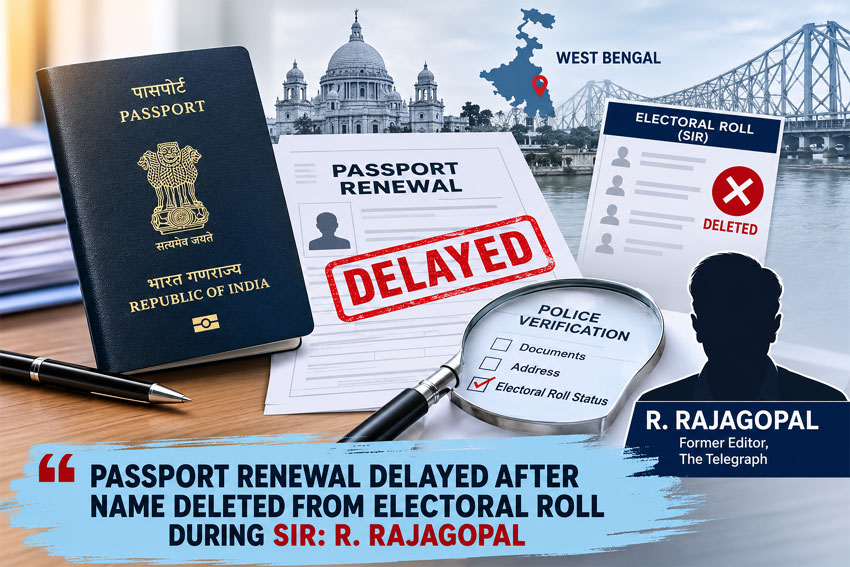
🟦 Key Takeaway
Veteran journalist R. Rajagopal has alleged that his passport renewal was delayed after his name was removed from West Bengal’s electoral roll during the Special Intensive Revision (SIR). While his case has sparked widespread debate and political reactions, no official government notification currently states that deletion from an electoral roll automatically disqualifies a person from passport renewal.
A Passport Renewal Delay That Became a National Conversation
A routine passport renewal application has turned into one of the most widely discussed stories surrounding the ongoing Special Intensive Revision (SIR) of electoral rolls in West Bengal.
The issue involves R. Rajagopal, a veteran journalist and former editor of The Telegraph, who publicly stated that his passport renewal process stalled after his name was removed from the state’s electoral roll during the SIR exercise. His account has since attracted attention from journalists, political leaders, civil society groups, and legal observers, raising broader questions about the relationship between electoral records and other government services.
What Happened?
According to Rajagopal, he applied for passport renewal in February 2026 and completed biometric formalities in March. Around the same period, he discovered that his name had been deleted from the electoral roll of the Ballygunge constituency in Kolkata as part of the Special Intensive Revision.
He later said that the police verification required for passport renewal was not cleared because his name no longer appeared on the electoral roll. Rajagopal has also stated that his appeal against the deletion of his voter registration remains pending before the tribunal established for SIR-related disputes.
🟨 Why This Case Matters
The controversy is not only about one passport application. It has triggered debate over whether information generated during the electoral roll revision process can or should influence administrative services unrelated to voting, such as passport verification. Rajagopal himself has said this larger policy question is more important than his personal case.
Why Did the Issue Gain National Attention?
Rajagopal’s case drew attention because of his long career in Indian journalism and because he argued that if someone with decades of documented public records could face such difficulties, many ordinary citizens might find it even harder to resolve similar issues.
His comments quickly spread across media platforms and prompted reactions from opposition parties, journalists’ organizations, and public figures. The Editors Guild of India expressed concern over the reported treatment of the veteran journalist, while several political leaders questioned whether the implementation of SIR could have unintended consequences beyond voter registration.
Is There an Official Rule Linking SIR to Passport Renewal?
At present, there is no publicly available government notification or passport rule stating that removal from an electoral roll under SIR automatically makes a person ineligible for passport renewal.
This is precisely the point Rajagopal has raised. In interviews following the controversy, he said he was seeking clarity from the government on whether electoral roll information is being used during passport verification and, if so, under what legal framework.
Legal experts have also noted that voter registration and passport issuance are governed by different laws and administrative procedures, although police verification forms part of the passport issuance process.
Political and Public Reactions
The controversy quickly entered the political arena.
Opposition leaders from the Congress, Trinamool Congress (TMC), and CPI(M) criticised the Centre, arguing that Rajagopal’s experience reflected broader concerns about citizens’ rights and administrative transparency. Some leaders described the case as evidence that the SIR exercise was creating uncertainty for individuals whose names had been removed from electoral rolls.
Meanwhile, journalist bodies and civil society organizations called for greater transparency regarding the interaction, if any, between electoral verification and passport processing.
🟥 Important Context
Rajagopal’s experience represents his account of what occurred and has become the subject of public debate. It should not be interpreted as proof that every person whose name is removed from an electoral roll will face passport-related issues. No official policy establishing such a direct link has been publicly announced.
Has the Passport Been Issued?
Subsequent reports indicate that Rajagopal eventually received his renewed passport.
However, he has maintained that the broader issue remains unresolved. According to him, the government should clearly explain whether and how data generated during the SIR process can influence passport verification or other public services so that citizens understand the applicable rules and safeguards.
The Larger Debate Around SIR
The Special Intensive Revision has already generated legal and political discussion regarding voter verification, documentation requirements, and electoral roll accuracy.
Rajagopal’s case has expanded that conversation by raising questions about whether administrative actions connected to electoral records could affect unrelated government services.
Supporters of greater transparency argue that any such interaction should be governed by clear public guidelines. Others caution against drawing broad conclusions from an individual case before all facts and official procedures are clarified.
Conclusion
The passport renewal controversy involving former The Telegraph editor R. Rajagopal has become one of the most closely watched developments linked to the ongoing Special Intensive Revision in West Bengal.
While his passport has since been renewed, the episode has sparked a wider discussion about administrative transparency, due process, and the need for clear public guidance on whether electoral roll status has any bearing on passport verification.
Until an official clarification is issued, the central question raised by Rajagopal remains open: Should voter roll status influence passport processing, and if so, under what legal authority?

This is supervised, written, directed or edited at Our Office Desk.
Any issue or disagreement can be sent to the help desk, after thoroughly analyzing we will be open for any amicable solution.

 News Desk



 Shafiq