


 Editor's Desk





Underground Hydrogen: Two High-Reward Bets, One Indispensable Science

The most productive scientific programs are not those in which researchers know the answers to their questions in advance. Instead, they are those organized around questions that are genuinely open, consequential, and resolvable by investigation.
The discourse surrounding underground hydrogen storage (UHS) and natural geological hydrogenâincreasingly discussed in recent years as a potentially important part of a lower-carbon energy systemâoffers such questions: How much of the hydrogen injected underground can be recovered later? Will Earthâs own hydrogen ever accumulate in commercially useful quantities?
The barriers should be the focus of research. They define what needs to be known, why it is not yet known, and what the consequences of knowing it would be.
Potential applications of UHS and natural hydrogen are rooted in real physical possibility. Yet deep uncertainties also exist that no honest assessment can resolve with currently available data. Addressing these uncertainties requires investigation through a rigorous scientific program justified on its own terms, regardless of preexisting ideas of whether commercial applications will eventually succeed.
The barriers facing applications of UHS and natural hydrogen are not evidence that researching them is futile, as some observers have suggested (e.g., in recent work questioning self-replenishing production and commentary urging scientific rigor over hype).
In fact, the opposite is true. The barriers should be the focus of research. They define what needs to be known, why it is not yet known, and what the consequences of knowing it would be.
Fixed Constraints for Subsurface Hydrogen
Though they may seem unrelated, UHS and natural hydrogen exploration share identical scientific foundations in the subsurface behavior of molecular hydrogen (H2). H2 is the smallest and lightest molecule in nature. It leaks through rock and cement far faster than methane (natural gas) and rises buoyantly along fractures and faults. Furthermore, many underground microbial communities consume H2 wherever water and suitable chemical partners are present.
Whether one is considering injecting and storing hydrogen underground or whether Earth has already done that on its own, the underlying science is the same. Research efforts looking into those questions are not parallel; they are studying the same geological process from opposite ends.
Hydrogen contains roughly 3.5 times less energy per unit volume than methane at any given pressure and temperature, a consequence of their respective molecular weights and bond chemistries. This physical fact sets an inescapable constraint for applications of either UHS or natural hydrogen explorationâno engineering advance can close that gap.

It might seem reasonable to expect that this disadvantage would narrow at the high pressures found in deep reservoirs, where gases compress and pack more efficiently. Under reservoir conditions, however, methane actually compresses more efficiently than hydrogen, meaning the energy gap is, if anything, slightly greater at depth.
To be economically viable, hydrogen-generating or storage systems must compensate through high generation volumes, efficient trapping, and minimal microbial losses.
This gap is not a verdict against hydrogen as an alternative to methane. But it is a calibration that every economic model and every research design must incorporate. To be economically viable, hydrogen-generating or storage systems must compensate through high generation volumes, efficient trapping, and minimal microbial losses. The understanding of all these factors, apart from the volumetric comparison to methane, is far from completeâand is where vital science lives.
Underground Storage: Open Questions, Not Dead Ends
Whether geological formations can serve as reliable, large-scale hydrogen traps is a genuine open question. Some challenges involve engineering problems likely to be solved: For example, hydrogen embrittlement of steel, which is used throughout hydrogen infrastructure, from injection wells to pipelines and storage tanks, is a real, but tractable, problem.
The deeper unknowns are geoscientific and fall into three classes.
The first is geological specificity: The formations best suited to hydrogen storageâsalt deposits and depleted gas fields with intact caprocks, for exampleâare not necessarily distributed where they are most needed operationally (Figure 1). Whereas some facilities could have a direct demand for hydrogen, others that generate surplus energy from renewable sources could use this energy to hydrolyze water, and the resulting hydrogen could be stored for use when energy demand exceeds supply. Quantifying the mismatch between storage locations and operational needs has barely begun.
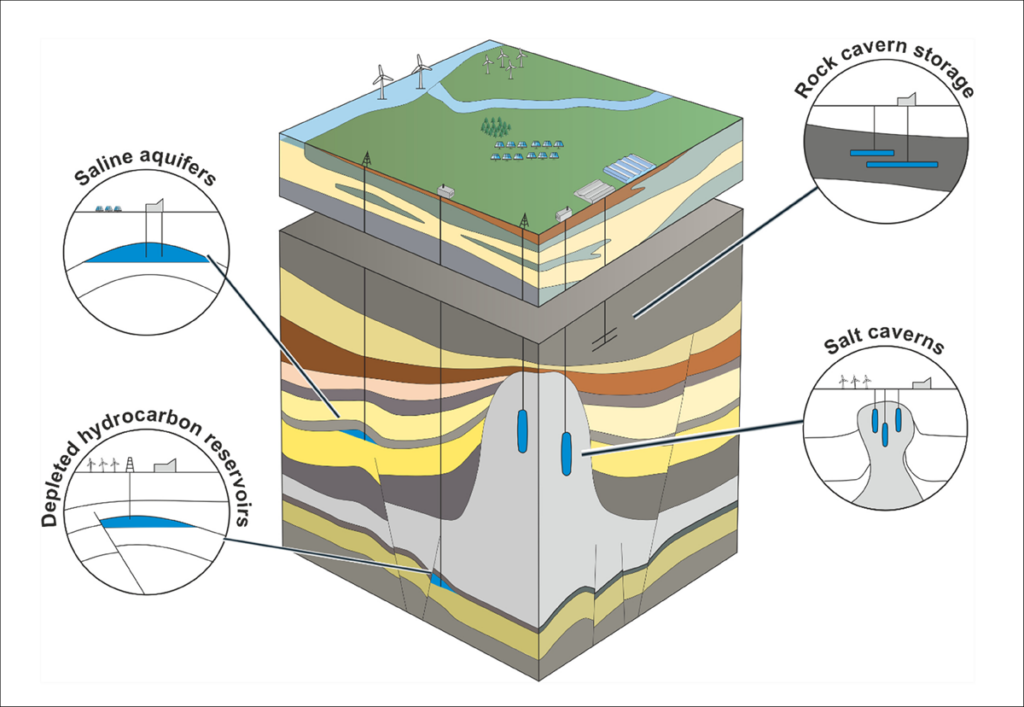
Second is the biological sink: Subsurface microbial communities can consume hydrogen at significant rates over operational timescales. Pilot experiments injecting hydrogen underground have documented substantial losses due to microbial activityâfield pilots report losses from a few percent up to more than 50%. But how much consumption occurs varies across geological settings, and whether it can be predicted or suppressed remains unknown. Current estimates of full-system, round-trip efficiency (the percentage of energy retrieved from a storage system compared to the total energy initially used to charge it) span from 25% to 40%, reflecting genuine uncertainty.
The third unknown is caprock integrity: Hydrogenâs much higher diffusivity means that seals adequate for methaneâshales, evaporites, and tight carbonates, for exampleâmay not work for H2. However, experimentally based knowledge about hydrogen diffusion through these rocks under reservoir conditions is thin.
These unknowns arenât dead ends; they outline valuable research directions.
Natural Hydrogen: Generation Is Certain, Accumulation Is Not
Earthâs crust generates hydrogen continuously. Serpentinization of iron-rich rocks, decomposition of water by natural radioactivity (radiolysis), and fluid circulation along active faults all contribute to H2 production within the lithosphere.
How much of this hydrogen reaches the atmosphere remains poorly constrained, though. Documented point sources account for far less than 1 megaton per year globally. Diffuse degassing across the ~2.5 million square kilometers of serpentinized terrains worldwide, potentially the dominant pathway, is essentially unmeasured, with estimates ranging from roughly 0.02 to a few megatons per year.
Whether any of this geologic hydrogen accumulates underground in commercially useful concentrations is also unclear. The one producing hydrogen well, located in Mali, yields the energy equivalent of roughly 30 kilowatts of continuous power: scientifically significant, but not a template for commercial production.
The geological conditions required for large, long-lived hydrogen accumulations are demanding.
Indeed, the geological conditions required for large, long-lived accumulations are demanding.
In many environments, dissolved hydrogen in groundwater never reaches the saturation needed to exsolve into a separate gas phase at all. Where it does, microbial communities that consume hydrogen may be active. Furthermore, gas accumulation requires a porous reservoir sealed by a caprock that can withstand hydrogenâs powerful tendency to escape. No such accumulation has been confirmed anywhere in the world; the Mali borehole, for example, taps a shallow (~120 meter) aquifer that continuously degasses hydrogen, not a sealed pressurized reservoir.
Also, unlike thermogenic methane, abiotic hydrogen generation can be continuous, making the sources of surface seeps fundamentally ambiguous. The same signal measured at the surface could indicate a large column of trapped hydrogen or a flow-through system with no accumulation at all. Distinguishing between these scenarios requires subsurface dataâgathered from wells, seismic surveys, and pressure and geochemical measurementsâthat do not exist yet for most prospective terrains.
This catalog of uncertainties could be read as an argument against research. If commercial-scale UHS appears unlikely within a realistic timeline and if commercial production of natural hydrogen faces structural barriers, why treat the underlying science as indispensable?
The question is fair. We suggest, however, that scientific research into UHS and natural hydrogen production is justified on grounds that do not depend on confident commercial outlooks.
The Need for Research Now
The knowledge gaps described above cannot be closed within the compressed timelines that commercial deployment demands or by market forecasting.

They require systematic, hypothesis-driven scientific investigation. This research will require subsurface data, pilot injections, reactive transport experiments, and mechanistic characterization of microbial consumption and caprock/unconventional reservoir behavior. Ultimately, it will reveal the specific geological, biological, and thermodynamic conditions under which UHS and exploration for natural hydrogen could succeed.
A useful precedent comes from the development of enhanced geothermal systems (EGS): For more than 4 decades, systematic characterization of fracture networks, rock mechanics, and fluid-rock interactions in hot, dry rock proceeded despite deep uncertainty about commercial viability. That patient, systematic scienceânot optimistic projectionsâis what eventually let a handful of projects demonstrate technical feasibility only in the past few years.
The lesson is not that EGS were destined to succeed, but that sustained research was what allowed the question to be answered at all.
A research program that maps the subsurface, showing where storage is feasible and where natural accumulations can persist, will provide actionable knowledge about specific formations, specific depths, and specific trapping configurations. The economic value of such knowledge is asymmetric: Credible answers about viability in specific places and conditions could prevent costly commitments in the wrong places and, conversely, could direct exploration to potentially productive formations.
Billions of euros, dollars, yuan, and dinars invested in infrastructure will be guided, or misguided, by the quality of the science available when decisions are made. Indeed, major funding programs in Europe, North America, and China are already channeling substantial resources toward developing UHS and natural hydrogen projects. Those commitments will not wait for full scientific resolution of uncertainties.
Uncertain science, pursued systematically and transparently, is a far better foundation for public decisionmaking than perhaps overly optimistic commercial narratives that mask the unknowns.
In that context, the responsibility of the research community is not to endorse or reject individual programs, but to ensure that the knowledge base on which they rest is as rigorous as possible. Uncertain science, pursued systematically and transparently, is a far better foundation for public decisionmaking than perhaps overly optimistic commercial narratives that mask the unknowns.
Beyond these pragmatic considerations, understanding the subsurface behavior of molecular hydrogenâamong the least characterized topics in applied geochemistryâhas intrinsic scientific value. Hydrogenâs generation by serpentinization and radiolysis, its migration along faults, its interaction with minerals and fluids, its microbial consumption, and its occasional trapping are fundamental concerns of planetary chemistry. These concerns are directly relevant to illuminating the formation and early differentiation of Earth and other rocky planets, how life on Earth originated, and the functioning of todayâs deep biosphere.
The tools required for this science, such as trace gas sensors, reactive transport models, and equations of state for high-pressure gas mixtures, already serve applications in geothermal monitoring, carbon storage, and astrobiology. The current mobilization of funding around hydrogen creates an unprecedented window of opportunity to accelerate investigations into these questions. But that window will not stay open indefinitely.
The Choice Ahead for Hydrogen Scientists
The deepest argument for pursuing research into UHS and natural hydrogen accumulation within a unified framework is not administrative, but scientific. Both are governed by the same set of physical constraints on generation, trapping, sealing, and microbial loss.
The uncertainties of each track are precisely what make dialogue between them productive. A subsurface environment inhospitable to developing storage today is also one where natural accumulations are unlikely to have survived. Conversely, identifying where natural hydrogen has persisted provides an empirical blueprint for where engineered storage might succeed. What limits one therefore informs the other.
Scientists studying underground hydrogen face a choice. They can court favor with hydrogen technology advocates and fundersâa path that can bring faster funding and greater visibilityâby framing their work as steps toward commercial deployment while risking future damage to their credibility if promises outpace evidence. Or they can frame their work as the rigorous investigation of a geochemical system whose commercial potential is uncertain but whose scientific significance is not.
The second framing is harder to sell. It is also more honest, more durable, and, ultimately, more powerful because it produces knowledge that retains its value regardless of which way commercial verdicts fall.
The open questions cataloged should not be obstacles to research. They are the research. The science required to find out whether UHS and natural hydrogen exploration are likely to succeed or fail has independent value that holds across every possible outcome.
Author Information
Laurent Truche ([email protected]) and Frédéric-Victor Donzé, Institut des Sciences de la Terre, Université Grenoble Alpes, Grenoble, France; and Chris Ballentine, Department of Earth Sciences, University of Oxford, U.K.
Citation: Truche, L., F.-V. Donzé, and C. Ballentine (2026), Underground hydrogen: Two high-reward bets, one indispensable science, Eos, 107, https://doi.org/10.1029/2026EO260292. Published on 15 September 2026.
This article does not represent the opinion of AGU, Eos, or any of its affiliates. It is solely the opinion of the author(s).
Text © 2026. The authors. CC BY-NC-ND 3.0
Except where otherwise noted, images are subject to copyright. Any reuse without express permission from the copyright owner is prohibited.

News reported through various sources and compiled with AI. This is automatically generated news content from known, popular, and reliable sources available at the time of publication.
We do not take any responsibility for, nor make any representations regarding, the accuracy, completeness, credibility, or
reliability of the content.
In case of any discrepancy, error, or copyright claim, we will promptly review and remove the content in question where appropriate.
We do not claim ownership of third-party content and assume no responsibility or liability whatsoever for any information contained herein. The credit, links and images are kept intact as an honest gesture, are property of its respective owners.