


Chandni Chowk: Where the Moon Once Kissed the Waters and History Still Whispers
By Burning Topics Editorial
There are cities that grow with time, and then there are places that carry time within themselves. Chandni Chowk, nestled in the heart of Old Delhi, is one such place—a living chronicle where every stone has witnessed triumph, tragedy, love, commerce, rebellion, and resilience. It is not merely a marketplace; it is one of India’s greatest living museums, where history walks beside humanity every single day.
Today, millions know Chandni Chowk for its bustling lanes, legendary street food, jewelry markets, textiles, and endless crowds. Yet beneath the chaos lies a forgotten elegance—a story that deserves to be remembered with reverence.
A Dream Born Under the Mughal Sky
The story begins in 1650 CE, when Mughal Emperor Shah Jahan decided to move his capital from Agra to his newly built city of Shahjahanabad, now known as Old Delhi.
To complement his magnificent Red Fort, Shah Jahan envisioned an avenue unlike any other. The responsibility of designing this grand boulevard fell upon his beloved daughter, Princess Jahanara Begum—a woman admired not only for her royal stature but also for her intelligence, philanthropy, and refined artistic taste.
She envisioned a marketplace that would embody beauty, prosperity, and harmony.
Thus, Chandni Chowk was born.
Why Was It Named Chandni Chowk?
The name “Chandni Chowk” literally translates to “Moonlit Square.”
The reason is poetic rather than practical.
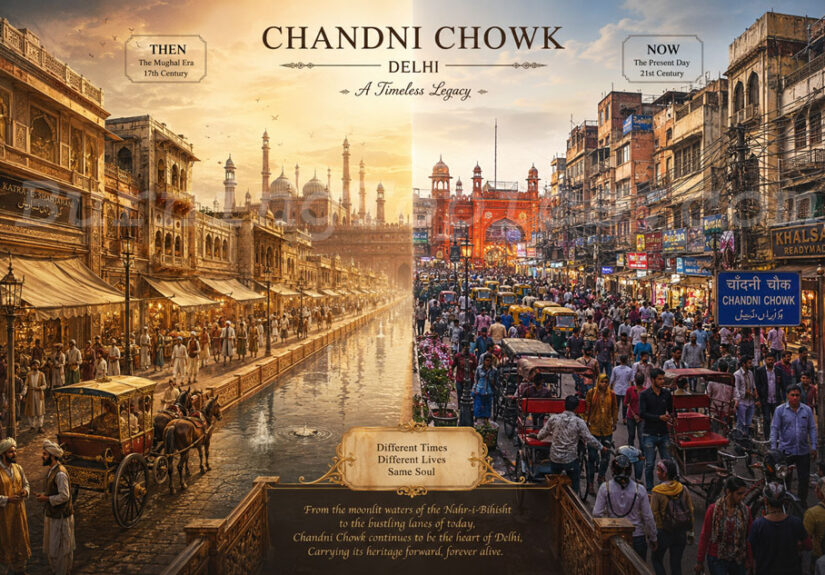
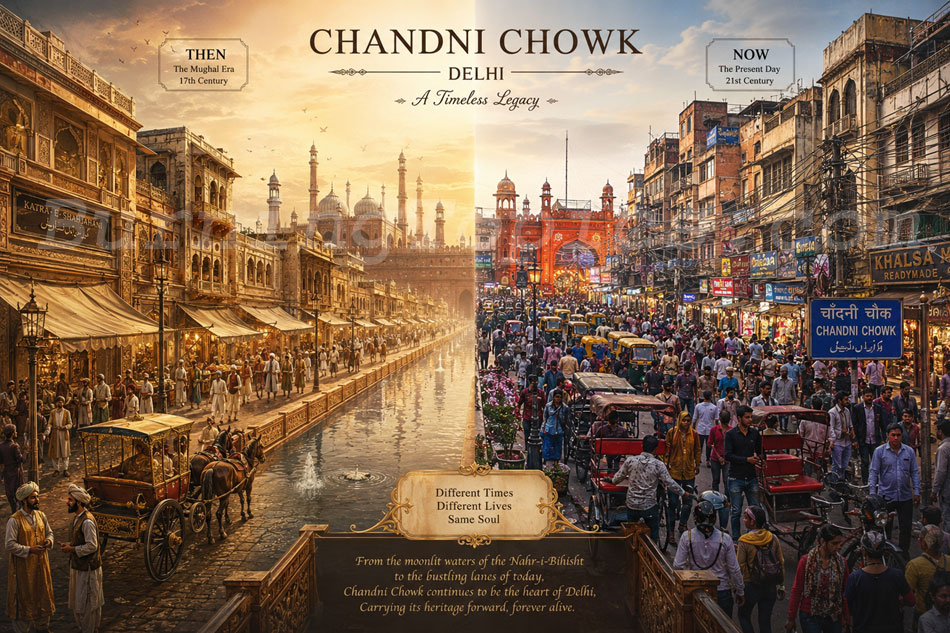
At the center of the avenue ran a beautifully designed water canal, part of the Mughal irrigation system known as the Nahr-i-Bihisht (Stream of Paradise). During full moon nights, the calm water reflected the silver glow of the moon, creating an enchanting spectacle.
Merchants, nobles, travelers, and poets often gathered along these shimmering waters.
The square glowed beneath moonlight.
It looked as though the moon itself had descended upon the earth.
Thus, people lovingly began calling it Chandni Chowk.
Sadly, the canal no longer exists, yet its name continues to preserve one of the most beautiful memories of Mughal urban design.
More Than a Market — It Was the Soul of an Empire
Unlike ordinary bazaars, Chandni Chowk served many purposes.
It became:
- The commercial heart of Mughal India.
- A meeting point for traders arriving from Persia, Central Asia, Arabia, Tibet, and Europe.
- A center for precious gems, silk, spices, perfumes, manuscripts, and fine craftsmanship.
- A cultural hub where poets, scholars, musicians, and artisans exchanged ideas.
Imagine walking through its streets nearly four centuries ago.
Silk merchants displaying fabrics from Kashmir.
Persian traders bargaining over carpets.
Jewellers crafting exquisite ornaments.
The fragrance of attar drifting through the air.
The rhythmic sound of horse-drawn carriages.
The call to prayer blending with temple bells.
The marketplace reflected India’s incredible diversity long before globalization became a modern concept.
The Tragedies That Changed Chandni Chowk
History, however, rarely allows beauty to remain untouched.
Chandni Chowk witnessed some of the darkest chapters in Indian history.
Nadir Shah’s Massacre (1739)
When Persian ruler Nadir Shah invaded Delhi, Chandni Chowk became one of the primary sites of unimaginable bloodshed.
Thousands lost their lives.
Markets were looted.
Homes were destroyed.
The city that once celebrated prosperity mourned in silence.
The Revolt of 1857
The First War of Indian Independence transformed Chandni Chowk once again.
Following the British suppression of the uprising, large sections of Shahjahanabad were demolished.
Many historic structures disappeared forever.
Gardens gave way to military installations.
The elegant Mughal city gradually transformed into a colonial administrative center.
Partition of 1947
Perhaps no event changed Chandni Chowk’s social fabric more profoundly than the Partition of India.
Families who had lived together for generations were forced to leave.
Many Muslim families migrated to Pakistan.
Thousands of Hindu and Sikh refugees arrived from newly formed Pakistan.
The shops changed owners.
The neighborhoods changed identities.
Yet somehow, Chandni Chowk survived.
Its spirit remained stronger than politics.
The Markets That Continue to Thrive
Even today, Chandni Chowk remains one of India’s busiest commercial districts.
Each lane has developed its own identity.
Dariba Kalan
Known for silver jewelry and traditional ornaments.
Kinari Bazaar
Famous for wedding decorations, lace, borders, and bridal accessories.
Khari Baoli
Recognized as one of Asia’s largest wholesale spice markets.
The aroma of cardamom, cinnamon, cloves, saffron, and dried fruits fills the air.
Bhagirath Palace
India’s largest wholesale electrical market.
Ballimaran
Known for footwear and as the neighborhood where legendary Urdu poet Mirza Ghalib once lived.
A Place Where Every Faith Walks Together
One of Chandni Chowk’s greatest strengths has always been coexistence.
Within a short walking distance stand places of worship belonging to different faiths:
- The majestic Jama Masjid
- The historic Gurdwara Sis Ganj Sahib
- The sacred Digambar Jain Lal Mandir
- Several ancient Hindu temples
- Churches established during colonial times
This remarkable closeness reflects centuries of shared history and cultural exchange.
The Modern Face of Chandni Chowk
Recent redevelopment projects have transformed parts of Chandni Chowk into a more pedestrian-friendly environment.
Overhead wires have been reorganized in many sections.
Roads have been widened.
Public spaces have been restored.
Efforts continue to balance modernization with heritage conservation.
Despite these changes, the essence of Chandni Chowk remains remarkably intact.
The same narrow lanes still lead to unexpected treasures.
Old craftsmen continue traditions passed down through generations.
Age-old recipes are still prepared in kitchens that have served families for decades.
A Letter to the Forgotten Stones
Perhaps the greatest tragedy is not that canals disappeared.
Nor that empires fell.
Nor that kings vanished.
The real tragedy is forgetting.
Every weathered wall in Chandni Chowk has watched children become grandparents.
Every ancient doorway has welcomed strangers who later called Delhi home.
Every shopkeeper carries stories inherited alongside the family business.
History does not survive because of monuments alone.
It survives because ordinary people continue opening their shops every morning, kneading dough before sunrise, polishing silver by hand, repairing old books, measuring silk with practiced fingers, and greeting customers with the same warmth their ancestors once offered centuries ago.
The soul of Chandni Chowk does not live in bricks.
It lives in its people.
A City That Refuses to Be Forgotten
Chandni Chowk is not simply one of Delhi’s oldest markets.
It is a testament to India’s resilience—a place where architecture, commerce, poetry, faith, and memory have coexisted through centuries of upheaval.
The moonlit canal may have vanished, the royal processions may have faded, and the emperors may have become history, yet the heartbeat of Chandni Chowk continues to echo through every bustling lane and every smiling shopkeeper.
To walk through Chandni Chowk is not merely to visit a market.
It is to walk through the living pages of India itself.
And if one listens carefully beneath the sounds of rickshaws, bargaining voices, temple bells, and the call to prayer, one may still hear the quiet whisper of the moon reflecting upon waters that once gave this timeless place its name.

This is supervised, written, directed or edited at Our Office Desk.
Any issue or disagreement can be sent to the help desk, after thoroughly analyzing we will be open for any amicable solution.

 News Desk