

 Editor's Desk





The erosion of international law is unfolding in plain sight
Originally published on Global Voices
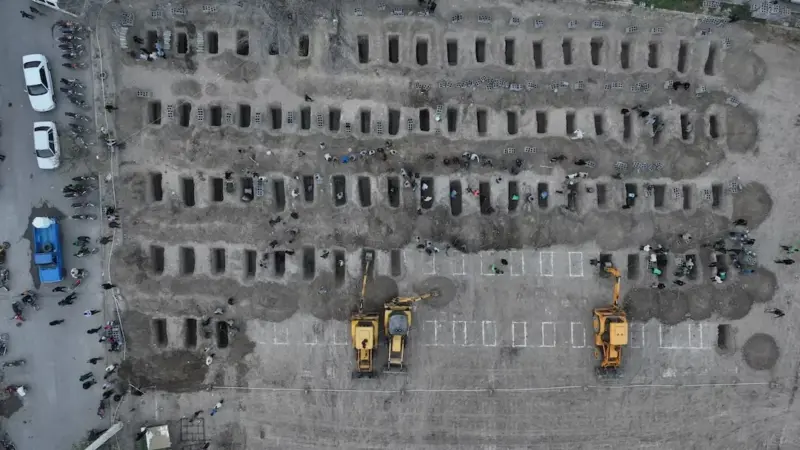
Drone footage shows rows of fresh graves in Minab, Iran, where over 150 schoolgirls were killed by a U.S. air strike. Screenshot from video published on Facebook by Reuters. Fair use
For two years, as the genocide in Gaza was unfolding live in front of the worldâs eyes, we have warned. For decades, we have documented the hypocrisy that underpins international law and the selective outrage that defines global responses to conflict, which only serve to feed these conflicts. Today, those warnings are no longer theoretical â they are playing out in real time across West Asia, as the war crimes normalized in Gaza now serve as the blueprint for new theaters of destruction in Lebanon and Iran.
Gaza as precedent
Israelâs genocidal war on Gaza was never an isolated incident. It was the extreme iteration of a doctrine that has been developing for decades and facilitated by decades of impunity. Israelâs âDahyieh doctrine,â unleashed on the Lebanese capital during the 2006 war, was explicitly about destroying civilian infrastructure or âdomicideâ to pressure governments through collective punishment of the civilian population. This doctrine, named after the southern Beirut suburb known as âDahyiehâ (literally âsuburbâ), established a dangerous precedent: collective punishment of civilian populations could be publicly presented as legitimate military strategy without consequences.
Gaza represented the extreme version of this approach. Now, with the wars on Lebanon and Iran by the U.S. and Israel, we see the same pattern. The tactics are familiar, the rhetoric is consistent, and the international response â or lack of it â is predictably skewed.
A dangerous pattern
Lebanon became the second major theater in 2024 and now again in 2026, mirroring the Gaza playbook but with some regional adaptations. The displacement of populations from Dahyieh, southern Lebanon and the Bekaa valley, nearly 1 million people, follows the same demographic engineering strategy seen in Gaza â forcing civilian populations, in this case predominantly the Shia community, to flee, then destroying the territory, including infrastructure, homes, and poisoning soil so that life can no longer exist.Â
Medical workers in Lebanon have faced deliberate targeting, with reports of hospitals being threatened and having to be evacuated. This echoes the systematic targeting of healthcare infrastructure in Gaza, where ambulances, medical personnel, and hospitals became frequent targets. Israeli attacks on United Nations peacekeepers in southern Lebanon represent another dangerous escalation, undermining international humanitarian law and the protections afforded to peacekeeping forces, though again met with little repercussions on the attackers.Â
In Iran, attacks on civilian infrastructure have created environmental disasters of catastrophic proportions. The bombing of oil storage facilities in Tehran and other Iranian cities has unleashed environmental crises that will affect generations. These attacks on civilian infrastructure â desalination plants, oil facilities, media outlets, public utilities, among many others â represent clear violations of international humanitarian law and are also met with little repercussions on the aggressors.
Article 54 of Additional Protocol I to the Geneva Conventions explicitly prohibits attacks on objects indispensable to the survival of the civilian population, including foodstuffs, crops, livestock, drinking water installations, and irrigation works.Â
The rhetoric of terror
Perhaps most disturbing has been the public rhetoric from U.S. and Israeli officials. A recent post by U.S. President Donald Trump on Truth Social threatened that âwe will take out easily destroyable targets that will make it virtually impossible for Iran to ever be built back, as a Nation, again â Death, Fire, and Fury will reign upon them.â Such statements represent not just inflammatory rhetoric but explicit threats of collective punishment.
This is not a single occurrence; we hear it from Secretary of War Pete Hegseth, for instance, when he says that âthe only ones who need to worry are the Iranians who think theyâre gonna live.â Or senior United States senator from South Carolina, Lindsey Graham, and one of Trumpâs closest advisors and staunchest Israel supporters, who said: âWe flattened Berlin, we flattened Tokyo. Were we wrong to drop an atomic bomb to end the Japanese reign of terror? ⦠If I were Israel, I would have probably done it the same way.â
This is added to the countless documented statements by Israeli officials blatantly announcing intent to commit genocide and, more recently, explicitly stating their intent to repeat their crimes in Gaza, this time in Beirut and Tehran.Â
These public statements are not mere bluster; they serve as advance notice of intended violations. When officials announce their intentions to make living conditions unbearable for a group of people, they are essentially admitting to plans that violate fundamental principles of international law and literally the definition of genocide, including âdeliberately inflicting on the group conditions of life calculated to bring about its physical destruction in whole or in part.â We have seen this again and again in Gaza, and later in Lebanon and now also in Iran, with Israeli and U.S. officials boasting their intended crimes before committing them.Â
Selective outrage
While condemnations of Iran and Hezbollah are issued with predictable regularity, imposing sanctions and unleashing armies, there is deafening silence about the aggressors who are not only responsible for starting the ongoing war in the first place, but whose war crimes are immeasurably larger and certainly more deadly. This includes the murder of over 175 Iranians, most of them little schoolgirls, on the first day of attacks by the U.S. The international communityâs selective outrage reveals the hypocrisy that underpins the so-called ârules-based international order,â and only confirms to those who feel unprotected by it that they need to seek alternative ways to protect themselves.Â
What makes this double standard particularly glaring is the economic calculus driving the silence. All that matters, it seems, is keeping the Hormuz Strait open so that oil continues flowing and money continues to change hands. The lives of civilians in Lebanon and Iran, and elsewhere in the region, for that matter, appear to be secondary to economic interests.
The end of international lawâs façade
What we are witnessing is not just the escalation of conflict; it is the death of international law as a meaningful constraint, however limited, on powerful states. When war crimes are announced in advance and committed openly, when civilian displacement becomes a stated objective, and when environmental destruction is treated as collateral damage, we have moved beyond the realm of legal gray areas into a world where might makes right.
The international communityâs failure to act, its selective condemnation, and its economic complicity all point to that same conclusion.
European Commission President Ursula von der Leyen and High Representative for Foreign Affairs and Security Policy Kaja Kallas openly acknowledged the collapse of the international legal order when they called on Europe to adapt to a âchaotic, coercive world orderâ amid âmounting violations of international law.â In her March 2026 speech, von der Leyen admitted that “we cannot solve every global issue or perfectly reconcile our values and our interests on each occasion,” effectively signaling the EUâs acceptance of a post-international-law reality.Â
This admission of powerlessness comes as the European Union itself bears significant responsibility for the current destruction. Through decades of appeasement toward Israeli occupation policies, complicit silence on collective punishment in Gaza, and prioritization of energy security over human rights, the EU has actively enabled the normalization of war crimes that are now being replicated in Lebanon and Iran.Â
The blocâs strategic interests, including maintaining access to Hormuz Strait oil flows, have consistently overridden its professed commitment to international law, making von der Leyenâs call for adaptation less an acknowledgment of external circumstances and more an admission of the EUâs own role in dismantling the very legal framework it claims to uphold.
In a recent speech during the Munich Security Conference, U.S. Secretary of State Marco Rubio called on his European allies to ânot be shackled by guilt and shameâ over their âculture and heritage,â and called for a return to âthe Westâs age of dominance.â Rubio continued: âThis is what we did together once before, and this is what President Trump and the United States want to do again now, together with you.â The speech was met not with horror about a call for reviving one of humanityâs most brutal centuries of colonialism and slavery, but with a standing ovation from the European leaders in the room.
A future of normalized atrocity
Unless there is a dramatic shift in global consciousness and political will when people in the countries that produce the worldâs most advanced weapons and unleash wars abroad react not because gas prices are rising but because bankrolling war crimes committed in their names is wrong, we can expect this pattern to continue.Â
The normalization of these war crimes has created a dangerous precedent â or return to a tradition of brutal colonialism â that could be applied anywhere, anytime, yet again. When powerful states can act with impunity, when they can announce their intentions to commit atrocities and then follow through without consequence, the entire framework of international law becomes meaningless, even as a smokescreen.
The warning issued over two years ago â that Gaza was the blueprint for a bleak future for the whole world â was not hyperbole. It was a factual observation of where we were headed. Today, that future is not just closer; it is already here.
The question no longer is whether these actions are war crimes; we have enough evidence to make that determination. The question is whether the world will finally muster the courage to acknowledge the truth and hold the powerful accountable by applying sanctions to the criminals and practical measures to pressure them, or whether it will continue down the path of complicity through silence and selective outrage.
The answer will determine not just the fate of Lebanon, Iran and Palestine, but the future of a planet reeling under the pressure of human-made destruction.

News reported through various sources and compiled with AI. This is automatically generated news content from known, popular, and reliable sources available at the time of publication.
We do not take any responsibility for, nor make any representations regarding, the accuracy, completeness, credibility, or
reliability of the content.
In case of any discrepancy, error, or copyright claim, we will promptly review and remove the content in question where appropriate.
We do not claim ownership of third-party content and assume no responsibility or liability whatsoever for any information contained herein. The credit, links and images are kept intact as an honest gesture, are property of its respective owners.