



UN Experts Raise Questions Over India’s SIR Exercise; Election Commission Rejects Allegations
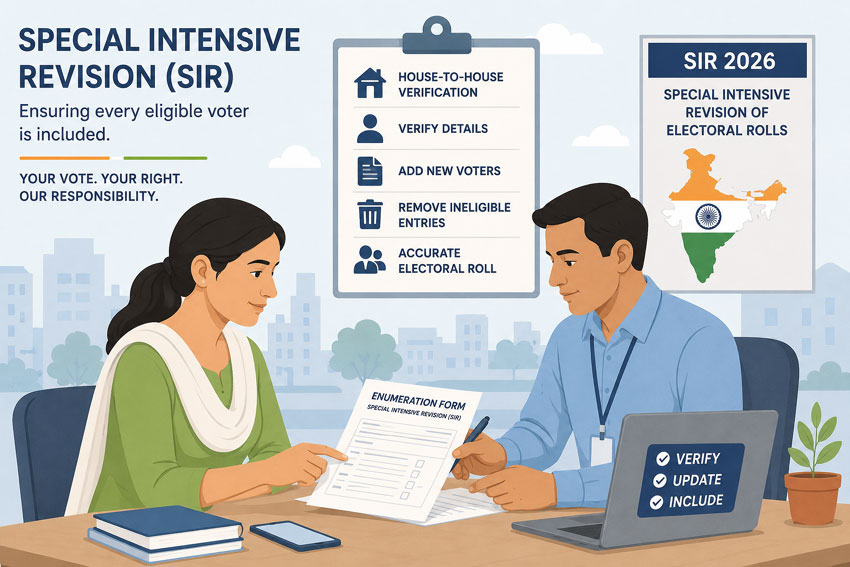
Three United Nations Special Rapporteurs have expressed concerns about India’s ongoing Special Intensive Revision (SIR) of electoral rolls, prompting a detailed response from the Election Commission of India (ECI). While the UN experts highlighted issues related to transparency and voter inclusion, the Commission has firmly rejected the allegations, maintaining that the revision exercise is lawful, transparent, and backed by constitutional provisions.
UN Rapporteurs Express Concerns
According to reports, a communication sent to the Government of India by three UN Special Rapporteurs raised several issues regarding the implementation of the SIR process.
The experts reportedly questioned whether the exercise could result in eligible citizens being left off the electoral rolls. Among the concerns highlighted were:
- Possible large-scale deletion of voter names.
- Insufficient time for voters to produce supporting documents or file objections.
- Allegations that artificial intelligence might influence the verification process.
- Concerns that minority communities could be disproportionately affected.
The letter is said to have been signed by the UN Special Rapporteurs responsible for minority issues, freedom of opinion and expression, and freedom of religion or belief.
Election Commission Rejects the Allegations
The Election Commission has dismissed the concerns, describing them as unfounded and without factual basis.
According to the Commission, the Special Intensive Revision is a statutory exercise conducted in accordance with India’s electoral laws and constitutional framework. Officials stated that every eligible voter is provided adequate opportunities to verify their details, challenge proposed deletions, and seek corrections wherever necessary.
The Commission also emphasized that the final electoral rolls do not indicate any systematic discrimination against minority communities.
Why is the SIR Being Conducted?
The ECI explained that the primary objective of the Special Intensive Revision is to improve the accuracy of electoral rolls.
The exercise seeks to:
- Register eligible citizens who are missing from the voter list.
- Remove duplicate registrations.
- Delete names of deceased voters.
- Eliminate entries of people who have permanently shifted or are otherwise ineligible.
- Correct inaccuracies in voter information.
Officials maintain that keeping electoral rolls accurate is essential for ensuring free and fair elections.
Nationwide Verification Exercise
The Election Commission noted that the revision is being implemented across the country through an extensive network of election officials.
The process involves:
- Around 12 lakh Booth Level Officers (BLOs) conducting field verification.
- More than 4,000 Electoral Registration Officers (EROs) supervising the exercise.
- Hundreds of District Election Officers and Chief Electoral Officers overseeing implementation.
According to the Commission, all personnel involved are government officials working under the provisions of the Representation of the People Act.
No AI-Based Decision Making
One of the allegations referenced the possible use of artificial intelligence in determining voter eligibility.
The Election Commission categorically denied this claim, stating that no AI system is used to decide whether an elector should be added to or removed from the electoral roll.
Instead, officials said the revision relies on:
- Physical field verification by Booth Level Officers.
- Examination of official electoral records.
- Document verification where required.
- Decisions taken by the designated Electoral Registration Officer after following due legal procedure.
Constitutional and Legal Basis
The Commission reiterated that the SIR process derives its authority from the Constitution of India and the Representation of the People Act.
It referred to Article 326 of the Constitution, which provides for adult suffrage and establishes eligibility for voter registration subject to legal qualifications.
According to the ECI, the revision exercise is intended to ensure that only eligible citizens remain on the electoral roll while protecting the rights of qualified voters.
Opportunity for Claims and Objections
The Election Commission also highlighted that the revision process is not limited to field verification.
After publication of the draft electoral roll, citizens are given an opportunity to:
- File objections against incorrect entries.
- Request corrections.
- Apply for inclusion if their names are missing.
- Challenge proposed deletions through the prescribed legal process.
Officials say these safeguards are designed to ensure that no eligible voter is excluded without an opportunity to be heard.
Monitoring and Oversight
The Commission stated that the revision process is subject to multiple layers of oversight.
In addition to verification by election officials, recognized political parties are permitted to appoint booth-level agents who can monitor the preparation and revision of electoral rolls. Final decisions on additions and deletions are made only after scrutiny by the Electoral Registration Officer.
Supreme Court Reference
In defending the exercise, the Election Commission pointed to judicial observations supporting the legal framework governing electoral roll revisions.
According to the Commission, the constitutional process for revising electoral rolls has been upheld as a legitimate mechanism for maintaining accurate voter records.
Conclusion
The debate surrounding the Special Intensive Revision reflects the importance of maintaining both accurate electoral rolls and public confidence in the electoral process.
While UN experts have called for close attention to transparency and the protection of vulnerable groups, the Election Commission maintains that the exercise is conducted under established legal procedures, includes multiple safeguards for voters, and provides opportunities for claims and objections before the final electoral roll is published.
As the revision progresses, voters are encouraged to verify their electoral details, cooperate with Booth Level Officers, and make use of the official grievance and correction mechanisms provided by the Election Commission of India.

This is supervised, written, directed or edited at Our Office Desk.
Any issue or disagreement can be sent to the help desk, after thoroughly analyzing we will be open for any amicable solution.
 Shafiq
 News Desk