

 Editor's Desk




‘Iron Man Epic Collection: Demon in a Bottle’ features a tame expression of Bronze Age bravery
It might not have been as groundbreaking as Green Arrow’s sidekick getting hooked on heroin, but Tony Stark’s drinking problem certainly heralded a change in the tone of American comics in its own way. This was the 1970s; the US was still mired in the Vietnam Conflict, Watergate had devastated the people’s trust in governmental authority, and the idea of an “American hero” was quickly becoming a troubling paradox. Even Captain America, the man wearing the flag, was confused about his position in a country so troubled from within. He’d go on to renounce the title and costume – after taking on a corruption inside the White House itself.
The Demon in a Bottle storyline doesn’t directly reflect this troubled American ethos, but it does grapple with the idea that heroes (or simply people with good intentions) cannot be seen to be morally spotless, no matter how valiant their endeavors. Maybe the story arose from an easy drinking culture that permeated business for decades, or perhaps writer David Michelinie intuited the more capitalist excesses we’d see from corporate America in the decade following. Either way, Tony Stark was a lush.

Marvel
It begins simply, in March, 1979’s issue #120, with the man himself ordering a fourth airline martini. The drinking hasn’t been a major focus of the story up to this point, and it doesn’t become the true focus of the story until several issues later, but it is somewhat ever present; Tony is often seen offering drinks to business people much too early in the day. He’s seen pouring himself said drinks. This isn’t the most damning evidence of a drinking problem, but it’s not a sign of a steady life. Further, this is technically a comic book for children. Shouldn’t Tony be a role model for a more healthy lifestyle?

Marvel
But this is what the Bronze Age of comics was all about: the slow shaking free of the shackles of the medium’s original, childish roots. Though Demon in a Bottle never dives headlong into the adult, it stands as a time capsule of the middle period of the era. Things are just heating up, ready to jump into the ‘gritty graphic novels’ period that would define the next decade.
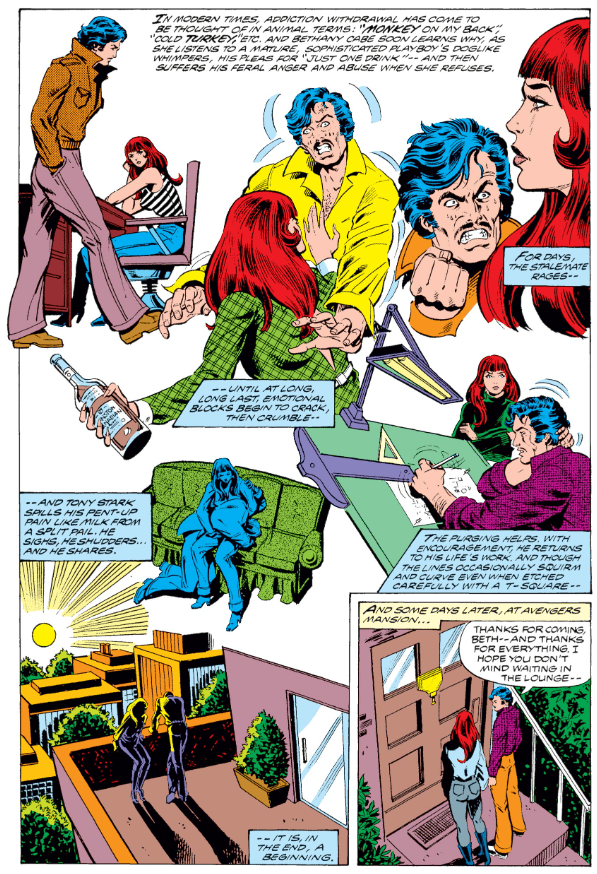
When Tony hits rock bottom in issues #127 and #128, it comes at the expense of his relationships first, then his inability to dress in his armor responsibly; drunk, he flies in to help out after a rail line disaster, only to rupture a gas canister and release deadly chlorine gas.

Marvel
Perhaps the way the book is most childish is in its easy resolution; #128 features that disaster, a rise to sobriety, and a sort of ham-fisted summary of what withdrawal might look like from a child’s understanding. By the end of the issue, Tony Stark is sober once more, forever changed by his nine-issue run in with alcoholism. Our understanding of him is all that remains changed.
Iron Man Epic Collection: Demon in a Bottle features more than this story, but the issues seem to reinforce the Bronze Age’s uneasy commitment to change. Demon in a Bottle is all but buried by much tamer, more classic Iron Man outings and concerns. The book wasn’t trying to turn heads elsewhere but this one, fateful story. Even early work by John Romita, Jr, who had yet to cultivate the style that would define his career, seems standard house style. The book is inoffensive for all but its one moment of daring.

News reported through various sources and compiled with AI. This is automatically generated news content from known, popular, and reliable sources available at the time of publication.
We do not take any responsibility for, nor make any representations regarding, the accuracy, completeness, credibility, or
reliability of the content.
In case of any discrepancy, error, or copyright claim, we will promptly review and remove the content in question where appropriate.
We do not claim ownership of third-party content and assume no responsibility or liability whatsoever for any information contained herein. The credit, links and images are kept intact as an honest gesture, are property of its respective owners.