


 Editor's Desk





Scientific communications have never traveled so far so fast. Medical affairs teams need an omnichannel approach to planning and monitoring publication strategy.
Compass Points: The Future of Medical Affairs is a series exploring the strategic challenges facing medical affairs teams in today’s communication landscape—and the tools that will help them get it right.
The goal of everyone working in medical affairs is ultimately to improve patient care. But success is contingent not only upon the research, trialing and production of innovative treatments; it depends equally upon the firm’s ability to educate on the suitable applications of a new treatment and establish trust within healthcare environments.
If healthcare practitioners don’t know a better treatment or diagnostic exists—or if they do, but they don’t trust it—they won’t use it in treatment plans. This has implications for the quality of patient care and commercial impacts for the firms creating those new treatments.
But the chain of communication is more fragmented and complex than it has ever been, and this makes identifying and monitoring how information travels difficult. In order to make sure information is reaching the right people in the right places, medical affairs teams need benchmarking and measurement tools, like Compass by Dimensions, which are capable of processing the rich, complicated reality of the communication landscape today.
How does scientific information travel?
Up until the recent decade, it was common for a healthcare provider to learn about new treatments and come to believe in their legitimacy after reading about them in a respected journal. This was a typical part of a clinician’s day, and reflects the supremacy of journals such as The Lancet or the New England Journal of Medicine, which is still entrenched today.
In recent years, scientific breakthroughs have found purchase across more diffuse channels, such as newspapers, radio and television. Now, scientific information is disseminated in every direction—both via “linear” one-to-many channels such as journals and also rhizomatically, across low-frequency networks such as social media, podcasts, internet forums, and word of mouth.
This has the undeniable benefit of bringing critical information to wider audiences, often with tremendous speed, but these channels lack the legitimacy of the big journals.
A new approach to scientific communication
Everything from peer-reviewed podcasts and video abstracts to plain language summaries and audience-segmented data now form a critical part of scientific communication. Where before this information could only travel in the rarefied air of prestigious journals, today, important research outcomes are accessible to audiences beyond academics and even beyond healthcare professionals.
This is a positive trend; these popular channels open research findings and awareness to patients and advocates—who, in rare disease settings, are often the best-informed in a given room.
Publication planners should embrace the potential that comes with this reality; with it comes the opportunity to reach new markets and to better influence treatment protocols even in remote fields.
For example, isolated clinicians in dispersed healthcare environments are historically among the hardest to reach and among the most likely to be using outdated treatments. They may not be reading The Lancet. They may not be at the big conferences. But if those clinicians encounter a new treatment option in a mid-tier journal, in a podcast, on social media, and in a clinical newsletter, they may change their prescribing behavior.
In these popular channels, trust and legitimacy is assigned instead by the opinion leaders who share about medical or scientific topics. The speed with which information travels and nature of the conversation it elicits can color its reception—making monitoring each type of channel all the more important.
Without a clear view of this data, medical affairs risks unsuitable communications plans that fail both the commercial objectives attached to a given asset and the people they intend to help with it.
How can measuring publication performance impact commercial and medical objectives?
Scientific information is traveling in novel ways. It is an entirely new challenge for publication planners and communications professionals to attempt to parse, measure, and analyze this data so that they may better design future communications strategies.
To know if you’re succeeding, you first need to know what success looks like.
In the 1980s, success could be measured in citation counts. This was appropriate as journals were a primary mode of scientific communication. Today, the gold standard for measuring how information travels and resonates is fuzzier.
Planners know that omnichannel communication forms a critical part of a robust publication strategy. But to date, there hasn’t been a simple way to collate a unified view of research impact across the spectrum of communication channels at play.
So, planners often still rely on citation counts, as these are concrete and reproducible as a measurement. But they reflect academic attention almost exclusively and obscure the impact of a given asset outside of these narrow academic channels. Weaving in altmetrics is a highly manual process, where planners must stitch together sources such as mentions on social media, broadcast media and journals. This practice is time consuming and difficult to rely upon because it is so difficult to standardize and view in aggregate. Online conversation might move in ways that are impossible to predict or track, making metrics difficult to compare and learn from.
But pressure for hard numbers and clarity is growing. High-quality research that fails to reach its audience is, commercially, wasted investment. Research that doesn’t travel can’t shape clinical awareness, influence prescribing behavior, or support often costly distribution activities. Planners need a single, unified view of total scientific impact which they can rely upon.
How should medical affairs teams build publication strategy?
To know a given communication is having the desired effect, planners need a view of three things:
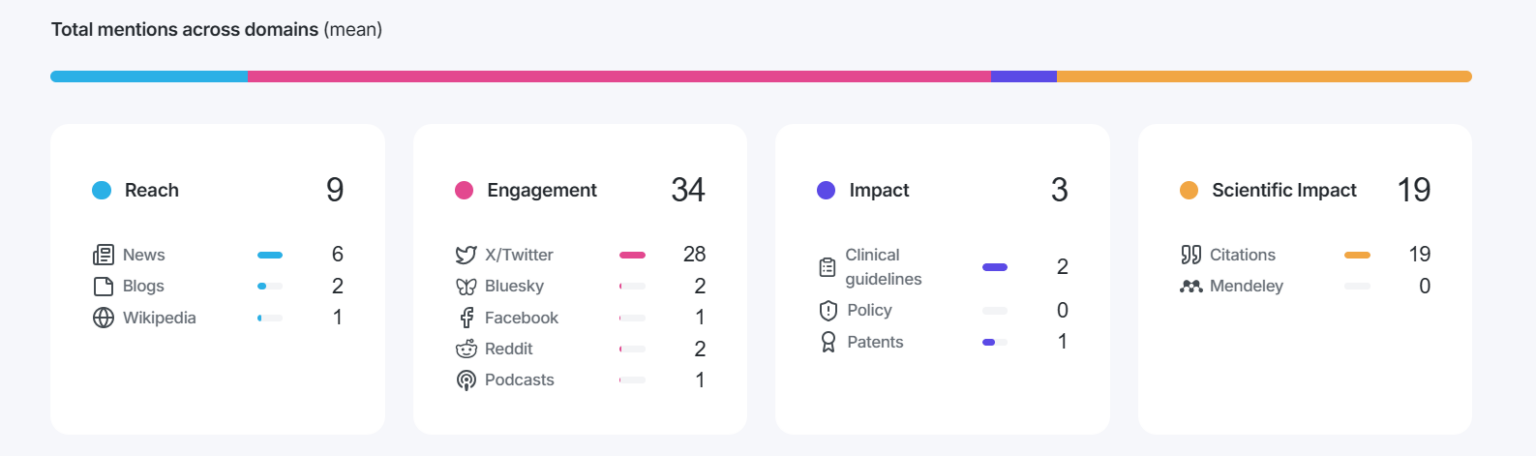
- Reach: is information propagating across relevant networks, i.e., news, social media, podcasts, clinical commentary
- Engagement: are the intended audiences engaging with the research, and how are they talking about it
- Impact: is there evidence of the therapeutic conversation or relevant policies shifting
The performance data needed to answer questions of reach and commercial viability exists. But the fragmentation of social platforms adds complexity—monitoring must now span X, BlueSky, Reddit, and beyond—but the richness of this data is unprecedented and therefore invaluable.
Compass tracks reach, engagement and impact and provides an overall view of scientific impact, so planners tracking alternative metrics can identify, track and analyze trends over time. From there, they can use aggregate views of asset performance as jumping off points for sentiment analysis and deeper audience research.
Having this data to hand makes publication strategy an endeavor of cause and effect rather than guesswork—seeing where research has resonated particularly well or potentially missed the mark informs each subsequent communications plan.
Why is benchmarking so important in medical affairs publication strategy?
Understanding your own reach and engagement is important, but without a point of comparison, it’s impossible to know whether a result is strong or where resources are well spent. Benchmarking performance—understanding what reach, engagement impact looks like per therapeutic area—against internal track records and those of competitors must form a central tenet of publication strategy.
Medical affairs teams must benchmark in two directions.
The first is competitive benchmarking: understanding how your publications and communications are performing relative to peer firms working in the same therapeutic area. This type of benchmarking helps identify gaps in therapeutic discourse along with spaces that are already crowded, helping planners tailor and prioritize their approach.

The second is industry benchmarking: understanding how your publication performance compares across therapeutic areas and channels. What does a typical volume of clinical engagement look like for the launch of a publication? What level of social chatter is reasonable to expect from a given journal tier? What rate of sentiment shift can be linked to momentum within therapeutic environments?

In short: benchmarking defines how we might judge success. Together, competitive and industry benchmarking transform measurement from a simple reporting exercise into a strategic one. They make it possible to set meaningful publication targets, track progress against them, and align publication activity with clinical trial milestones and other medical affairs priorities.
Ultimately, being able to access, monitor, and derive insights from this data will deliver not only a critical competitive and strategic advantage; it will help ensure information is reaching the people who need it.
“The proliferation of communication channels, and the increasingly diverse ways in which HCPs gather and share information about treatments have resulted in a very dynamic and complex impact environment. Compass from Dimensions represents a significant step forward in simplifying how we understand and communicate the values of our omnichannel strategies.”—Mike Taylor, Head of Information & Analytics, Digital Science
Compass was designed to help answer these questions of impact. Built on Dimensions and Altmetrics data, Compass combines publication and altmetrics into a single collaborative workflow, simplifying how medical affairs teams benchmark, track and manage publication impact and reach. Compass by Dimensions is developed by Digital Science, an AI-focused technology company that transforms fragmented data into unified knowledge assets, leveraging AI and Knowledge Graphs to deliver structured, actionable intelligence for high-value discovery and innovation. By combining unparalleled data depth and breadth with enterprise-ready AI technology, we help leaders confidently accelerate product life cycles and secure a decisive market lead.
The post From The Lancet to TikTok: Benchmarking success for publication strategy in medical affairs appeared first on Digital Science.

News reported through various sources and compiled with AI. This is automatically generated news content from known, popular, and reliable sources available at the time of publication.
We do not take any responsibility for, nor make any representations regarding, the accuracy, completeness, credibility, or
reliability of the content.
In case of any discrepancy, error, or copyright claim, we will promptly review and remove the content in question where appropriate.
We do not claim ownership of third-party content and assume no responsibility or liability whatsoever for any information contained herein. The credit, links and images are kept intact as an honest gesture, are property of its respective owners.