
 Editor's Desk




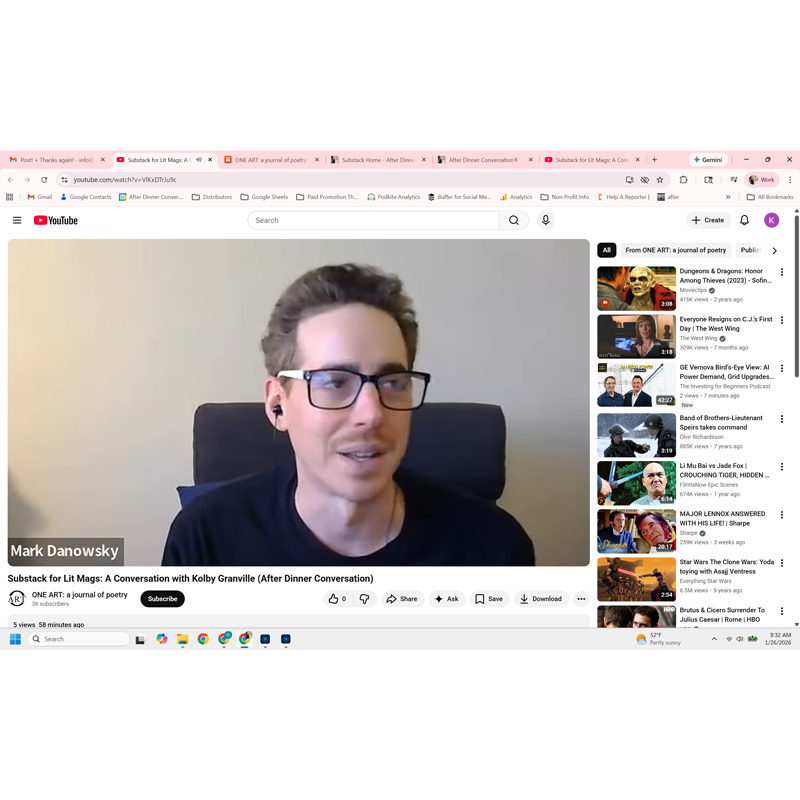
After Dinner Conversation’s editor and founder, Kolby Granville, believes in fewer gatekeepers and radical transparency. Recently, Kolby was invited to speak with Mark Danowsky, who runs ONE ART Poetry, about how After Dinner Conversation grew its Substack to more than 150,000 subscribers. We’re sharing the conversation here in the hope that it helps others in the literary magazine space who are looking to grow their audience.
After Dinner Conversation® is an award-winning, independent nonprofit publisher. We believe in fostering meaningful discussions among friends, family, and students to enhance our shared humanity through truth-seeking, reflection, and respectful debate. To that end, we publish philosophical and ethical short fiction accompanied by discussion questions. https://afterdinnerconversation.substack.com/
ONE ART is a home for good poems. We publish poetry that adds value to the lives of our readers and seek to offer, sustain, and nourish a kind, inviting, and thoughtful community. https://oneartpoetry.substack.com/
Have a literary magazine you’d like to bring to Substack? Email Kolby at [email protected] with your questions. Interested in interviewing Kolby? Reach out at the same address.
Mark Danowsky discusses with After Dinner Conversation editor Kolby Granville how After Dinner Conversation grew their literary magazine Substack to 150,000+ subscribers.
AI Generated Discussion Summary
This conversation between Mark Danowski (Editor-in-Chief of One Art) and Kolby Granville (After Dinner Conversation) provides an in-depth look at how a literary magazine can utilize Substack, data analysis, and marketing automation to achieve significant growth and sustainability.
The Philosophy of Growth
-
The “Greater Fool” Theory: Granville critiques the “Substack expert” community, noting that many successful accounts only sell courses on how to be successful rather than selling an actual product [03:14]. He argues that true growth comes from consistent, daily effort rather than secret shortcuts.
-
First-Mover Advantage: Success often stems from a “snowball effect” where being popular early on makes a platform’s algorithm suggest you to even more people, creating a self-sustaining cycle of growth [15:20].
Substack Growth Strategies
-
BookFunnel and Ethical Lists: Granville explains how they used BookFunnel to legally and ethically build an email list of over 25,000 subscribers by offering free stories in exchange for opt-ins [19:42].
-
Social Media Automation: The magazine utilizes tools to identify followers of similar literary accounts on Instagram and Twitter, engaging them through targeted DMs and follow-unfollow strategies to drive traffic to the Substack [24:57].
-
Facebook Lookalike Audiences: By exporting data on their most engaged “five-star” subscribers and uploading it to Facebook, they create “lookalike” audiences of one million similar people to target with highly effective ads [44:11].
-
The Role of AI: Granville uses tools like ChatGPT and Gemini to analyze subscriber churn rates, calculate the lifetime value of a customer, and even refine the layout of their emails to ensure the “action” of a story starts as soon as possible [36:34].
Sustainability and Business Ethics
-
Paying Staff: A major theme is the danger of relying on volunteer labor, which Granville argues creates a “culture of privilege” where only those who can afford to work for free can participate [54:23]. He emphasizes building a model that eventually allows for paid stipends to prevent burnout [51:12].
-
Nonprofit Structure: Granville discusses the practicality of a nonprofit board, suggesting it should be composed of trusted individuals who allow the founder to move quickly rather than a complex democracy that could stall growth [01:01:01].
-
Authors’ Rights: They utilize a specific contract that pays authors a flat rate upfront while allowing the magazine to reuse the content in future anthologies, avoiding the logistical nightmare of renegotiating rights for every new publication [10:45].
The Motivation Behind the Work
-
Moral Purpose: Granville views his work not just as publishing, but as a “moral good” intended to make people analyze their own value systems through fiction [01:17:12]. This sense of mission is what fuels his seven-day-a-week work schedule [01:13:35].
-
Open Transparency: Throughout the video, Granville stresses that there are no secrets to his success; he is willing to share all his data and methods because he knows most people will not put in the “grind” required to replicate them [01:12:38].
https://www.youtube.com/watch?v=VlKxDTrJu9c

News reported through various sources and compiled with AI. This is automatically generated news content from known, popular, and reliable sources available at the time of publication.
We do not take any responsibility for, nor make any representations regarding, the accuracy, completeness, credibility, or
reliability of the content.
In case of any discrepancy, error, or copyright claim, we will promptly review and remove the content in question where appropriate.
We do not claim ownership of third-party content and assume no responsibility or liability whatsoever for any information contained herein. The credit, links and images are kept intact as an honest gesture, are property of its respective owners.