

 Editor's Desk





PAUL KUPPERBERG: Dig These 13 EXCERPTS From JULIE NEWMAR’s Never-Published Memoir
A BIRTHDAY TRIBUTE to screendom’s original Catwoman, who is turning 93…
By PAUL KUPPERBERG
Back in 2018, actress Julie Newmar — born 93 years ago, on August 16, 1933 — reached out to me on Facebook to say she enjoyed my essay on the Batman TV show in Gotham City 14 Miles: 14 Essays on Why the 1960s Batman TV Series Matters, edited by fellow 13th Dimension inmate Jim Beard, and to ask if I might be able to recommend a writer to work with her on developing her memoir.
It should come as no surprise that the first name that popped into my head was my own.
As a test, we decided I would write the chapter about her time as Catwoman, the role she’s best known for by generations of TV viewers. Others would portray Batman’s feline adversary over the years — in comics, animation, television, and film — but it was Newmar who first established the character’s live-action identity in the minds of millions during ABC’s Batman television series in 1966 and 1967.
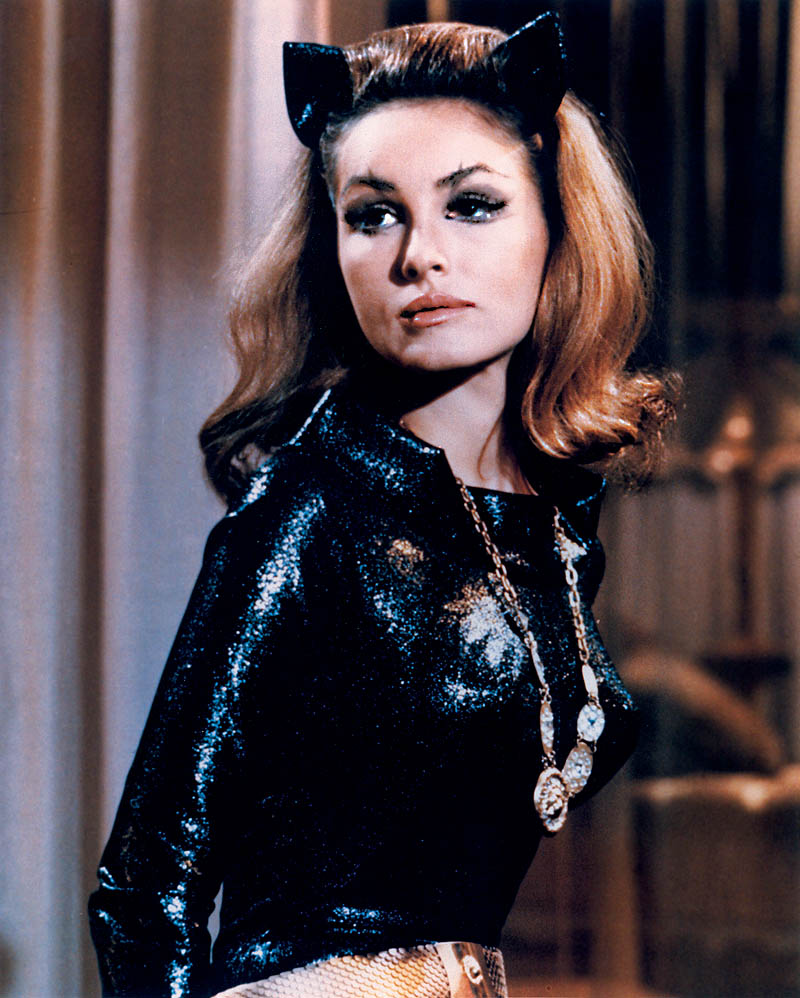
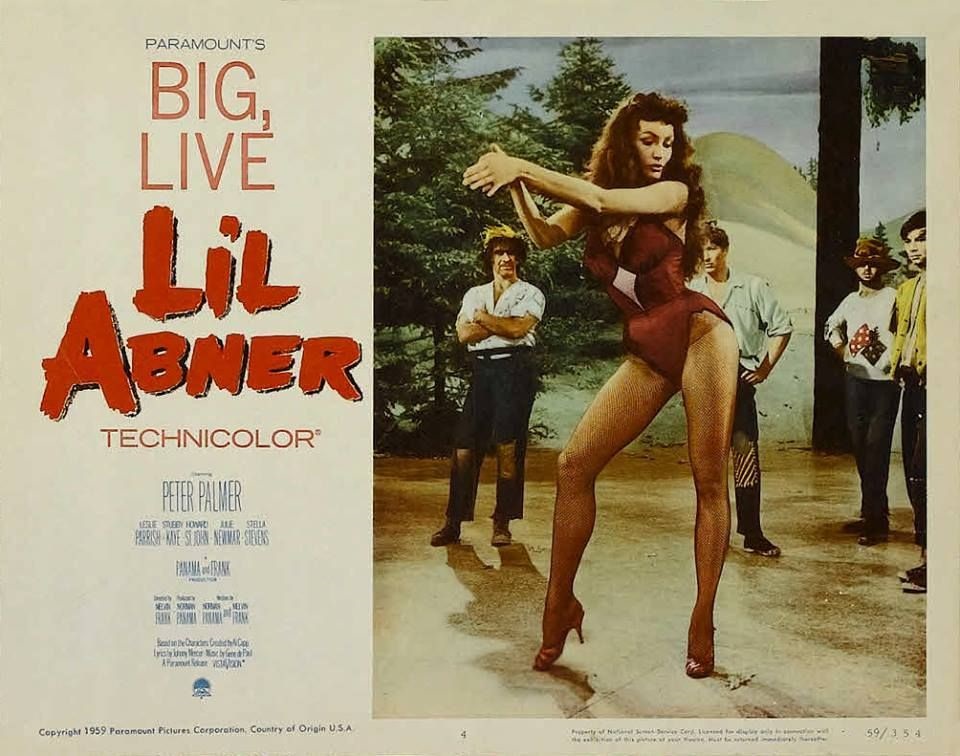
By the time she donned Catwoman’s black costume, Newmar had already built a successful career as a dancer, actress, and stage performer. Her credits included Broadway productions, feature films, and television appearances that showcased her versatility and physical presence, including The Band Wagon, L’il Abner, Seven Brides for Seven Brothers, The Twilight Zone, and a Golden Globe-nominated role starring in TV’s My Living Doll with Bob Cummings. Those talents proved well suited to Batman, a series that balanced superhero adventure with comedy, pop art, and self-aware performances.
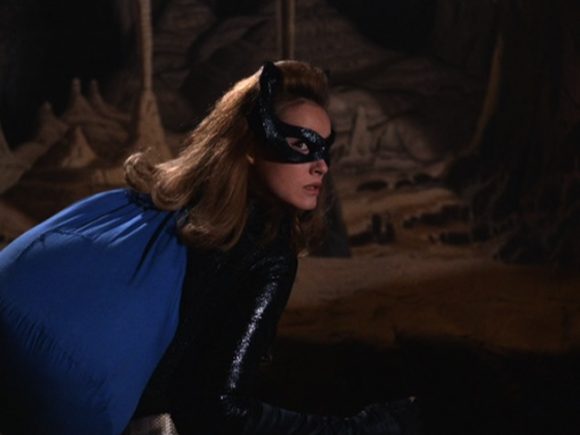
Newmar appeared in 13 episodes during the show’s first two seasons, developing a version of Catwoman that combined intelligence, confidence, wit, and playful flirtation. Her encounters with Adam West’s Batman became a recurring highlight of the series, built as much on verbal sparring and mutual respect as on elaborate schemes to outwit the Dynamic Duo. Rather than portraying Catwoman as simply another costumed criminal, Newmar gave the character a distinct personality that helped distinguish her from Batman’s other adversaries.
Although she was unable to appear in the 1966 Batman movie (with Lee Meriwether stepping in) or the third season (the role passed to Eartha Kitt), Newmar’s interpretation remained closely identified with the character. Her performance also influenced later portrayals of Catwoman, with many emphasizing the same blend of elegance, humor, independence, and mischief.
I wrote my sample chapter, combining Julie’s notes with my own research, but I apparently failed to hit the nail on the head and, while appreciative of my efforts, she didn’t feel I had quite the right voice and tone for the job. She offered me her thanks, a kill fee, and permission to reuse the material if I could find a use for it. (I did, to help flesh out another essay for another Jim Beard-edited project, “To Stanley Ralph Ross, Thanks for Everything! Julie Newmar” in Biff! Bam! Eee-Yow! The Subterranean Blue Grotto Essays on Batman ’66, Season Two.

Julie Newmar has yet to publish that memoir, alone or with a co-writer, which is a shame. (She did release a sort of philosophy/self-help book, back in 2011: The Conscious Catwoman Explains Life On Earth.) Her Catwoman has endured because it captured a moment in popular culture while remaining accessible to new audiences. More than half a century later, her work on the series continues to be part of the conversation whenever the history of Batman on screen is discussed, and it would be awesome to hear about her work straight from the cat’s lips!
For now, though, you’ll just have to settle for her words, ghosted by me.
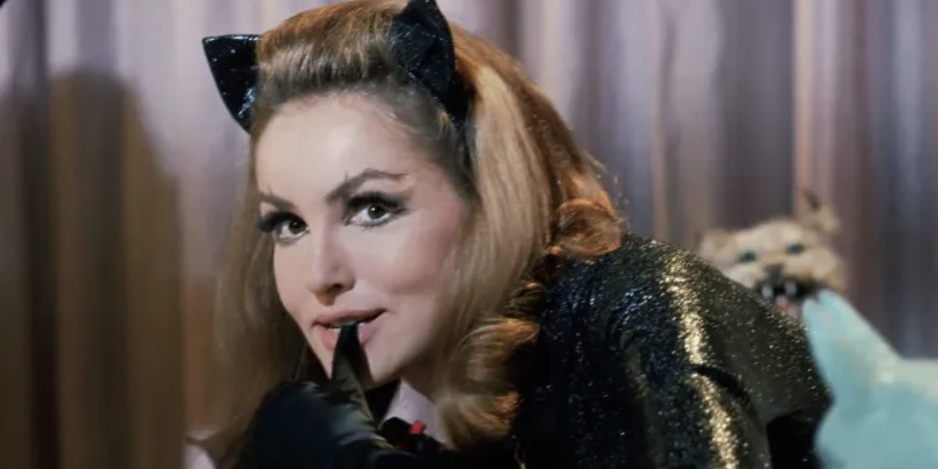
Here then, are 13 EXCERPTS FROM JULIE NEWMAR’s NEVER-PUBLISHED MEMOIR (or, My 13 Favorite Julie Newmar Ghosted Quotes):
—
1. On Reprising Her Most Famous Role, in 2016’s Animated Batman: Return of the Caped Crusaders. In the summer of 2015, I was given the opportunity to reprise a role I never expected to take on again. It was a part purrfectly suited to my talents and one I simply could not refuse.
“Julie, how would like to play Catwoman?”
At first, I think I might have laughed. It had been 50 years since I’d first donned the slinky, sparkly black bodysuit of the Batman’s favorite foe, that felonious feline, Catwoman. And while I had no doubt I could still fill the costume without any fear of embarrassment, I somehow couldn’t imagine current-day Hollywood having the imagination or courage to put a mature, sophisticated, sexy super villainess such as myself on the big screen.
—
2. Why She Returned for the Role. It was irresistible! We adored each other, Adam and I (and Burt, in his own way), both of whom had originally been perfectly cast as the stalwart Caped Crusader and his upright sidekick, Robin, the Boy Wonder. By the time he won the role of Bruce Wayne (the wealthy playboy alter ego of the crime-fighting Batman), Adam was a veteran of film and TV. He had starred in 1964’s Robinson Crusoe on Mars and co-starred on the TV series The Detectives. However, the performance that landed Adam the role of a lifetime had been a parody of a secret agent on a TV commercial for Nestle’s Quick chocolate mix. Batman producer William Dozier was impressed by Adam’s dead serious delivery of the farcical material—which included him escaping a sinking boat by inflating a rubber ducky lifebelt—and brought him in for a screen test.
—
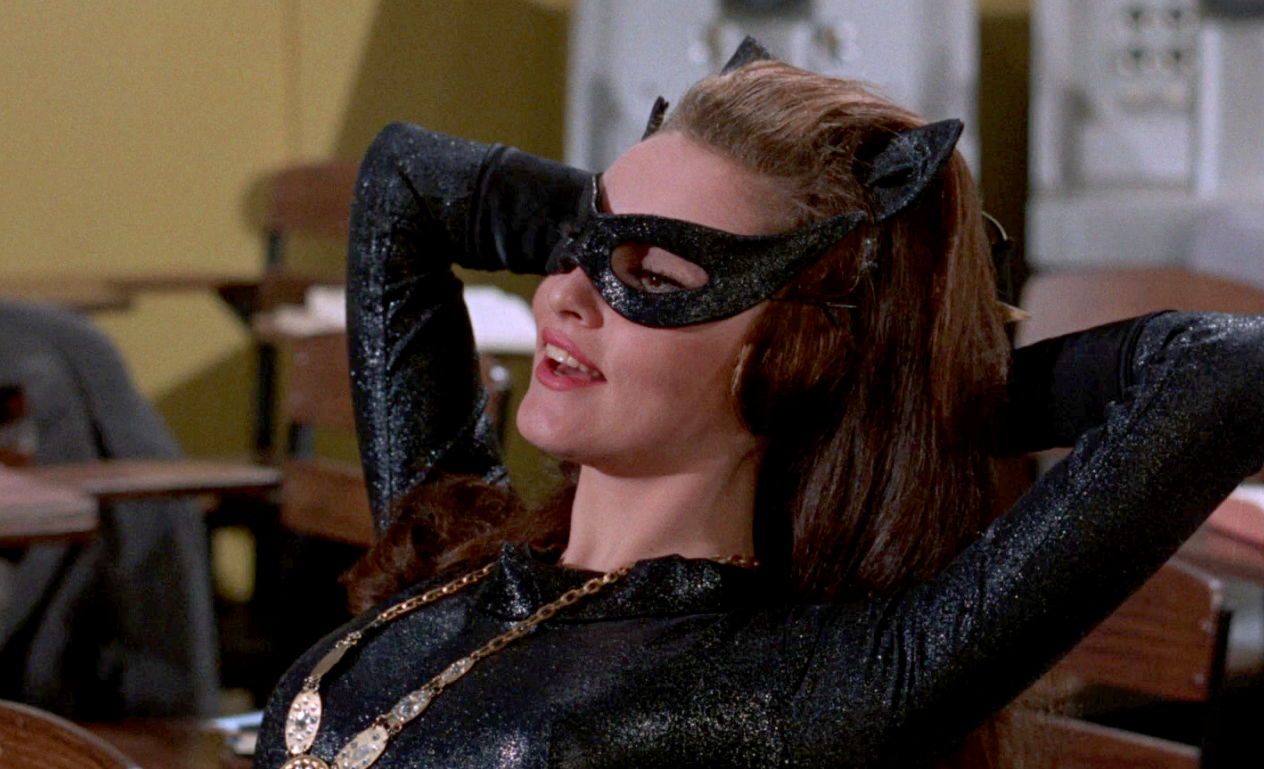
3. Born to Play Catwoman. Catwoman and I were a perfect fit. The costume, the witty dialogue, her sensuality, and the fact that I always felt I’d been born for the role. I was a trained ballerina, although at 5’ 11” one of admittedly outsized proportions. I called on all my training to play Catwoman, to appear so cat-like on my feet, almost floating. I jetéd, penchéd, even pirouetted. All my muscles obeyed the Saturnalian force of teleplay writer Stanley Ralph Ross’ delectable words. Most importantly, I knew what was happening between the lines, confidently throwing off words that Stanley had scripted as double-layered teases. What fun it was to be the first to bring this multifaceted female to life on the screen!
—
4. A Brother’s Advice. How strange that I never would have even considered the role if not for my brother John, who I’ve always said was smarter than me. In 1966, I was living in a penthouse apartment on New York City’s Beekman Place. John was visiting from Boston with five or six of his Harvard friends and, as we were trying to decide on a restaurant for dinner, I received a call about an audition for a Bat… or maybe it was, did I hear that right, a Cat-woman?
“I’ve never heard of it,” I told my caller.
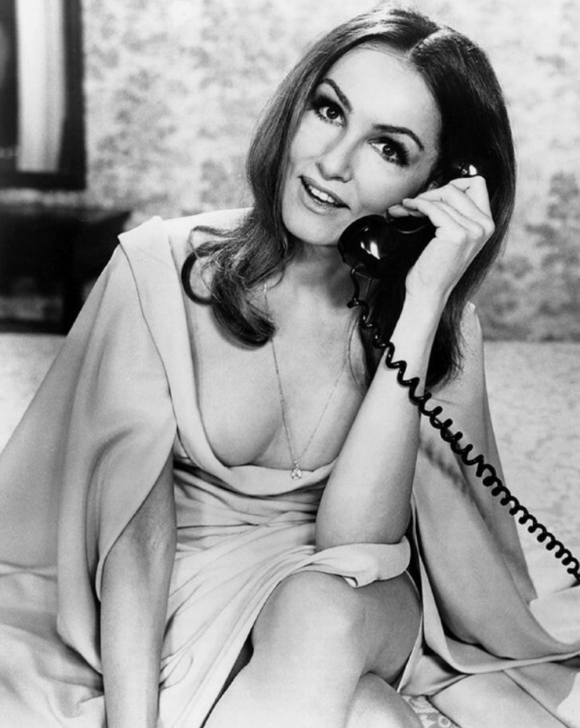
But John and his friends certainly had. Our parents had deemed comic books unacceptable amusements for us as children, but John had discovered this previously forbidden fruit on his own at Harvard and almost grabbed the telephone from my hand to accept on my behalf. “We stop our studies, everything, to watch Batman!” he said, practically pushing me out the door, our dinner plans forgotten.
—
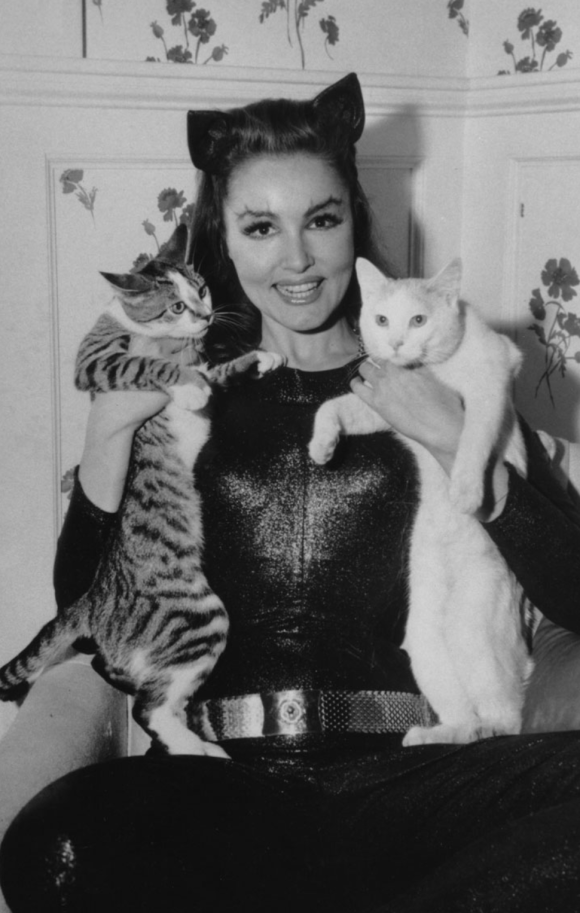
5. Method (Meow!) Acting. By the second show, I was also working with a pair of the finest feline tutors I could find, two newly adopted cats named Cat and Mouse. I would observe them for hours, watching their every movement. Unlike we clumsy human beings, cats flow through the world like liquid mercury, smooth and silent and, if misused, deadly. Cats are always watching, as still and silent as the Sphinx, their strange and magically startling eyes observing all. They don’t move any more than is necessary, but when roused, react with explosive speed and force.
—
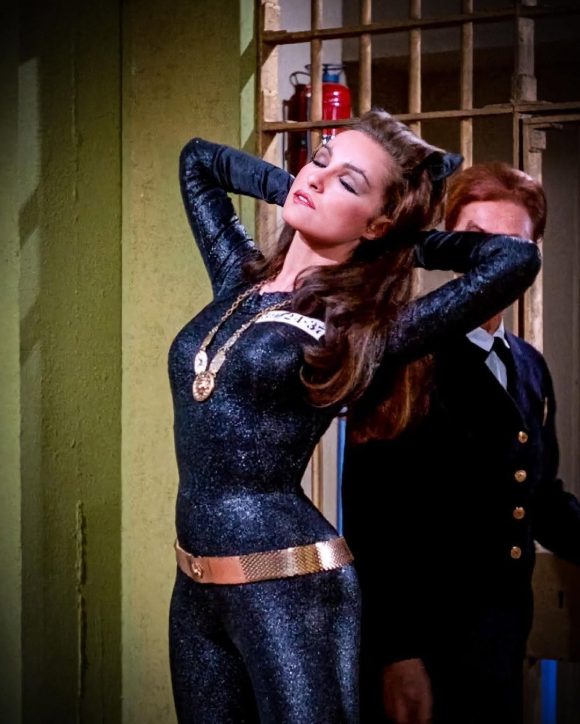
6. Things That Would Have Made the Censors’ Heads Explode. How tantalizing would it have been if my Catwoman had been allowed to trace a long, lingering lick to Batman’s cheek, as Michelle Pfeiffer did when she played the role in 1992’s Batman Returns opposite Michael Keaton’s Batman! Batman’s ratings, which were through the roof that first season, would have hit the stratosphere! But it wasn’t meant to be. This was an era when even a glimpse of Barbara Eden’s bellybutton peeking over the waistband of her harem pants on I Dream of Jeannie made network executives go weak in the knees.
—
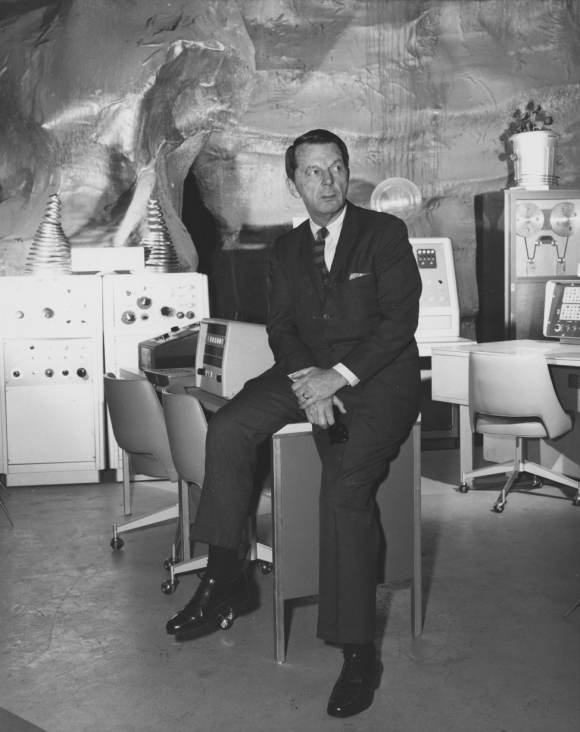
7. William Dozier. The credit for the tone and grand design of Batman belongs to Greenway Productions producer, William Dozier. Perhaps a little embarrassed by the childish comic book origins of his show, he decided to highlight and play off its absurdities by “camping” it up with a straight-faced portrayal of even the silliest situation, such as in my first episode, “The Purr-fect Crime,” when I tell my henchman Felix, “You can brush my pussy willows before you leave. And don’t go against the fur.”
—
8. Stanley Ralph Ross. But while the tone may have been Bill Dozier’s, the words were the work of the talented Stanley Ralph Ross. Stanley was much in demand, writing for The Man From U.N.C.L.E., The Monkees, and many other shows in the course of his career, from All in the Family to Banacek. And thanks perhaps to his experience in creating the ultimate super-villainess on TV, he would go on to develop the ultimate super-heroine TV show, 1975’s Wonder Woman, starring that real-life Amazon princess, Lynda Carter!
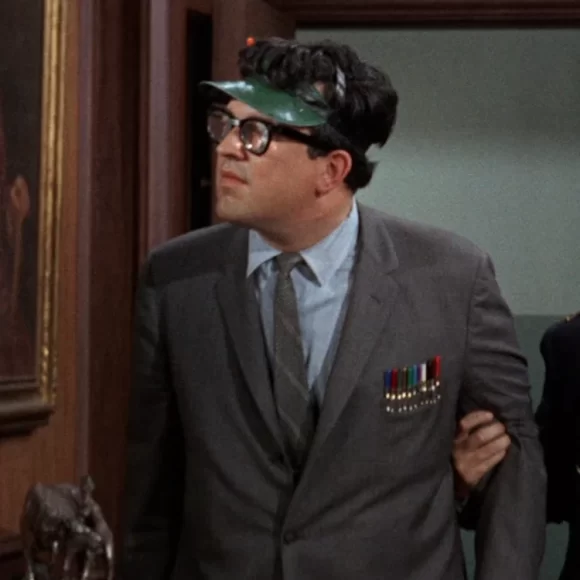
Ross had an unspoken cameo as “Ballpoint Baxter” in a Penguin episode
Stanley wrote five of the six one-hour shows in which I appeared, broadcast as two one-half hour episodes on successive Wednesday and Thursday evenings with the Part One cliffhanger ending — the hard-to-write Bat-trap — enticing the viewers back for Part Two. The show was written at its most basic level for children, while the dialogue and all-important subtext and double entendre were crafted to tickle the funny bones of their parents.
—
9. Paying Scale. Bill Dozier had convinced the front office to underwrite the most expensive television program of 1966. Every dollar of that budget was visible on the screen… but less so in the paychecks of the guest stars. My records show I received $1,250 for each two half-hour set of episodes, but what I didn’t make in money, Batman paid in the boost to my recognition and public image. Some years later, appearance fees from comic book and nostalgia conventions across the country helped make up for the earlier lack of monetary compensation.
—
10. A stitch in Time. There were some things that I instinctively understood I needed to take into my own hands. I had learned how to sew from my grandmother, and a junior high school class had taught me all about fitting and seaming. It was a good skill to have, because I hit my full height by the time I was 14 years old. I could live with the taunts of “How’s the weather up there?” but not with the styles available to me.
I solved the problem when it occurred to me that a curved line was shorter than a straight line of the same length. With that in mind, I created the infamous S-curve for my waistline and sewed it into all my garments. It resulted in an immediate “oomph!” effect, accentuating the curves without drawing undo attention to my height.
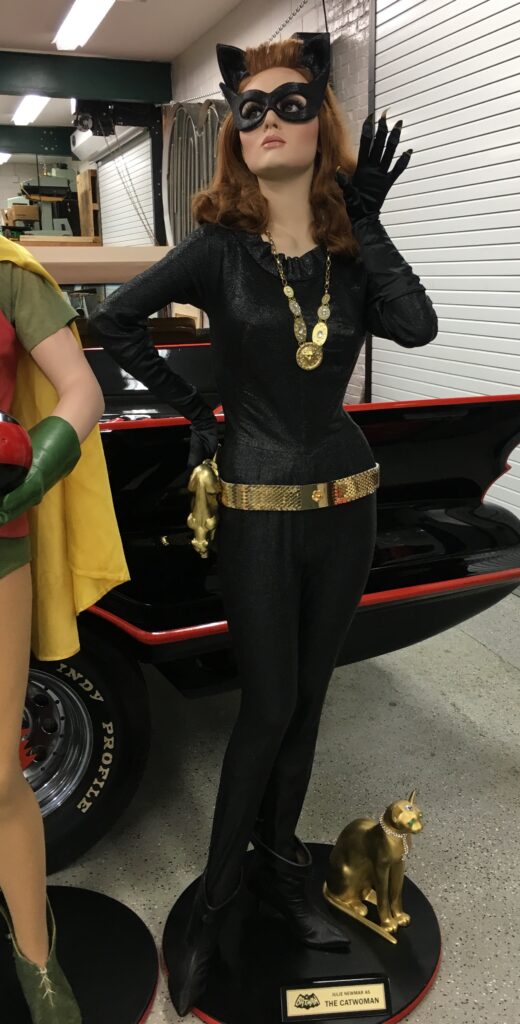
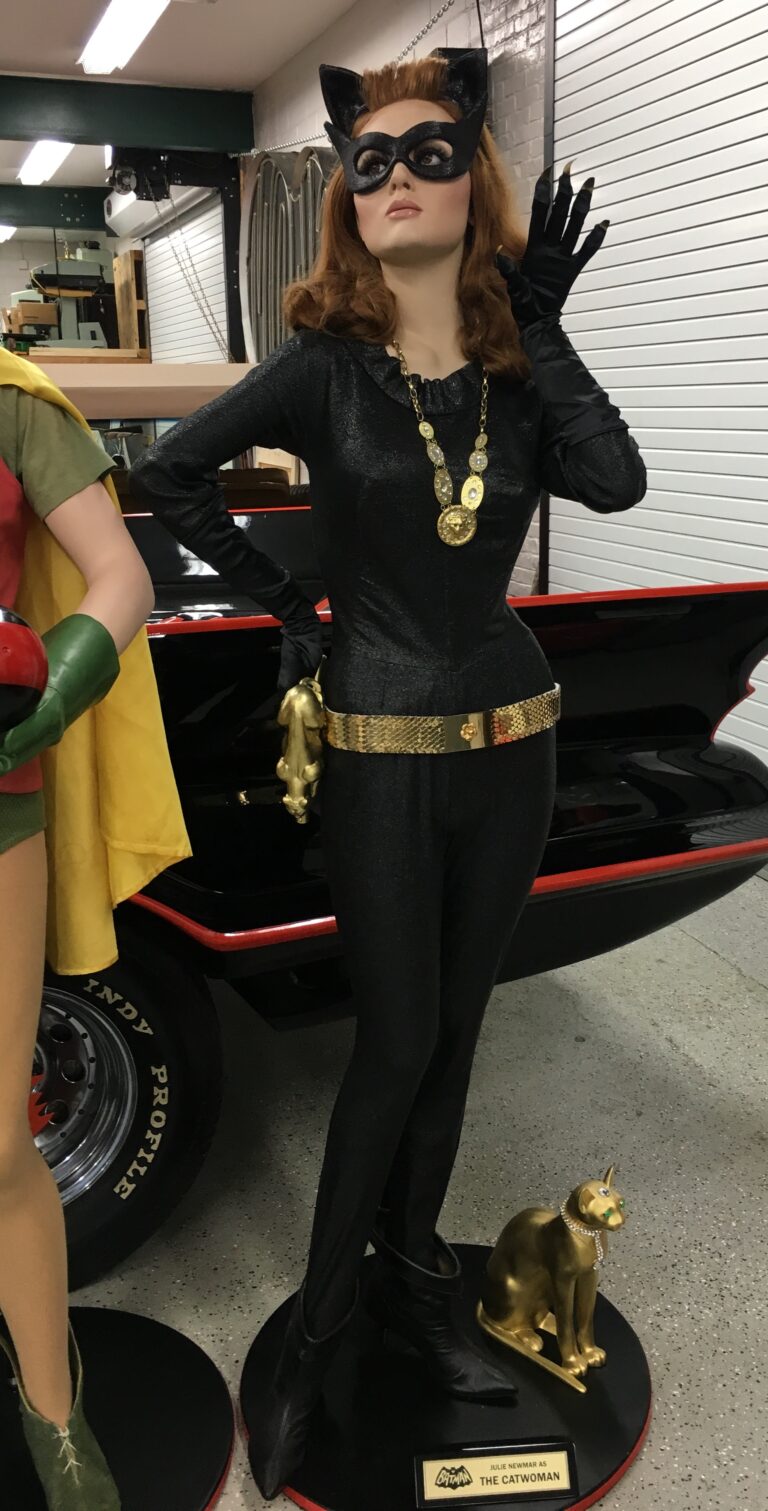
An original Catwoman costume. The jumpsuit and belt were used on screen. The rest are reproductions.
The Catwoman costume itself was made of a material called Lurex, which had a bit of give to it, unlike skintight Spandex. At the first fitting, I got down on the floor with the costume and a piece of white tailor’s chalk to show the wardrobe department where to sew in the S-curve. The effect of the black bodysuit on me was like liquid licorice, and it reinforced the acting truth that the better the costume (or prop) looks, the easier it is to find the character.
—
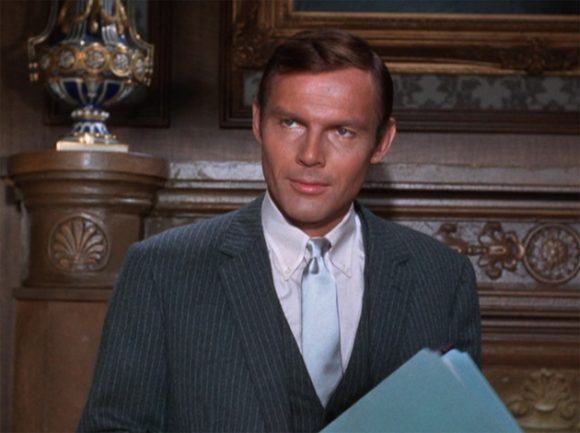
11. Adam West. The regular cast was the glue that held the show together. Adam West was suave and debonair as Bruce Wayne, and strongly stoic as Batman. On screen, we played a delicate dance of G-rated flirtation and seduction, but in real life, I always felt as though he was coming to me through a charming filter. He was a mixture of Cary Grant and his own polished persona, but he always seemed to be chirping some muffled repartee under his breath. Sometimes, while seated before the multitude of adoring fans lining up for his autograph at conventions, I could just make out his repetitious mutter of, “The train’s leaving, Joe!”
—
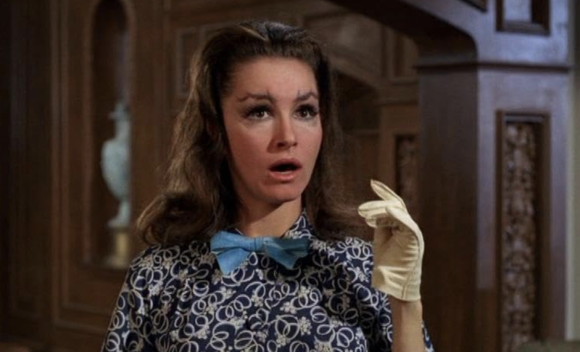
12. Burt Ward. My relationship with Burt Ward was a bit more complicated, although always fun. Perhaps it was the cat in me stalking the little Robin, or maybe it was a sister/brother dynamic. In Season Two’s “The Cat’s Meow,” the script called for Catwoman to disguise herself as dance instructor Miss Edna Klutz. Edna was an outrageously delicious character to create; her name says it all! During a break, I hightailed it to the wardrobe department and told them, “I’m looking for a 1930s-style schoolmarm dress, plus shoes three sizes too big for me! All the better to stomp on Burt Ward’s feet with.” I added thick, coke-bottle lens glasses to the outfit, heaping yet another layer of complication to his playing opposite me as I stumbled blindly around the set.
—
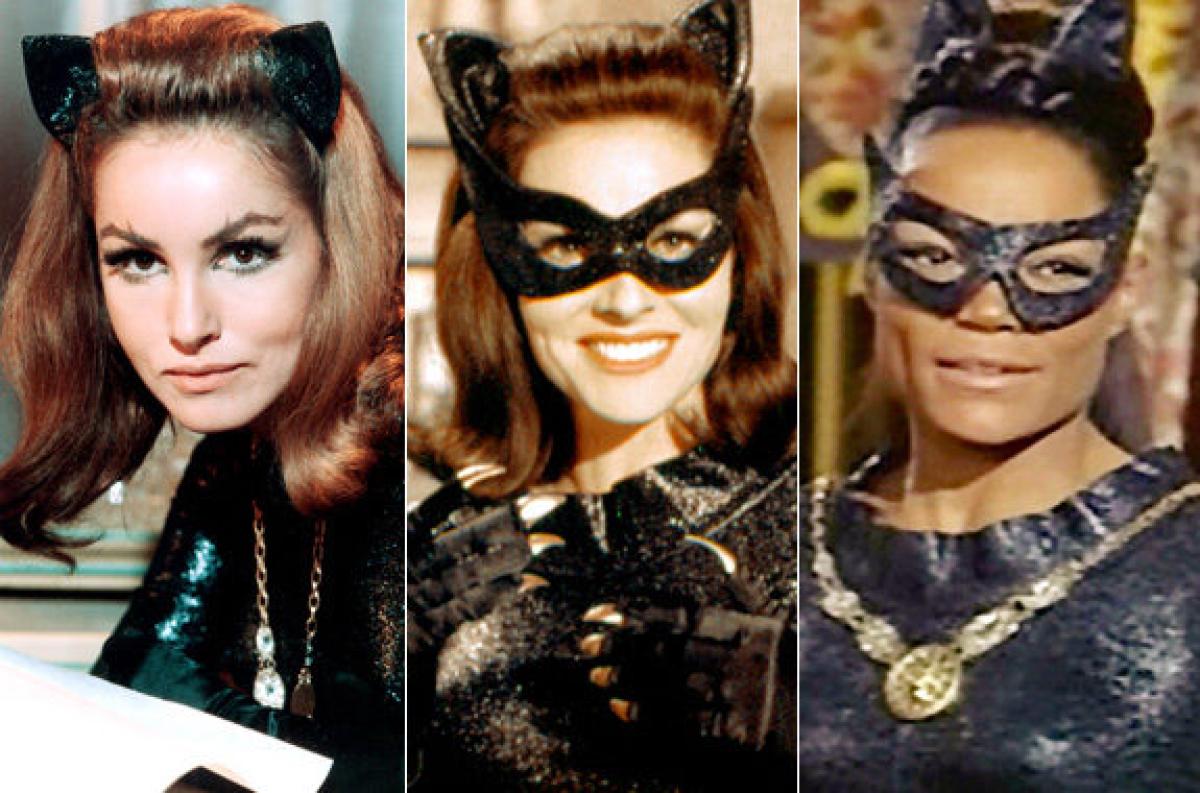
13. Scheduling Conflicts. Due to scheduling difficulties, I was unavailable to co-star along with Adam, Burt, and my fellow rogues, Cesar (Romero), Frank (Gorshin), and Burgess (Meredith) in the 1966 Batman theatrical film. Former Miss America and actress Lee Meriwether was selected for the part, crafting a Catwoman far more restrained than the one I portrayed, yet still deadly competent. Unfortunately, the movie I was to appear in, a British comedy called Monsieur Lecoq, ran into difficulties and had to be abandoned in mid-production. A similar conflict also prevented me from appearing in the show’s third season; in that case, they found a replacement in the marvelous Eartha Kitt, who brought her own brand of feline sensuality to the role.
—
MORE
— Jim Balent’s JULIE NEWMAR CATWOMAN Portrait Is the Cat’s Meow. Click here.
— JULIE NEWMAR: ‘I Always Thought That as a Cat, I Could Toy With Any Male Star.’ Click here.
—
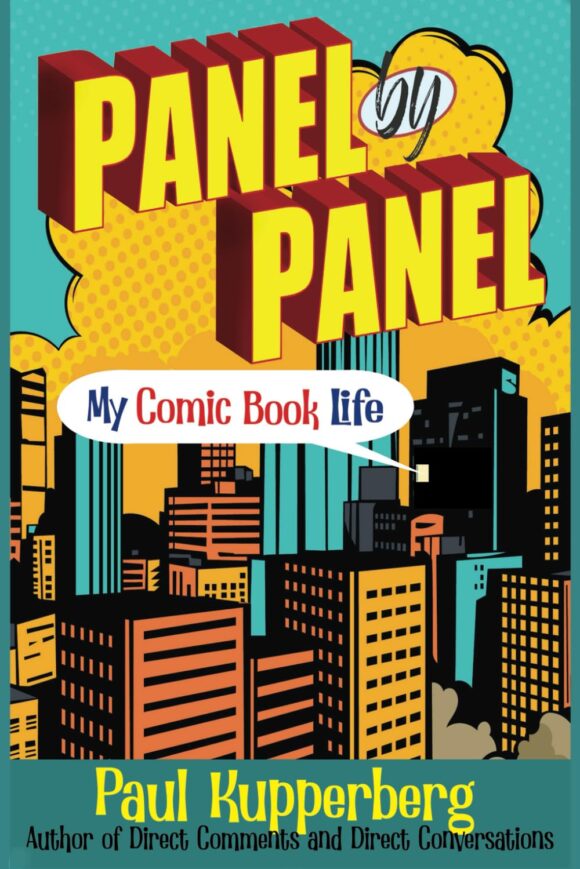
PAUL KUPPERBERG was a Silver Age fan who grew up to become a Bronze Age comic book creator, writer of Superman, the Doom Patrol, and Green Lantern, creator of Arion Lord of Atlantis, Checkmate, and Takion, and slayer of Aquababy, Archie, and Vigilante. He is the Harvey and Eisner Award nominated writer of Archie Comics’ Life with Archie, and his YA novel Kevin was nominated for a GLAAD media award and won a Scribe Award from the IAMTW. Check out his memoir, Panel by Panel: My Comic Book Life.
Website: https://www.paulkupperberg.net/
Shop: https://www.paulkupperberg.net/shop-1

News reported through various sources and compiled with AI. This is automatically generated news content from known, popular, and reliable sources available at the time of publication.
We do not take any responsibility for, nor make any representations regarding, the accuracy, completeness, credibility, or
reliability of the content.
In case of any discrepancy, error, or copyright claim, we will promptly review and remove the content in question where appropriate.
We do not claim ownership of third-party content and assume no responsibility or liability whatsoever for any information contained herein. The credit, links and images are kept intact as an honest gesture, are property of its respective owners.