
 Editor's Desk



SNAP waivers are associated with short-term decreases in soda purchases
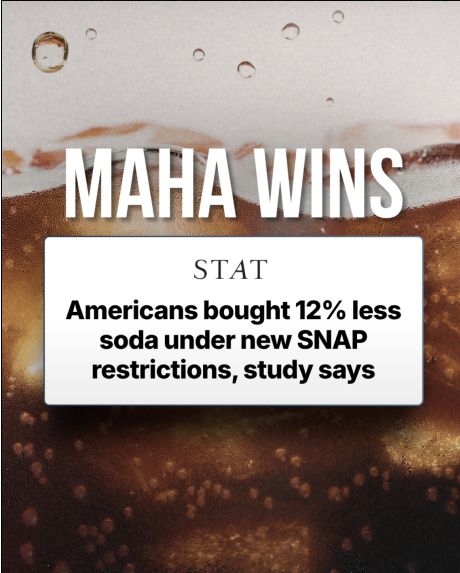
MAHA has announced a big win.
A study of purchase data from states with SNAP food restriction waivers, “Short-Run Impacts of SNAP Restriction Waivers on Beverage Purchases,” finds a 13% decrease in soda purchases within the first two months, with even larger decreases in the poorest households (18.5%). Yes, 13%, not 12% as the MAHA win poster says.
The study: Frisvold DE, Rojas FL. Short-run impacts of SNAP restriction waivers on beverage purchases. National Bureau of Economic Research, August 2026. doi: 10.3386/w35613.
Background: Just published USDA data from 2023 show households participating in SNAP to consume more sugar-sweetened beverages than non-participating households. A USDA study in 2016 showed similar results.
Attempts to restrict sodas on SNAP have been rejected by the USDA for years, but under the Trump administration, it has approved SNAP food restriction waivers for 23 states. At the moment, 8 states have banned sugary drinks, 10 are in the process of implementing bans, and the policy in 5 states is under litigation.
Some economists have argued that SNAP participants would just use their own money to buy sugary drinks. This study found that they did not.
According to the New York Times,
Fetch, a rewards app, found similar results in its data. Fetch users upload grocery and other receipts to receive coupons, allowing the company to track payment methods, including SNAP. In the company’s sample, SNAP households spent about 12 percent less on soda in the first three months of 2026 compared with the same period the year before. Water, coffee and juice purchases did not decline.
But some analysts say SNAP Food Restrictions May Help or Hurt—But We Will Probably Never Know. They are particularly concerned about the lack of appropriate data sources for evaluation of the policy, and the potentially negative impacts of the policies—especially a decline in SNAP participation.
The Trump administration’s tightened rules for SNAP eligibility has already resulted in 5.6 million fewer enrollees compared with last year.
Declines in enrollment can be tracked here and here.
Comment
I’ve long supported restrictions on sugary beverages on SNAP, something intended from the time the program first started by blocked by the soda industry and retailers (the principal beneficiaries of SNAP). But I wanted USDA waivers to come with rigorous evaluations plans that included not only purchase data, but also how participants felt about the bans and dealt with them.
The current waivers appear to me to be punitive, in line with the Trump administration’s other efforts to reduce SNAP enrollment—something it is achieving quite well.
So here’s another MAHA win: a big decline in SNAP enrollment. They aren’t boasting about that one though, at least not publicly.
The post SNAP waivers are associated with short-term decreases in soda purchases appeared first on Food Politics by Marion Nestle
News reported through various sources and compiled with AI. This is automatically generated news content from known, popular, and reliable sources available at the time of publication.
We do not take any responsibility for, nor make any representations regarding, the accuracy, completeness, credibility, or
reliability of the content.
In case of any discrepancy, error, or copyright claim, we will promptly review and remove the content in question where appropriate.
We do not claim ownership of third-party content and assume no responsibility or liability whatsoever for any information contained herein. The credit, links and images are kept intact as an honest gesture, are property of its respective owners.