

 Editor's Desk





Saiprasad Gundeti, Chief Embryologist, Malpani Infertility
Clinic Pvt. Ltd.
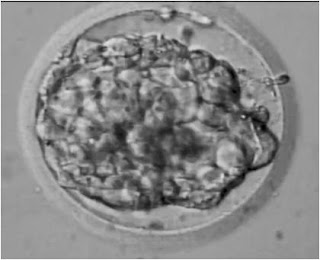
An embryo must break out or ‘hatch’ from its outer layer,
known as the ‘zona pellucida,’ in order to attach to the uterine lining and
implant in the uterus.
What exactly is Laser Assisted Hatching?
Prior to embryo transfer, a short laser beam is fired on the
zona pellucida (Shell) of the embryo under a microscope to produce a tiny
opening that allows the embryo to hatch. This increase the chances of Embryo
Implantation.
When should Laser assisted Hatching be used?
1) Advanced Maternal Age (>37 years)
2) Patients with Several IVF Failures.
3) Embryos with thick shell (Zona Pellucida)
How is laser hatch done on Day 3 Embryos ?
Laser assisted hatching is usually done on day 3 Embryos
(8-cell Stage)
Doing a Laser hatch on day 3 Embryos is relatively easier.
We find a gap between the cells where the laser can be fired
safely away from the cells to make opening on the zona pellucida.
.png)
How is laser hatch done on Day 5 Embryos (Blastocysts) ?
Doing a laser hatch on day 5 Embryos (Blastocysts) can be
tricky.
Since cavity is formed in blasotcyst, it expands and there
is no gap between the zona pellucida and the outer cells (Trophectoderm)
The following are some effective ways of doing Laser
assisted hatching on day 5 embryos.
In Fresh Embryo Transfer –
1) For a day 5 transfer at blastocyst stage, Laser beam is
carefully fired on the outer part of the zona and a partial opening is made on
the zona pellucida, without damaging the trophectoderm cells.

2) The other effective way of doing laser hatch for day 5
Embryo transfer, is doing a laser hatch on day 3 and culturing the embryos till
day 5.
The Embryos start hatching from the opening made on the zona
pellucida before the transfer.

In Frozen Thawed Embryo Transfer (FET) –
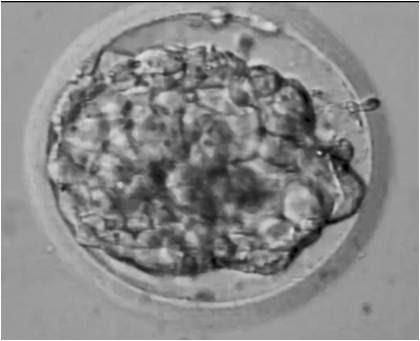
If Blastocysts are artificially collapsed prior to
Vitrification (Freezing) –
Blastocysts are artificially collapsed with the help of
laser beam, to remove the water from the cavity.
This reduces the exposure time to cryoprotectants and thereby increases survival rates post thaw
Because the laser beam is passed between the 2 trophectoderm
cells to shrink the blastocyst, a tiny opening is made on zona pellucida.
Hence there is no need to do laser hatch again prior to
transfer in FET Cycle
If Blatocysts are not collapsed prior to Vitrification
(Freezing) –
Although shrinking the blastocyst prior to vitrification
gives better post thaw surival, blastocysts
can be vitrified without artificially shrinking them. In such cases –
1) Laser hatch can be done on the blasotcysts immediately
after the thawing, when the cavity is less and there is gap between the zona
pellucida and the outer layer of blastocyst (Trophectoderm) and then incubate
(Culture) the blastocyst for 2-3 hours.

2) If the blastocyst remains expanded post thawing, then a
partial opening can be made prior to the Embryo transfer.
Laser assisted hatching is also used in Embryo Biopsy for
Pre Implantation Genetic Testing
A small opening is made on the zona pellucida to allow the
biopsy pipette to aspirate few cells (5-6 cells for trophectoderm biopsy),
which are placed in centrifuge tubes and
sent to genetic Lab for testing


Need help getting pregnant? We provide a free second opinion for all infertility issues.
Visit our website at www.drmalpani.com to know more.

News reported through various sources and compiled with AI. This is automatically generated news content from known, popular, and reliable sources available at the time of publication.
We do not take any responsibility for, nor make any representations regarding, the accuracy, completeness, credibility, or
reliability of the content.
In case of any discrepancy, error, or copyright claim, we will promptly review and remove the content in question where appropriate.
We do not claim ownership of third-party content and assume no responsibility or liability whatsoever for any information contained herein. The credit, links and images are kept intact as an honest gesture, are property of its respective owners.