

 Editor's Desk




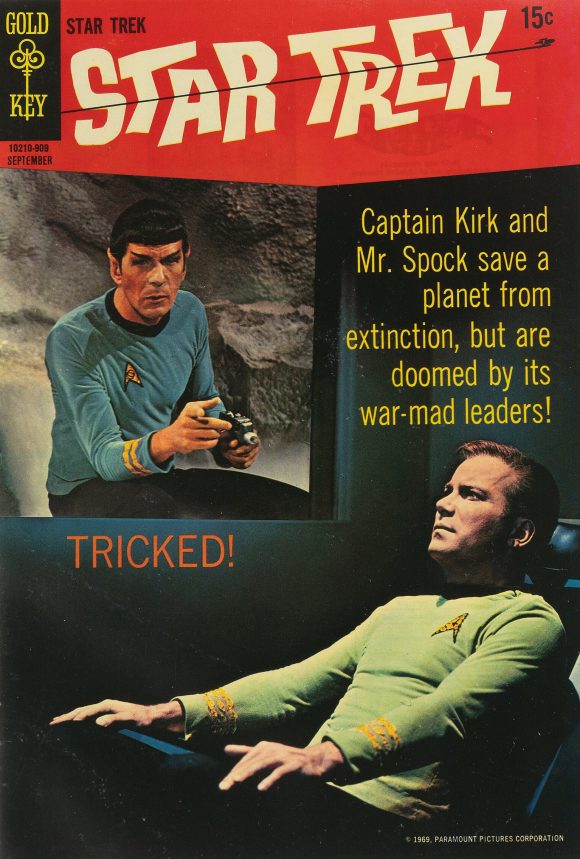
COMIC BOOK DEATH MATCH: 1966 WEEK collides with STAR TREK’s 60th Anniversary…
—
Welcome to 1966 WEEK — a 60th anniversary celebration of an extraordinary, landmark year in popular culture. For seven days, we’re bringing you a whole host of features on everything from Star Trek, to Batman, to the Beatles, to the Monkees, and much, much more. (Just check out Walt Grogan’s latest fab banner, above!) Click here for more of the far out fun! — Dan
—
By FRED VAN LENTE
Welcome back, Panel Pugilists, for a first-ever three-way COMIC BOOK DEATH MATCH battle in honor of the 60th anniversary of Star Trek, which debuted in the U.S. via NBC on September 8, 1966.
My personal history with Star Trek is a sporadic one. I watched TOS as a kid, even though my dad hated it: A naval history nut, he couldn’t get over the fact the captain aways went along with the lower ranks on landing missions, which he found ridiculous (we all have our pet bugaboos). I missed Next Generation completely, but when I came home from work at the mall the summer I spent in Syracuse, N.Y., in between college semesters, the only thing watchable on TV was Deep Space Nine, a show I fell in love with. During the pandemic lockdown I did a complete DSN rewatch, which was followed by a TOS rewatch, and since then, in my 50s, I’ve become a fairly hardcore Trekkie. Better late than never, I guess.
Mostly I’ve consumed my Star Trek on TV, as God intended, with the occasional movie thrown in, and have never actually read a Trek comic before (or read a Trek novel, or played a Trek video game, though the TTRPG from Modiphius is quite good) so this is my first perusal of the ’60s-’80s Gold Key, Marvel and DC series. In honor of Enterprise’s five-year mission, I’ll give each title five issues to wow me before I decide which is best.

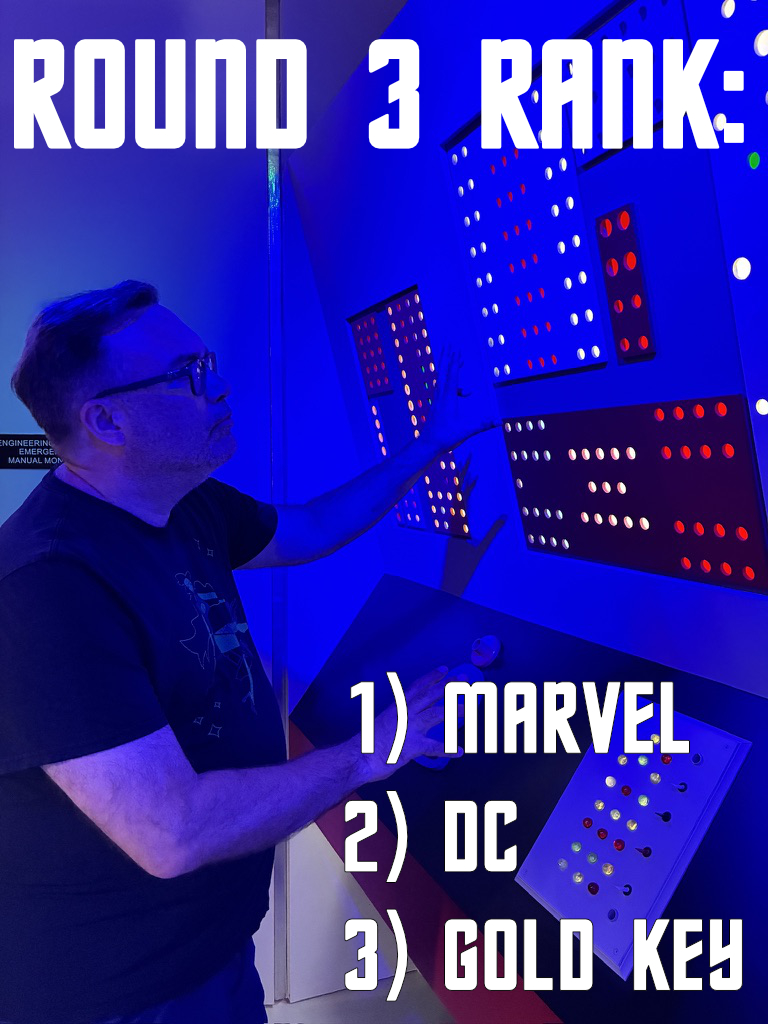
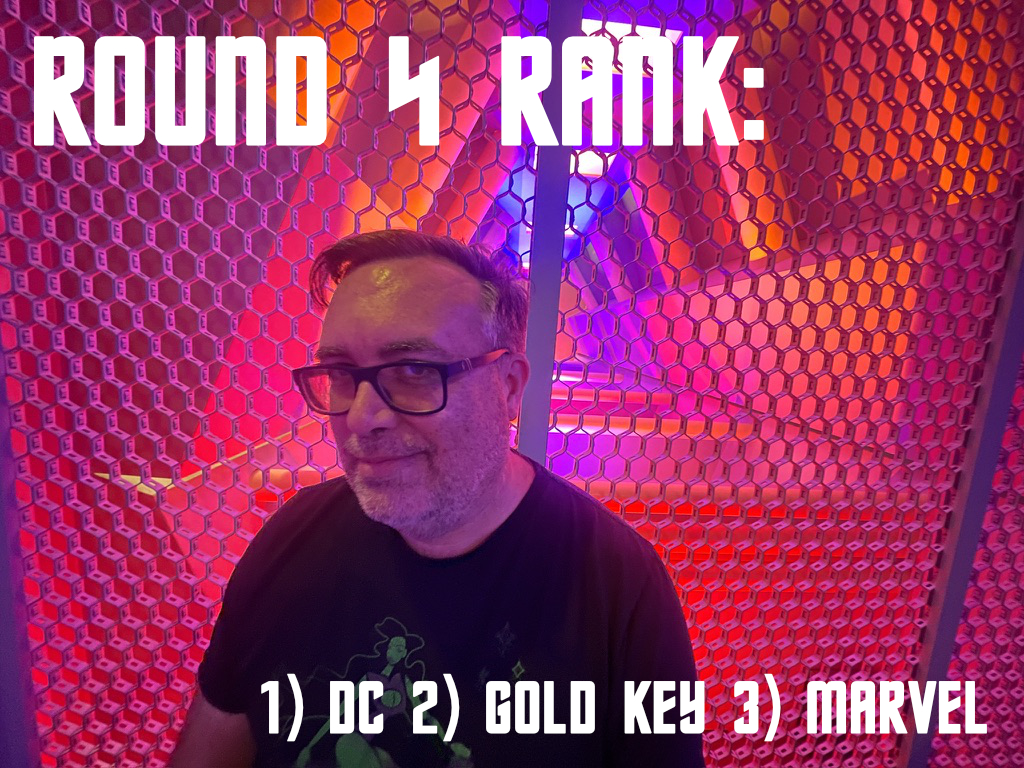
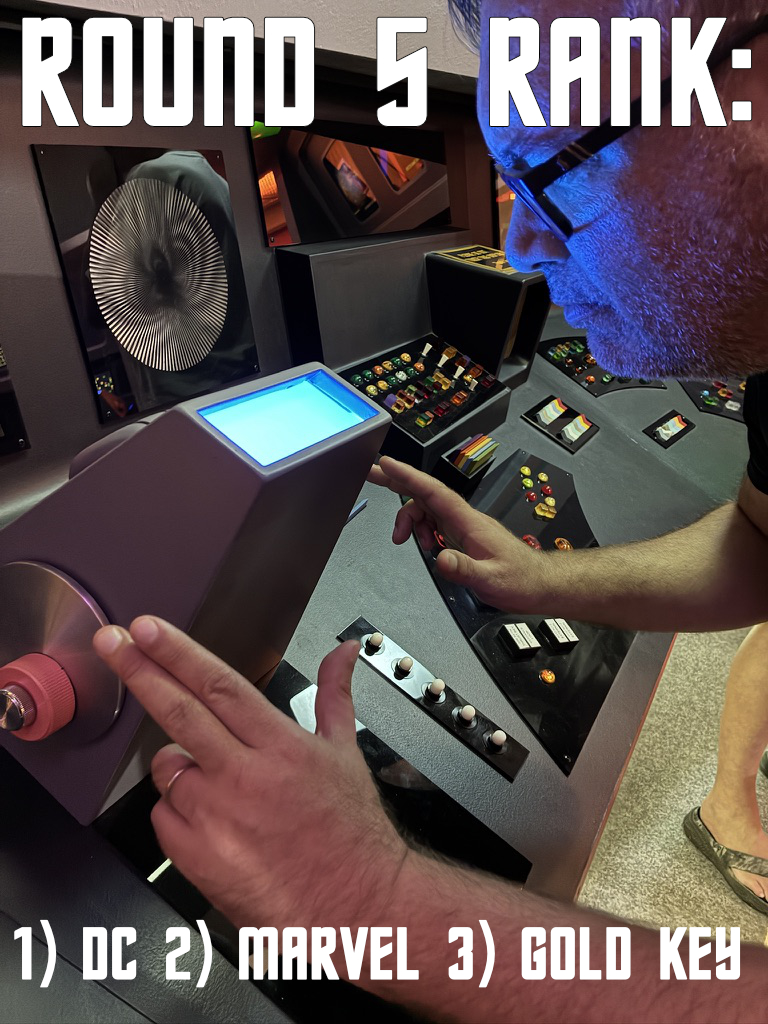
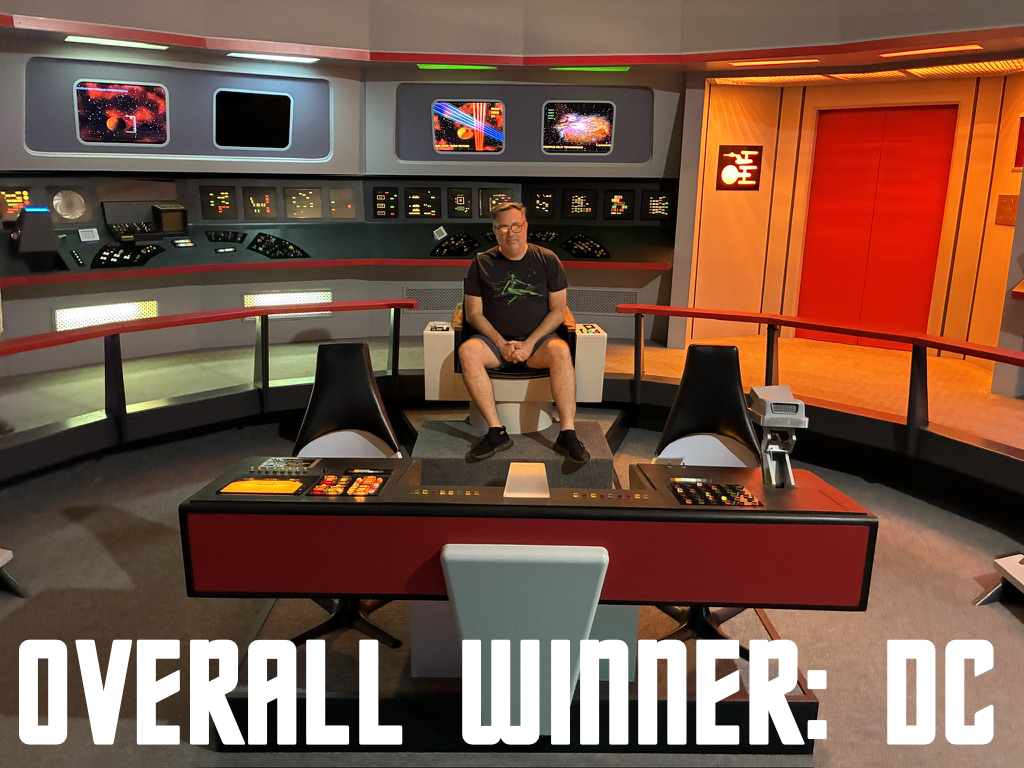
As an extra bonus, I’ll pepper the match with photos of me at the mind-blowing recreation of the TOS sets found at the Star Trek Original Series Set Tour in Ticonderoga, New York, which I had the extreme pleasure of visiting this summer. In addition to the sets itself, which you need to see to believe, the Tour has an impressive collection of costumes from both TOS and Next Gen. I was particularly thrilled to stand next to a dress worn by beloved-by-13th-Dimension Yvonne Craig as the Orion Marta in “Whom Gods Destroy.” That day I had worn my Orion dancer t-shirt given to me by the late, great S’Klallam comics artist Jeffrey Veregge, gone too soon, who specialized in geek designs with a Native American style.
So what are we waiting for? Hear that bosun’s whistle? Condition: Alert! FIGHT!
—
ROUND ONE
Star Trek #1: “The Planet of No Return” (Gold Key, 1967)
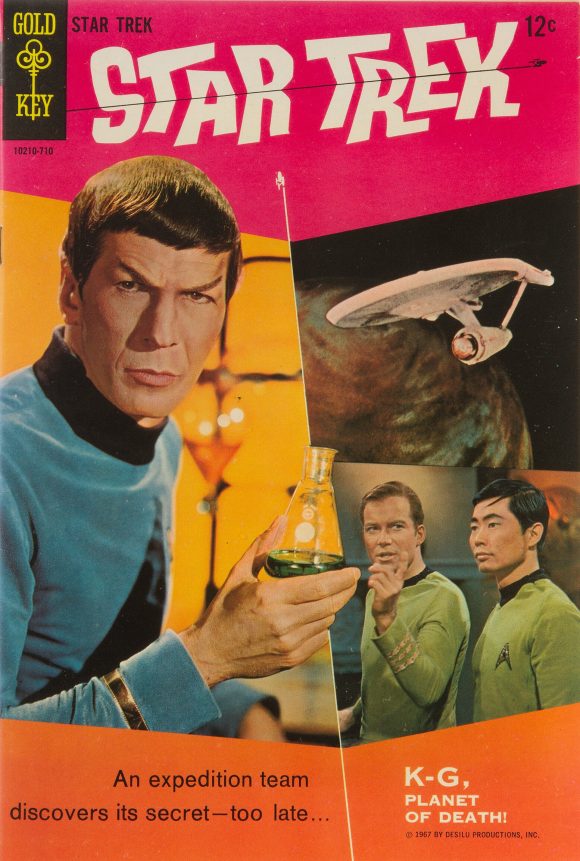
In this story by Sky Masters of the Space Force’s Dick Wood and artist Nevio Zeccara, a “space fog” of microbes that rapidly mutates animal life into killer plants has infested a planet Enterprise is exploring. (They name it “Planet KG,” after “Kelly Green,” and I was like “who’s she?” until I looked it up and realized it’s a particular shade of green…) An away team member is transformed into a giant Heap-like beast who slays another attacking plant.
They discover the plants are carnivorous and herd the animal forms like cattle to the slaughter, Yeoman Rand among them. Spock saves Janice by destroying the attacking plants with a pinpoint phaser beam from orbit. The away team beams back, and decides the only way to save “Galaxy Alpha” from the spore-emitting trees on the planet’s surface is to follow not the Prime Directive, but the Ripley Directive:
“Total destruction,” intones the Captain’s Log as Enterprise blasts the planet’s surface with death rays: “A mission that must be fulfilled before we can continue our tour of research through the vast reaches of the universe.”
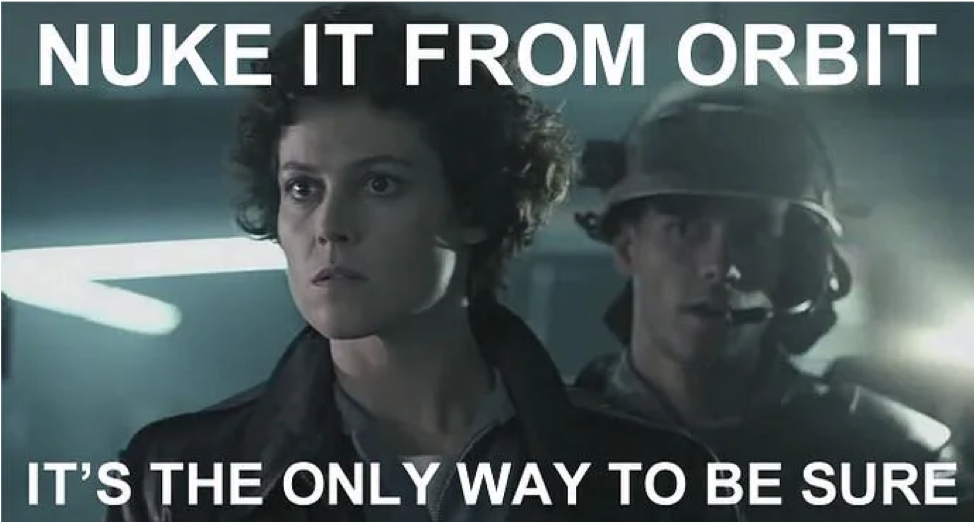
This is the least Star Trek thing ever. If this was the show, the writers would have contrived a peaceful, not-Ripley solution. It’s even less Star Trek than the green uniforms, the fact the transporters are called “the teleportation chamber,” and that nobody but Spock (and arguably Janice Rand) consistently looks on-model.
Of course, the show’s budget would have also never allowed the massive sci-fi horror action epic that Wood and Zeccara cram into 24 pages of comic book. Kudos!
—
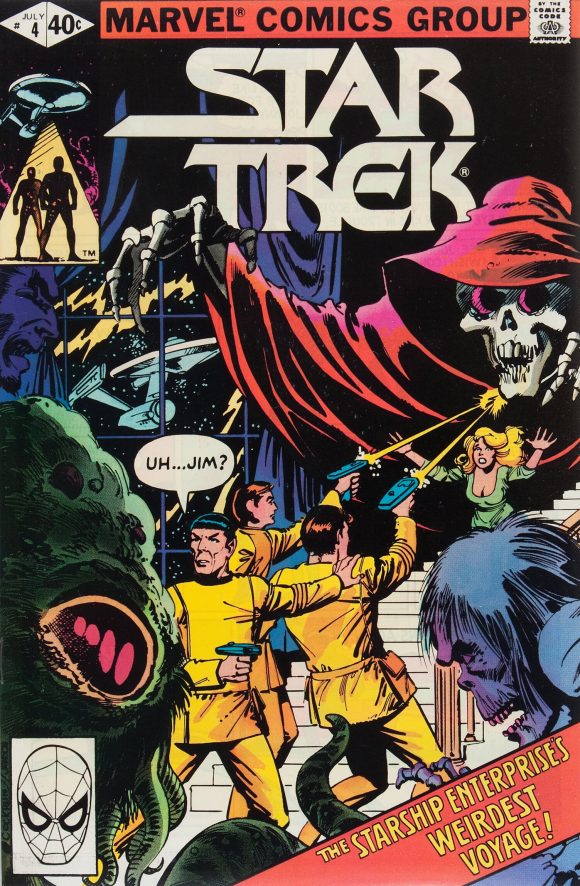
Star Trek #4: “The Haunting of Thallus” (Marvel, 1980)
“Hey Fred, why are you starting your Marvel read with #4?” I can hear you asking, and first off, how dare you question the chairman and sole member of the North American Comic Book Death Match Commission.
I’m starting here because I want this to be a fair fight, and the first three issues of the House of Ideas’ series are unfairly handicapped by being reprints of the Marvel Super Special adaptation of the 2001-wannabe snoozefest that is Star Trek: The Motion Picture. Rob Kelly does a great job summarizing the original and its Marvel version on this very site.
With the fourth issue, though, Marv Wolfman, Dave Cockrum and Klaus Janson actually get to provide us with original material, kicking the staidness of TMP out of the airlock. Enterprise is ordered to bring an orange Xenomorph back to a prison planet, only to be attacked by a Wolfman, a (Marv) Wolfman-mustachioed Dracula and a Frankenstein! Suck it, Robert Wise! The prison planet is a spooky cobweb-festooned mansion on a floating asteroid that… appears to be run by the Klingons? I have no idea what’s going on here, but as long as Kubrickian light shows are nowhere to be found, I’m happy.
—
Star Trek #1: “The Wormhole Connection” (DC, 1984)
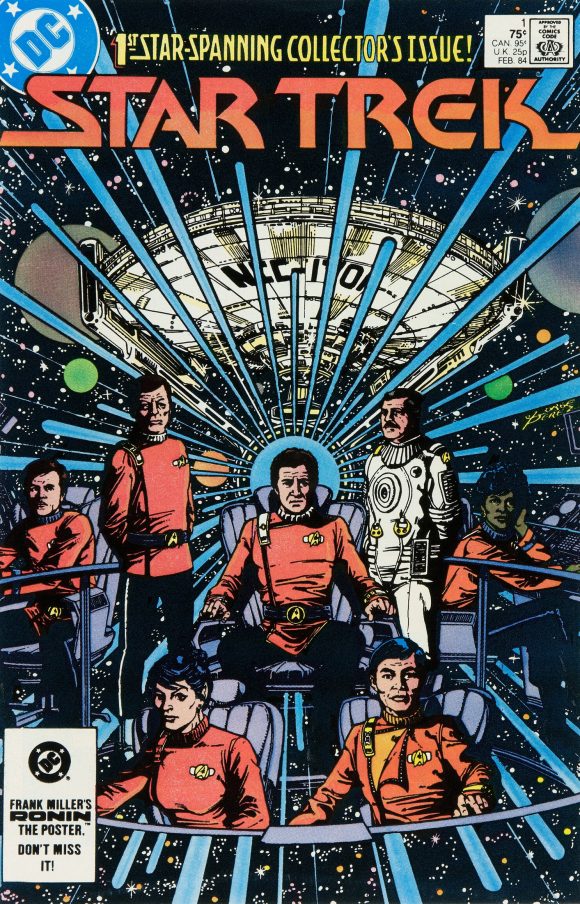
Marvel’s Trek lasted all of eighteen issues, and the Distinguished Competition wasted no time in picking up the story after Wrath of Khan, courtesy of Marvel Trek veteran Mike W. Barr, accompanied by Tom Sutton and Ricardo Villagran. Once again in command of the Enterprise, Kirk tangles with some Klingons blowing up Starfleet vessels in the not-very Neutral Zone. Much of the human—er, half-Vulcan, half-Romulan drama revolves around Saavik having a rough time settling in as replacement to the recently-deceased Spock. All 12 Saavik fans were thrilled to see her get more character development, I’m sure, but yet another Starfleet vs Klingons tale reads like a cover band that only knows one hit.

—
ROUND TWO
Star Trek #2: “The Devil’s Isle of Space” (Gold Key, 1968)
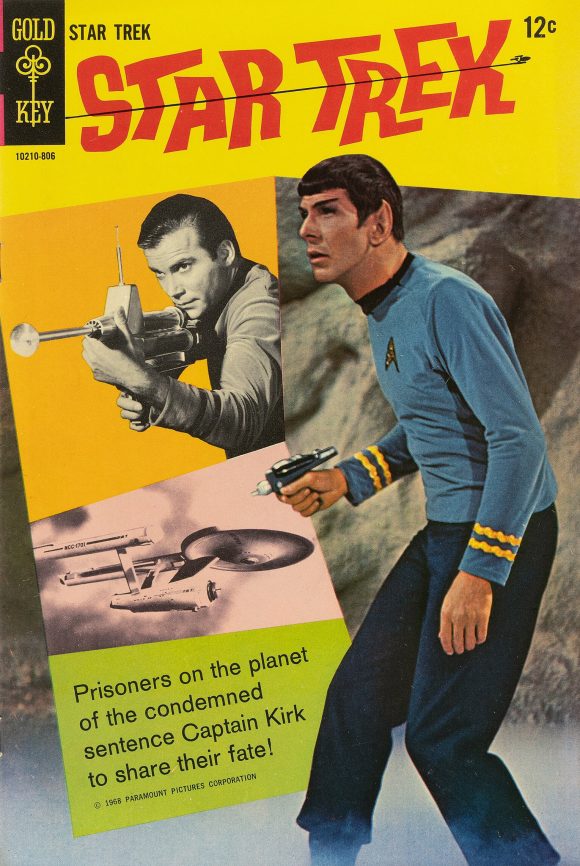
Wood and Zeccara send Murderprise to Galaxy Nabu, which, mercifully, is not infested with Jar-Jars, but does have a planet with “a huge electronic field” that grabs the ship in its grip. As per last issue, Spock hangs out on the ship doing his Alien Nerd stuff while Kirk and the landing party beam down to the surface.
James T and the Redshirts (my con band) discover the planet is a penal colony and are captured by the dominant faction of convicts. A super volcano will make the planet go “supernova” (you know, like stars normally do) in twenty-four hours, lending real urgency to the prisoners’ escape. Kirk nobly refuses to let any of these space psychos on board his ship; instead he gives Spock command, then orders him to get Murderprise as far away from planet Exploding Alcatraz as possible.
But! Kirk made Spock captain before giving him the final “order,” which means Spock outranks him and doesn’t have to do anything he says. Nyah! Instead he tricks the prisoners by dropping a phony supply shuttle onto the planet filled with a Starfleet raiding party that frees Kirk and lets Murderprise escape the planet before it blows, killing all the cons on its surface.
This one would have actually made a great episode of the show, even though for the second issue in a row a Trek story ends with the destruction of a planet and everyone on it.
—
Star Trek #5: “The Haunting of the Enterprise!” (Marvel, 1980)
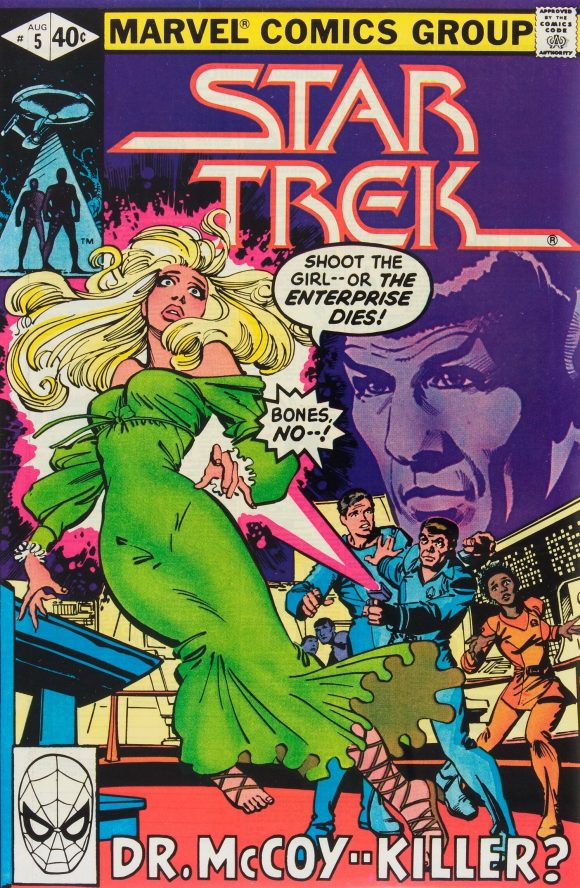
Things have gone pear-shaped for Starfleet’s Finest. The Klingons capture Spock and bring him aboard their ship while monsters overrun Enterprise. It turns out the Klingons found a “horror movie archivist” in a drifting spaceship and hooked him up to a “thought enhancer” that is sending his memories of old scare flicks to the Xenomorph in Kirk’s brig who’s acting as a transmitter to make those memories a reality. Geez, I can appreciate Wolfman’s replacements Denny O’Neil and Mike W. Barr (with Cockrum and Janson) are trying to give us a rock-em, sock-em anti-The Motion Picture adventure here, but I have no clue what’s going on.
—
Star Trek #2: “The Only Good Klingon…” (DC, 1984)
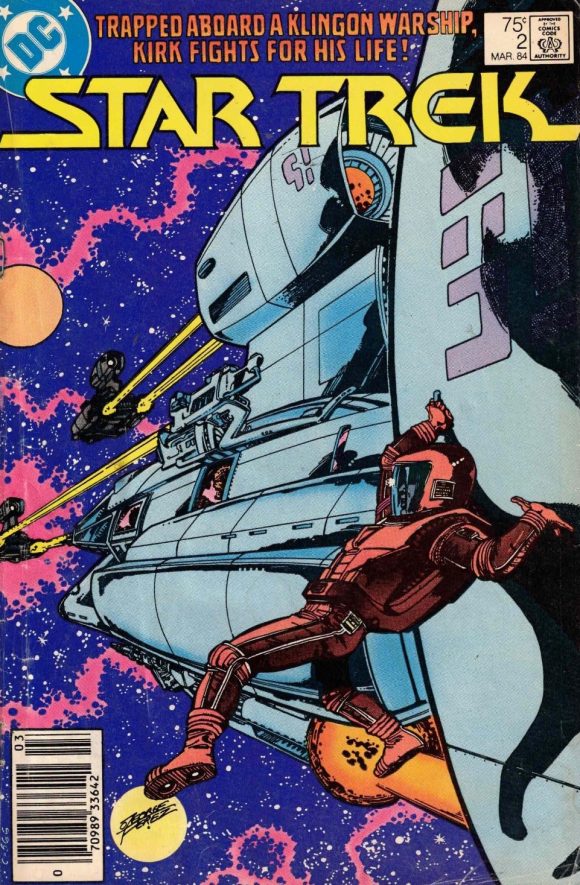
Kirk and Klingon-hating Ensign Bryce (they killed her dad) have beamed into “wormhole space” where lurks a Klingon space station running secret anti-Starfleet ops in the Neutral Zone. Bryce freezes temporarily before helping Kirk take out the Klingons that try to capture them, and he reminds her he froze once on Tycho IV, the kind of oblique TOS reference I thought I’d have to wade through a lot more of in these comics. Trekkies who show restraint, I like it!
Lt. Saavik also infiltrates the station on a shuttle and the trio beams out with a defector who is the rare Klingon pacifist. They force the space station to phase out of the wormhole, but the commander blows up the station rather than let Enterprise capture it. The furious Klingon Empire declares war on the Federation, blaming Kirk by name. Seems bad! A vast improvement by Barr and Sutton from #1.
—
ROUND THREE
Star Trek #3: “Invasion of the City Builders” (Gold Key, 1968)
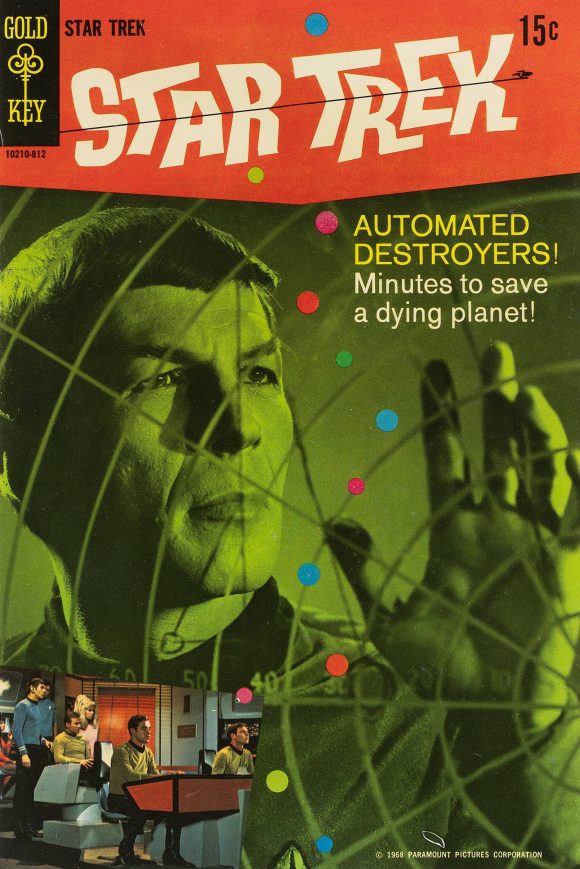
Alberto Giolitti takes over art duties. This month, Murderprise flies (literally, through the atmosphere) to “Planet Questionmark” (sic), where the natives’ machines do their farming, policing, and taxes for them. Ultimately, city-building machines arise that, once turned on, never stop building, even though said cities stand empty, since there’s not enough people to populate them.
This prescient story anticipates both our current A.I. anxiety and China’s “ghost cities.” Because machines now program other machines, the dwindling organic populace has lost the skills to shut them down. Kirk pledges Murderprise’s support in whooping robot ass via what I like to call The Magnus Directive. After some false starts, Spock sciences up a compound that weakens the builders’ metal and the robocalypse commences. The local organics saved, Murderprise flies off to a new mission of planetary destruction, perhaps slightly disappointed that they genocided half a planet’s intelligent entities this time.
—
Star Trek #6: “The Enterprise Murder Case!” (Marvel, 1980)
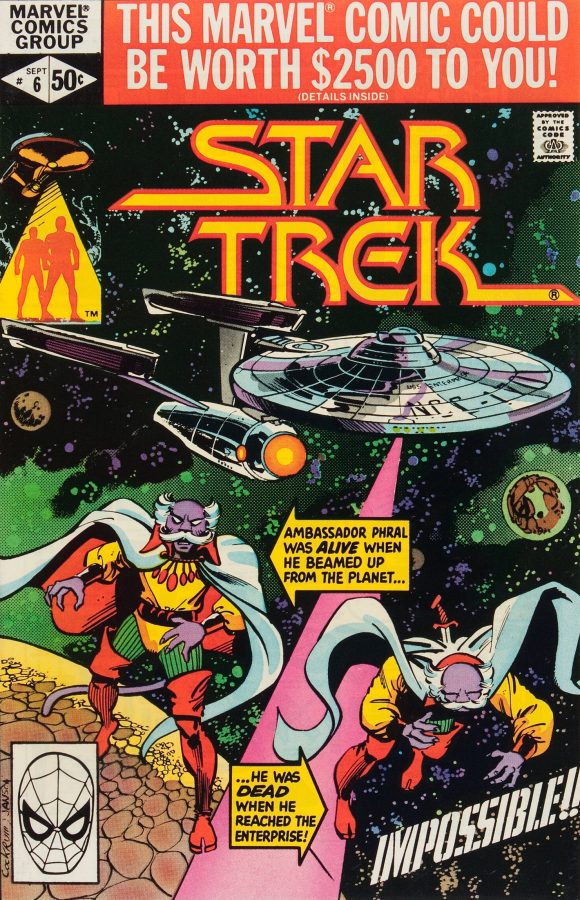
Marvel must have heard all my Murderprise cracks, because in this Barr, Cockrum and Janson joint, the ambassador from Federation member-elect planet Yannad VI gets beamed up with a knife in his back. He was fine when he left his homeworld, how did the knife get in his back in the transporter beam? Kirk is unusually cranky about this mystery, and when confronted by McCoy we learn it’s because he knew the murder victim: a stray phaser blast from Ensign Kirk while quelling a planetary uprising years ago injured the ambassador badly enough to prevent him from taking the throne. Unfortunately, with that clue, most anyone who’s read a murder mystery can now figure out the solution (the ambassador “murdered” himself to get revenge on Kirk), leaving the rest of the story to spool out without much tension.
For reasons known only to Paramount, apparently Marvel’s Star Trek license limited them to use only characters from The Motion Picture in their comics; this is used as an excuse for this series’ failings. On which I, somebody who (often) does licensed comics for a living, call bullshit. If all you’ve got is TMP, all you’ve got is Kirk, Spock, McCoy, Sulu, Uhura, Chekov, Scotty, Rand, Chapel, Vulcan (the planet), the Klingons, whatever species that bald lady was from, and the entire Enterprise herself. That’s plenty to work with for compelling story hooks, as Barr proves here. It’s the execution that’s iffy.
—
Star Trek #3: “Errand of War!” (DC, 1984)
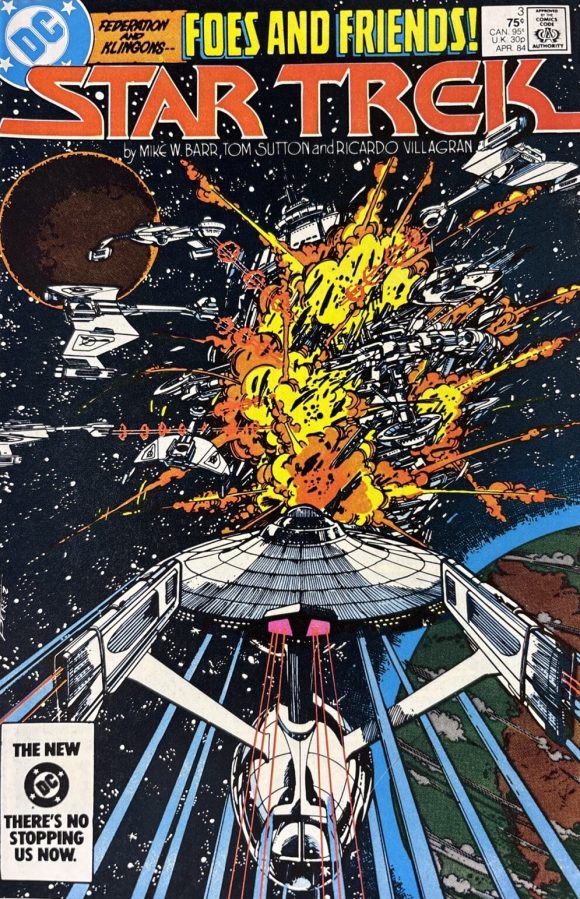
The one thing I could do with less of in Trek, next to time travel, is god-like space genies who can manipulate time, matter and energy with a snap of their fingers: your Qs, your Trelanes, your Excalbians, who thought they could determine the superiority of good or evil by pitting Kirk, Spock, Abraham Lincoln and Genghis Khan against each other like Pokémon in one of my least favorite third-season episodes, “The Savage Curtain.” (The superhero genre overly abuses this space-genie trope as well, I’d have to say.)
In this issue, Barr and Sutton reveal that the Excalbians, dissatisfied with the results of “Curtain,” have manipulated the Klingons and Federation into declaring war on each other by impersonating each other’s leaders. They broadcast vicious propaganda that causes a riot on Enterprise and the near-lynching of the pacifist Klingon still on board. Kirk figures out he’s being manipulated soon enough, and recruits Klingon Captain Kor, his sparring partner in “Errand of Mercy,” the excellent episode that introduces the Klingons, into exposing the aliens’ subterfuge. On the show, the Excalbians are poo-piles of steaming lava; here Sutton renders them as humanoid geodes, which makes the proceedings all the more surreal.
—
ROUND FOUR
Star Trek #4: “The Peril of Planet Quick Change” (Gold Key, 1969)
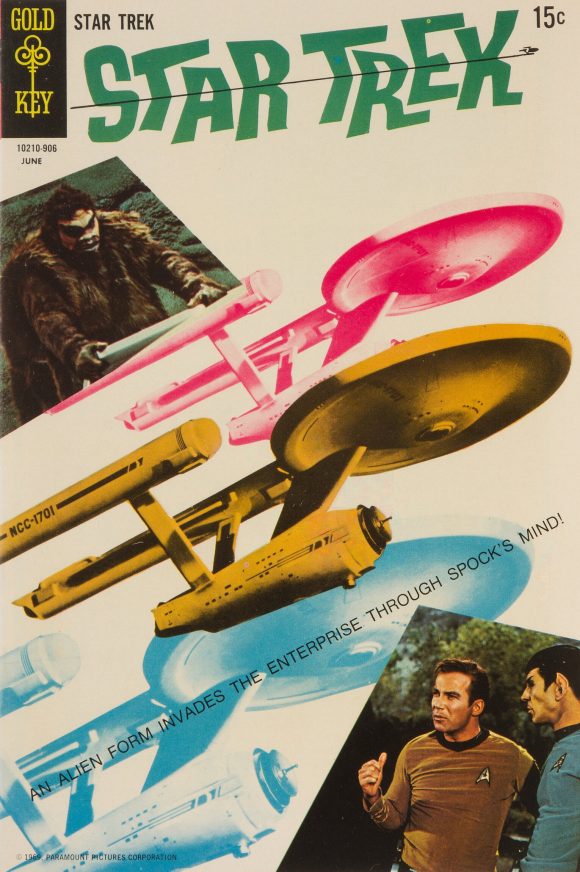
Kirk & Co. beam down to a constantly evolving planet in search of “Tiantianium,” which can power a spaceship for a year (dilithium crystals must not have been in the stack of old TV Guides that, as far as I can tell, were all Dick Wood had to go on for research). Spock is acting weirder than usual, though, insisting the crew figure out a way to fix the planet’s many changes before extracting the “TI” ore.
Turns out the Science Officer has been possessed by the glowing balls of light that are all that remain of the planet’s original inhabitants, zapped by a weird meteorite. They’ve shanghaied Spock’s body (not to be confused with “Spock’s Brain“) because his Vulcan hardware and their alien software are simpatico.
Once the natives are restored to flesh-and-blood form, however, the evilest Ball of Light remains inside Spock, because he wants to leave this dumb planet and go partying in space. Back on Murderprise, though, Spock manages to seal himself into the “teleportation chamber” (transporters also not being in the TV Guides) and he uses it to separate himself from the alien freeloader. Transporter mishaps have been a stock Trek episode hook since TOS Season One, and I like how Wood uses one to resolve a conflict.
—
Star Trek #7: “Tomorrow or Yesterday” (Marvel, 1980)
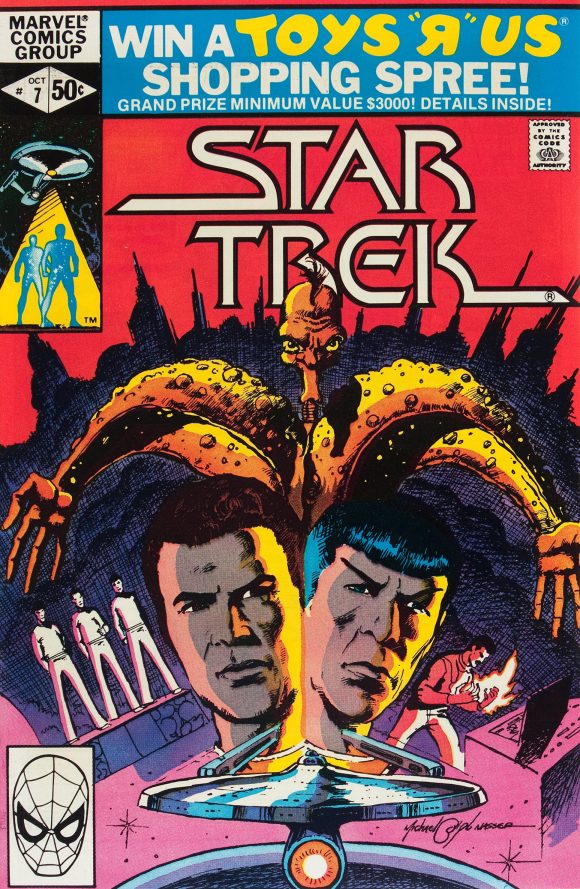
Tom DeFalco and Mike Nasser take the conn, with Janson still on inks, telling the story of Andrea IV, a planet in the path of a deadly radioactive cloud. Kirk, Spock and McCoy beam down to evacuate the population, only to discover there’s ancient statues of the three of them already there! The landing party figures out that the seemingly primitive Andreans (Prime Directive? Hello?) experience time in toto as opposed to sequentially, so they both anticipated Enterprise’s arrival and built the doohickeys necessary to save their planet from the cloud. For some reason, though, the device requires the temporally locked crew to throw the “on” switch.
—
Star Trek #4: “Deadly Allies!” (DC, 1984)
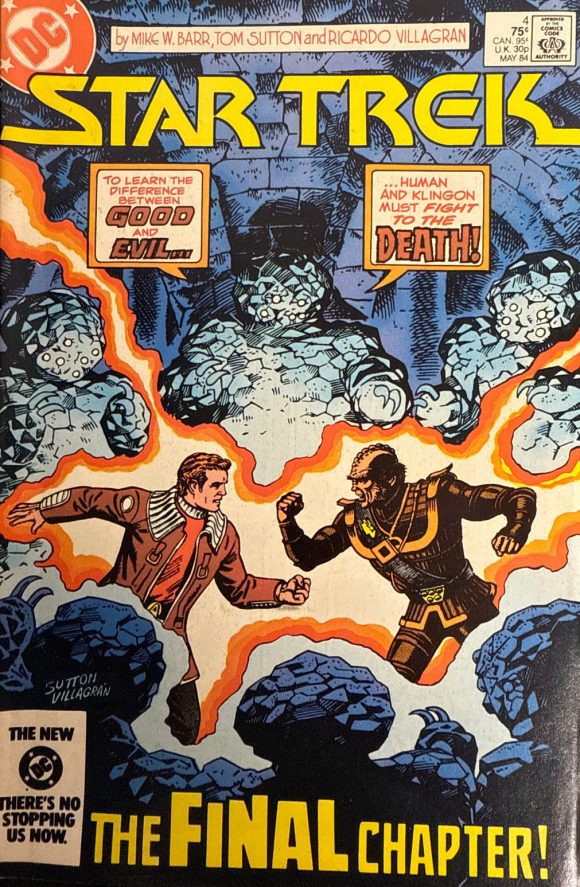
Kor and Kirk join forces to track down the Excalbians by heading to Organia, where their space genies forced a treaty on the Federation and the Empire in the latter’s first appearance, a truce all Trekkies have been whining about being violated in the Marvel and DC lettercols since both series began.
Once the Klingons and Starfleet arrive on the planet, the admiral gives a big speech in classic Kirkian fashion, successfully daring the Excalbians to pick on someone their own size, and take on the Organians in a War of the Space Genies to truly determine this good versus evil stuff. My one gripe with this fun issue from Barr, Sutton and Villagran is that colorist Michele Wolfman has all the Klingons be bright lemon-yellow for some reason.
—
ROUND FIVE
Star Trek #5: “The Ghost Planet” (Gold Key, 1969)
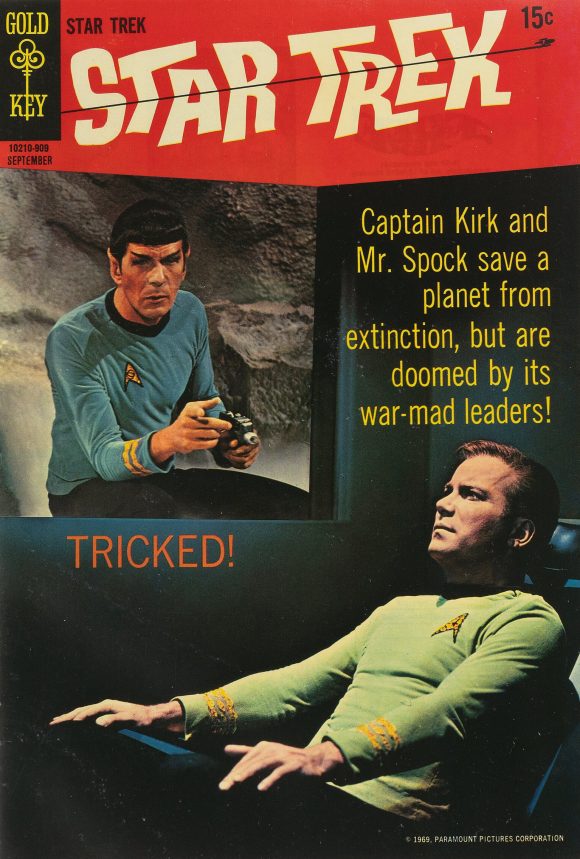
“Secure seat belts!” is my favorite Captain Kirk command in any series so far, as Murderprise is sucked into the rainbow rings encircling what appears at first sensor-glance to be a barren planet with an empty city. Big-headed “twin supremes” of Planet Numero Uno (Wood puts a lot of effort into his planet names) have engaged in a deadly civil war that caused the factions to retreat to twin orbiting satellites. Murderprise manages to drag the radiation-emitting rings into space and the factions immediately recommence hostilities, but then the rings return. Murderprise says they can turn the rings back on whenever they feel like it, so they’d better start making nice or they’re gonna get it. Turns out this is a ruse by Spock: He played old movies of the rings onto the atmosphere to make the combatants give up their arms.
—
Star Trek #8: “The Expansionist Syndrome” (Marvel, 1980)
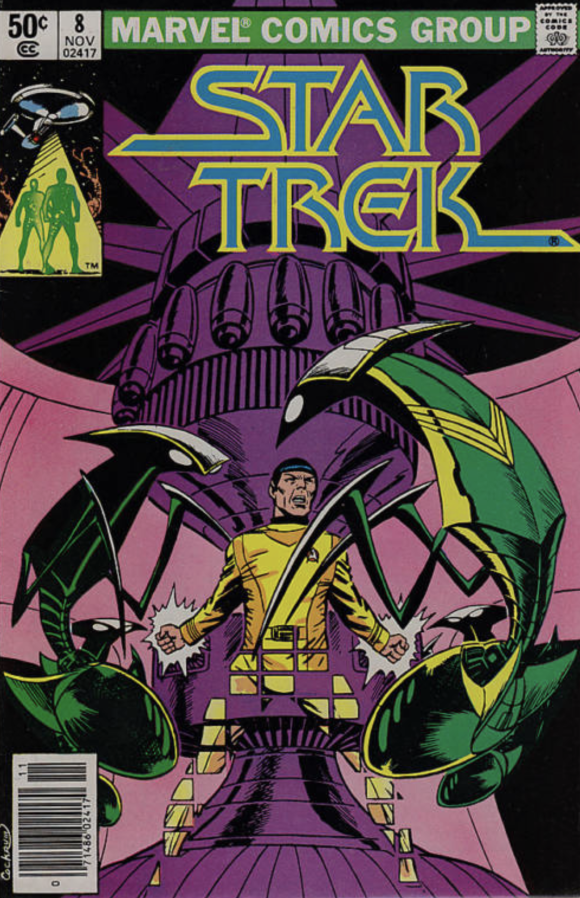
Poor Spock, he keeps getting hijacked by aliens! In this story by Martin Pasko, Cockrum, and Ricardo Villamonte, it’s the Mox of Agena IV who zap Spock onto their ship, after disabling Enterprise’s matter/antimatter generators for intruding into their territory. Kirk and a landing party beam down to the planet to look for him, recruiting a member of the “Orgs,” a rival race, as a guide into the very cool Cockrum-designed Mox city. (The design of the Mox themselves are pretty cool, too — that’s them on the cover.)
Our heroes noodle out that the “Mox” are machines and the “Orgs” are organic creatures. The Orgs resent the Mox for living in “comfort” (because they have no organic needs) while the Orgs struggle to feed and clothe themselves. Committed pacifists, the Mox snatched Spock hoping to use his Vulcan telepathy to non-violently quell an Org invasion force. When this fails, a scientist stuck in Enterprise’s sick bay beams down to try and defuse the conflict, as without being able to travel to a starbase for medical treatment, she’ll die anyway.
This script could’ve used another draft. There’s a lot of great ideas here, but the resolution is rushed and muddled.
—
Star Trek #5: “Mortal Gods” (DC, 1984)
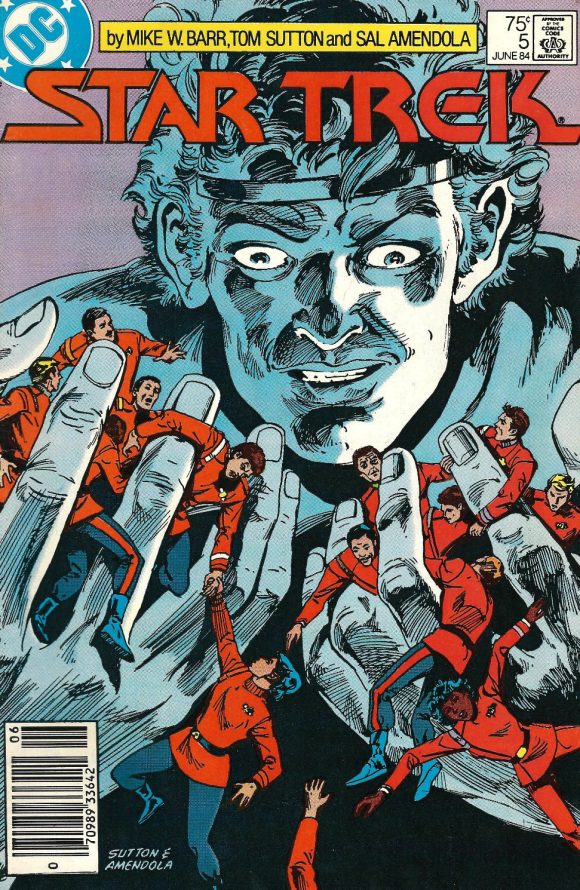
In the best of this trifecta of planetary civil war stories, Barr, Sutton and Sal Amendola have Enterprise discovering a crashed Starfleet captain has cornholed the Prime Directive by taking over a primitive planet as a pseudo sky god. The captain has used his godly authority to quell the world’s two dueling factions but the landing party’s arrival puts the lie to his divinity, jump-starting the conflict and forcing Kirk, Saavik and crew to save the day.
—
THE VERDICT: Gold Key’s stories are banana-pants, equal parts exhilarating and exhausting; Marvel never really found its footing post-TMP; while, to my shock, replacing Spock with Saavik made DC’s stories refreshingly different Trek fare for a brief era rarely fleshed out in any other medium.
—
MORE
— The Complete 1966 WEEK INDEX of Features. Click here.
— The TOP 13 STAR TREK Episodes — RANKED. Click here.
— The TOP 13 STAR TREK Episodes: THE BEST OF THE REST. Click here.

News reported through various sources and compiled with AI. This is automatically generated news content from known, popular, and reliable sources available at the time of publication.
We do not take any responsibility for, nor make any representations regarding, the accuracy, completeness, credibility, or
reliability of the content.
In case of any discrepancy, error, or copyright claim, we will promptly review and remove the content in question where appropriate.
We do not claim ownership of third-party content and assume no responsibility or liability whatsoever for any information contained herein. The credit, links and images are kept intact as an honest gesture, are property of its respective owners.