
 Editor's Desk




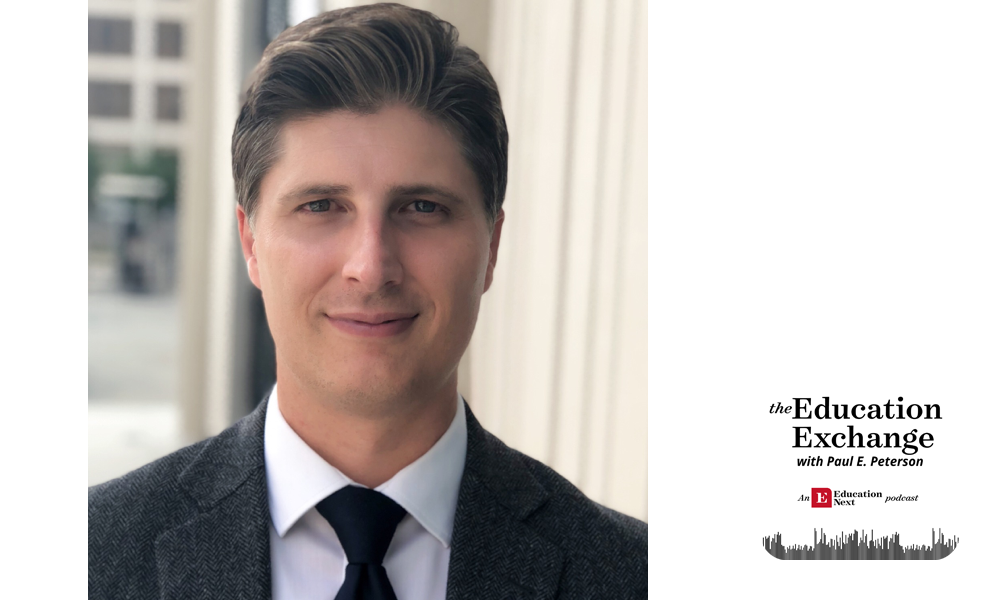
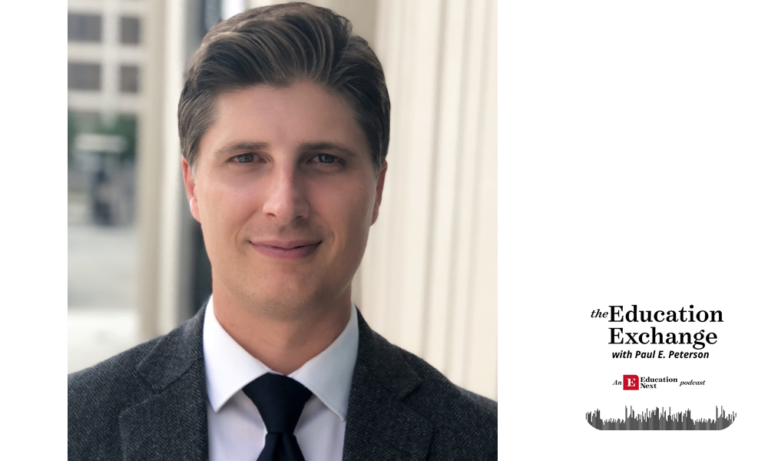
Dan Hamlin, the dean of the College of Education at the University of Texas, joins Paul E. Peterson to discuss Hamlin’s latest research, which looks to measure the growth and impact of microschools in the United States.
The study “Measuring the Microschool Experience: A National Analysis of Student Experiences, Family Perspectives, and Learning Outcomes,” will be presented during the Emerging School Models: Broadening the Landscape for Choice conference, to be held by the Harvard Kennedy School’s Program on Education Policy and Governance in Cambridge, Mass., on Sept. 17 and 18, 2026.
Visit the conference page for information on how to attend, as well as the full agenda.
Follow The Education Exchange on Soundcloud, Apple Podcasts, Spotify, YouTube, or here on Education Next.
— Education Next
Transcript
PAUL PETERSON, HOST:
This is the Education Exchange with Paul Peterson. I am the director of the Program on Education Policy and Governance at Harvard University. Thank you for joining us. Microschools. Microschools are currently the hottest topic in the homeschool space. They may have only a million students or so, but they are growing in number and in the number of students they have. And they’re probably the most rapidly growing sector of all the sectors in the educational space. And they’ve suddenly become controversial. Microschools seem to be excluded from the federal tax credit scholarship program, according to the regulations that are out there by the U.S. Treasury Department. Now, these can all be changed before they go into effect on January 1, 2027. But microschoolers are worried that they’re not going to be able to collect tuition and have reimbursement through the federal tax credit scholarship program because they’re not officially defined as a private school. So, this is a topic that makes microschools so very interesting in general, but we know nothing about it. Well, or we did know nothing about it until the recent report entitled “Measuring the Microschool Experience,” which has been prepared by Daniel Hamlin working with the National Microschooling Center. And that provides us with the very first empirical data that I know of that tells us what’s happening across the country in the microschool space. Daniel is the dean of the School of Education at the University of Texas in Austin, Texas. And he’s also co-moderating with me a forthcoming conference on microschools and many other topics in the school choice space at a conference entitled Chartering a New Terrain. It’s being held at Harvard University on September 17th and September 18th. You can see the agenda by going to the homepage. Some of you may want to register in person, and those of you who can’t make it can register online. So, I’m pleased to have Daniel Hamlin, a good friend, of course. He’s with me on the Education Exchange today. Thank you, Daniel, for joining us.
DANIEL HAMLIN: Hey, Paul. It’s great to be here with you.
PETERSON: Well, Daniel, the first question is, what is a microschool?
HAMLIN: Well, that’s actually a more complicated question than most people will think. But I think generally speaking, a microschool can be thought of as a small school. Typically, the average microschool has about 22 students on average. That’s total enrollment. So, these are small schools where personalized learning, individual attention, and close relationships are often an emphasis. And so there are really diverse ranges, as you might imagine, of these small schools all around the country that have different philosophies, missions, areas of concentration. So, it’s probably the most decentralized and diverse sector within the American education landscape right now.
PETERSON: Well, do you have to register with your local school district in order to go to a microschool?
HAMLIN: Well, it depends on the state. So, I think sometimes microschooling rightly it’s sometimes it gets conflated with homeschooling. And I think it’s a little bit different than homeschooling in that you have students who are going to a school. And sometimes this might be a school might be a public library where school is held or it might be in a church. So school is loosely defined or even in some cases in someone’s home. But they’re going somewhere to learn for the day. I think, you know, there’s just some of these definitions get really blurry because you may have microschools that operate three times a week, and then the other two days, the family is homeschooling the child. So—
PETERSON: My daughter actually set up homeschooling with her neighbors during Covid. She was sort of outraged at having the school shut down. So, she and her friends set up shop, and the kids would go from one house to the other or apartment they were in New York City and homeschool each other’s kids. But is that a microschool?
HAMLIN: I don’t, I wouldn’t call that a micro, I would think that that’s more closely associated with typical homeschooling or some aspect of homeschooling where you have a co-op where parents get together and the parents themselves are delivering instruction. I think you could think of your typical microschool, if there is such a thing, as having a teacher where the teacher or the founder of the microschool is providing instruction to the children and the parents aren’t necessarily participating in that in the same way that your daughter did.
PETERSON: Well, what age are the children in these schools? Are they all sort of like six and seven years of age, or are they high schoolers? What’s the age range?
HAMLIN: It’s a wide range. So, it mirrors the public education system. So, you see everything from pre-kindergarten right up to 18 years old.
PETERSON: Now, I was fascinated by your finding that a very high percentage of people who make use of microschools are people who have a child with some kind of a special education need. Can you elaborate on that a bit?
HAMLIN: Yeah, I think that’s what’s interesting about this research that I’ve been able to do recently. And it’s really changed my perspective entirely on the microschooling sector, because what you find is almost half of the kids, at least in the sample of schools and students that I had, almost half were identified either by their families or by their school as having a disability or being eligible for an IEP. And so, you know, when you think about the sector in those terms, that really gets you thinking about what are truly the measures of success? Why are parents choosing to send their kids to a microschool? And it really gets you thinking about just the nature of the type of students that microschools are educating.
PETERSON: Do you know what kind of, you know, special education, disability, that’s a big word, covers a lot of fronts? Do we have any idea of the kinds of disabilities that are most frequently mentioned?
HAMLIN: Well, in the work that I did, I didn’t go to that next level, which was to find out exactly what is the level of disability. I think there’s been some work that’s been done by the National Microschooling Center that does look at that. And it really finds a range, almost like what you would see in public schools. Although, while it has that same range, the proportion of students who are needing a little bit extra because they have a disability is much higher than what you’d see in a public school.
PETERSON: Well, let’s talk a little bit about the data that you’re working with. You work with the National Microschooling Center to gather this information. So, this is an advocacy group or a group that is sort of, you know, a collection of microschools. So, could you describe the center, and then could you describe the data collection method that you used?
HAMLIN: Yeah, that’s a really good thing to bring up. So first I would say it is very hard to study microschools because they’re so decentralized. It’s difficult as a researcher to be able to contact them, build trust in order to be able to study their student population. And so working with the National Microschooling Center was really important. They have about a thousand plus member schools that work with them. So, they were able to facilitate the study by reaching out to member schools to be able to, and ask them to participate in this study. And so we ended up doing a student assessment, a student survey, and a parent survey, but that was done through the National Microschooling Center.
PETERSON: So, how many schools belong to the National Microschooling Center?
HAMLIN: Yeah, so it’s about, they claim about a thousand plus members.
PETERSON: It’s a thousand schools, and then how many students?
HAMLIN: Well, the National Microschooling Center estimates that there are about 1.5 million students attending microschools nationwide. There have been some other more modest estimates that put that number at about 1 million students. And Paul, if I’m being totally honest, I don’t know if we really truly know. What the National Microschooling Center does is they do a survey of all of its member schools and then ask those member schools to report their enrollments. And so that’s how they come to their estimate of 1.5 million students. But I think, we just, I don’t know if we’ve… We don’t have a good system in place across the country that helps us to, one, identify where all these microschools are and to accurately be able to assess how many students are in the microschools. We also have situations where you have part-time and full-time microschool students, so that complicates things further. And then some of the blurriness that we’ve already discussed related to microschooling and homeschooling. So, this is this is a big challenge. But that range is based on the best estimates that we have between 1 million and 1.5 million.
PETERSON: All right. So, are microschools defined as private schools or is that…are they different from private schools?
HAMLIN: Well, I think you can in most cases, Paul, you can think of them as a private school that just happens to be a lot smaller than your average private school because they may, like I said earlier, have an average of about 22 students. But it operates similarly in terms of collecting tuition and fees from families in order to be able to run the school. There are, however, microschools that have a charter. So, they’re actually public microschools that operate as a public charter school. There are some microschools, as I understand it, that have arrangements with local school districts. So, what you may have is, let’s say you have a local school district that has an underutilized school building, and then you might have a microschool housed within it that’s separately serving a subgroup of students within a school that’s underutilized within a district run public school. And then you have these combinations of home and microschools. So, it really depends. But I would say, Paul, in most cases, we can think of these as small private schools.
PETERSON: Well, Daniel, the most famous microschool in the country, I think, is the one that is being run by of Facebook fame. The Palo Alto School District went after them for violation of something or other. And they moved out of that area, but they still have their microschool. So, you know, that might lead you to believe that microschools are for rich kids. Is that true? Or how true can that be? I mean, do you have any thoughts on that?
HAMLIN: Yeah, well, like any highly diverse, decentralized school sector, it’s very difficult to generalize. And sometimes the headlines in the media aren’t very closely associated with the reality of these types of schools. So I would say this. In my sample, where I have roughly about 500 students spread across 40 different microschools, on average, if you look at measures of family income or measures of socioeconomic status, it does seem to be the case that microschool students or families are a little bit more affluent than what you would find on average if you were to compare them to, say, the public education system. But I don’t think these are just for the affluent, because in the sample, there’s definitely plenty of low-income families, plenty, a fair proportion of families in the sample who come from a single-parent household or who come from families where the highest level of education is a high school level of education. So, I’ll give you an example of this. At least 10 percent of the families in my sample…they had the highest level of education was a high school degree or less. And about another 23 percent just had some college. So again, the story is a little bit more nuanced, but I would say that they do appear to be a little bit more affluent than what’s typical if you were just to compare them to the public education system overall.
PETERSON: Well, a lot of people think that homeschooling is sort of an evangelical Protestant kind of activity and that this is probably a spinoff from that. So how about the religious identification of these schools and these families that participate in the microschool world?
HAMLIN: Well, we did a parent survey in conjunction with the National Microschooling Center and asked parent caregivers, “Why did you choose a microschool?” with one of the reasons listed being religious or faith-based instruction. And I think only a third of respondents identified that as one of the reasons out of many different reasons. I think one of the differences between small microschools, let’s say, and the typical private school sector in the United States is that they’re less religious. So, for example, in the private school sector in the United States, you have quite a few Christian schools. And then, of course, you have a large proportion of private schools in the United States are Catholic schools. And this does not appear to be the case in the microschool center. This is quite different. And when you ask parents, “What is the number one reason why, if you have to select just one reason, why you opted for a microschool?” religious or faith-based instruction, I think just 3 percent of families chose that as the main reason, whereas about a third of families identify individualized attention for their child as the number one reason, and positive schools culture as another one that’s very frequently identified.
PETERSON: Well, that fits in with the fact that so many of these students seem to be in need of special education. This individualized attention is what the family is looking for. What are some of the other reasons parents give for selecting a micro… I know there were a whole list that you asked about, but what were some of the top ones?
HAMLIN: That’s right. So, some of the top ones: positive school culture; small size, not terribly surprising; a safe school environment; hands-on learning; a focus on non-academic skills. And so those are some of the big ones. And if you think about that, it comports, because it matches with the types of … You can imagine you have students who maybe are in— they’re in a 400-, 300-, 500-person elementary school, and a lot of these kids have special needs or disabilities. And you can imagine it’s easy to get lost in the shuffle in those schools. And so the parents take them out. They put them in a much smaller microschool where the teacher is individually working with all of the children every day, just by nature of the school being so small and the school by nature of it being so small is able to tailor things to the individual needs of these kids who, on average, appear to have very specific needs. And so I think it all kind of, when you look at the survey data from students, from parents, it really starts to kind of match up.
PETERSON: What do they say they like the best about the microschools?
HAMLIN: Well, the thing that they like the best is the individualized attention. So, if they’re given a range of different options, that’s the thing that comes out on top by far and away.
PETERSON: How about the least?
HAMLIN: The least? I think religious or faith-based instruction comes out as not being a commonly selected item. I also asked about whether it’s an affordable option. That one was not selected as much, which surprised me for different reasons. One of the options was high academic standards. That didn’t come out as much. And again, I think if you think about the student population, you might say, well, why do … parents are selecting high academic standards less than some of these other things? But if you think about this particular subgroup of students, it starts to make sense.
PETERSON: So, do the students like the schools?
HAMLIN: That’s a really good question. And I have to say, I’ve done a lot of school climate analyses of school climate surveys over the years, including student perceptions of their school climate. And I don’t know if I’ve ever seen such positive results from students when reporting on the climate of their school. So when students are asked about how safe they feel, whether they’re academically engaged, whether they feel like they’re involved in instruction, whether they enjoy school, whether they have friends, I mean, just incredibly high ratings from the students, as well as for the parents. So I’ll give you an example of this. I asked the parents lots of different questions about different aspects of the microschool, of their child’s microschool, but then also just ask your typical bread-and-butter satisfaction questions. “How satisfied are you with the teacher … the overall experience … the facilities?” And I think to give you an example of this, so 97 percent of parents who participated in my survey said that they were either satisfied or very satisfied with their child—… with the overall microschool experience that their child—
PETERSON: Maybe all the unhappy ones had left.
HAMLIN: Well, I mean, so that’s the other part of this. So, yes, that’s a very good point. So the results look very positive. But for your listeners, I think, we have to underscore a big caution here because this is very much an exploratory study, a highly selected sample where we basically were able to reach out to a range of microschools who chose to opt into. So these are going to be the ones that opt in—
PETERSON: You didn’t have to fill out this questionnaire. That wasn’t required from the school of every parent. They invited them to do this.
HAMLIN: Yeah, well, they did. But I think the bigger selection concern here is not within schools, the parents who participated, because within schools we had very high rates of participation of parents and students it was more the schools themselves who chose to participate in the study and so those schools that said hey we’re not we don’t we’re not interested in this. Maybe they’re different maybe they’re having greater struggles with parent and student attrition. And so we just have to be really careful with what we … the broader conclusions we draw about the sector from this analysis because of that.
PETERSON: How about the price tag? How much tuition? What’s the tuition charge there? I know in private schools, you can pay $60,000 a year pretty easily. Is that the same in these microschools?
HAMLIN: It’s really a wide range, Paul, from what I’ve seen. And the National Microschooling Center’s annual report breaks all of this down. I don’t look at this, but it ranges, I’ve seen anywhere from as low as $8,000. It can get up to, you know, into the $20,000, $25,000 or more per year, just depending on the microschool. So that’s an important issue as well.
PETERSON: But it’s not just it’s not a cheap thing. It’s not like you can do microschooling for a couple thousand dollars. You have to put some skin in the game.
HAMLIN: Yeah, I mean, there are some interesting models out there that try to do it for really cheap, in the four- or five-thousand-dollar range. And they … those schools will rely very heavily on technology so that virtual learning is a really huge component of everything that they do. But for the schools that are providing in-person instruction, it’s…I guess I wouldn’t say it’s not that it’s expensive. It just varies. So you see schools just doing this in all sorts of different ways, depending on the services they provide and depending on the families they serve. And this is a really interesting aspect. The cost, the financial part about this is something your listeners should be aware of, because I’ve looked at some of the outlays for microschools. And so, you know, let’s say you’re charging $12,000. You have in your state, that’s, you know, kind of the going rate. Well, if you have 22 students, you’re operating on very thin margins. If you lose one or two students in any given year, you could be out of business. And so, what’s relevant for that is you can imagine that microschool founders have to be extremely responsive to families and students because you lose one or two of them, you might be done.
PETERSON: So, is this scalable? I mean, at this. point, there’s a million or a million and a half, but how big can it get? I mean, a lot of families, the parents are working. How can they use a microschool, which probably requires a lot of family engagement? Will people really buy into this form of instruction?
HAMLIN: Well, it’s a good question. I think that if you look at the growth in recent years, and if the estimates are true that there is 1.5 million students, then that unto itself is evidence that these things can scale maybe more than what people might have thought, say, even just 20 years ago. The other component of this is the private school choice programs that a lot of states have enacted post-pandemic. So you can think about your tax credit scholarship programs, your education savings account programs. A lot of these programs out there allow microschools to participate. And so if you say, if your state has an education savings account where the family has access to $10,000 a year to pay for tuition, well, that makes this much more scalable for a much broader, much larger group of families. On the other side of this, while I do think this is going to continue to be appealing to a very large number of families across the country for a whole range of different reasons, special needs being one of the big ones, I think you’re going to find a lot of families who still want the traditional experience. They want their child to be on the cheerleading squad or on the football team. They want the range of different advanced placement courses that are available in a typical high school. So I think you’re just going to see a mix. But I think if you’re saying, well, is it scalable? If the estimates are true, we’re seeing scale.
PETERSON: Well, so that brings in the federal tax credit scholarship program that’s going to launch in January. It would seem to me whether or not microschools are eligible is going to be a big deal for these institutions.
HAMLIN: Yeah, I mean, it could matter, but I think folks need to keep in mind that the federal tax credit isn’t a large credit relative to your average school’s tuition and fees. So I think what we’re talking about here is $1,700. Now, I think from a layering standpoint, it’s important because if you are getting $10,000 for an ESA, and then you layer in $1,700, maybe that changes the calculus on a school for a family. But I don’t know. I think the guidance on some of this stuff is still being fleshed out. In fact, I know it’s still being fleshed out.
PETERSON: But I think the $1,700 is a limit on how much you can donate to the program, but I don’t think it’s a limit on how big the scholarships can be.
HAMLIN: My understanding, Paul, is that … and I’ll have to check again—
PETERSON: I could be wrong. I could be wrong.
HAMLIN: Yeah, no, actually, you may be right about that, Paul. Actually, in effect, I think you are right. So let me correct that.
PETERSON: It’s a moving target. It’s easy to be wrong when the target is …
HAMLIN: Yeah, no, I appreciate that.
PETERSON: The rules are changing by the day.
HAMLIN: You’re right. You’re right. $1,700 is the limit you donate. But I’m not sure what the limits are going to be on the scholarship amount. So that’s a that’s a very good point.
PETERSON: So maybe each state, I think, is going to be … you know, what I think, Daniel, is that’s why we’re having this conference on the 17th and 18th of September, because we’re going to have a lot of experts in this space telling us what’s the latest news in in this area.
HAMLIN: Yeah, well, that’s a pretty good segue, Paul, because we are holding our conference in September. It’s the Emerging School Models Conference. It’s the fifth year that we’ve had this conference. In year one, we had about 100 people show up, lots of microschool founders, a handful of researchers and policymakers. The conference every year has grown, in some in some years doubling in size. We now have microschool founders, homeschoolers, leaders of private schools, lots of different educational entrepreneurs, state lawmakers from all over the country, they attend the conference every year and we’ve got increasingly a lot of different researchers who come to the conference. So, it’s a really interesting mix of people that are coming together to talk about these issues. And I think that’s one of the hallmarks of the conference is that you have these different groups that normally don’t talk to each other mixing it up with each other on the same panel on some of these more challenging issues. And hopefully we’ll get a policymaker that can kind of correct the record as you just did. And we all come away being able to be more informed, I think, than where we started. But I’m really looking forward to the conference. Governor Polis of Colorado is going to be there to give a keynote address. We also have a keynote address from Assistant Secretary in the U.S. Department of Education, Kirsten Baessler. So, and just an amazing … I hope everyone checks out the agenda because we have a pretty incredible lineup of panelists this year as well.
PETERSON: Well, the agenda is on the Program on Education Policy and Governance website. So, I direct you all to that. And I thank you, Daniel, for sharing this report on the state of microschooling in the United States, the very first evidence we have on this fascinating sector, which is growing more rapidly than anybody would have imagined five years ago.
HAMLIN: Yeah, well, thank you, Paul. Appreciate the opportunity.
PETERSON: I’ve been speaking with Daniel Hamlin. He’s the dean of the School of Education at the University of Texas in Austin, Texas. Daniel, I got to congratulate you. That’s a new appointment for you, a great promotion, and very exciting to know that you’re now going to be able to provide this kind of leadership to the School of Education in Austin, Texas. So, Daniel is the co-moderator of the conference, as we have been saying. And I want to thank you, Daniel, for joining me. I am Paul Peterson. This is the Education Exchange. Please join me for a new podcast released on the Education Next website every Monday at noon Eastern time.
The post The Education Exchange: The Little School Sector That Roared appeared first on Education Next.

News reported through various sources and compiled with AI. This is automatically generated news content from known, popular, and reliable sources available at the time of publication.
We do not take any responsibility for, nor make any representations regarding, the accuracy, completeness, credibility, or
reliability of the content.
In case of any discrepancy, error, or copyright claim, we will promptly review and remove the content in question where appropriate.
We do not claim ownership of third-party content and assume no responsibility or liability whatsoever for any information contained herein. The credit, links and images are kept intact as an honest gesture, are property of its respective owners.