
 Editor's Desk




How twin-dom inspired Leah Hayes’ haunting sci-fi graphic novel ‘Identical’
For Leah Hayes, Identical wasn’t simply another graphic novel. Instead, it became an intensely personal exercise in examining one of the defining relationships of her life.
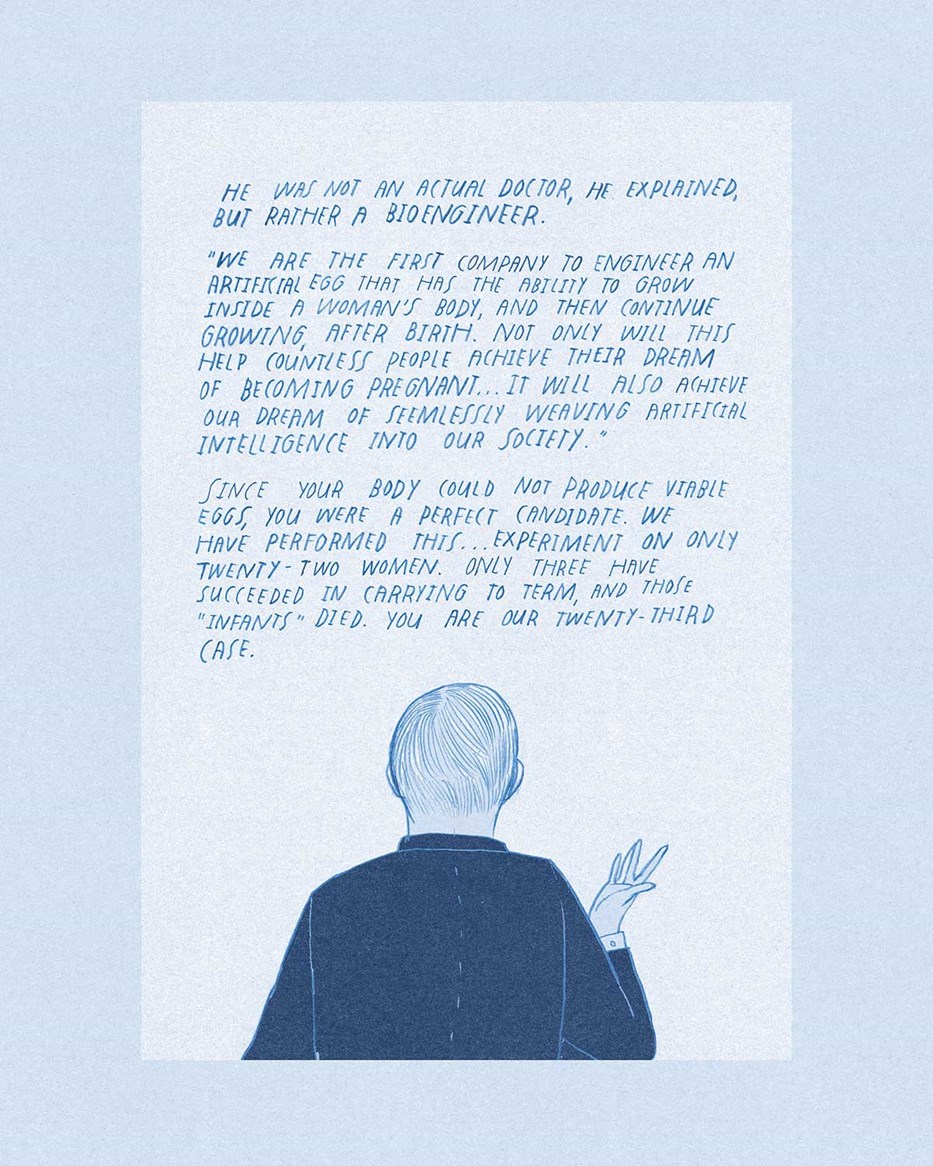
The upcoming Fantagraphics GN follows two identical twin girls born in a future where AI-assisted fertility has made the impossible seem plausible. As the sisters grow older, their mother becomes convinced that one daughter is human while the other is something else entirely. The premise sounds like science fiction, but Hayes notes that the emotional core came from somewhere far more intimate.
“I definitely did not start with AI or technology,” Hayes told me recently over Zoom. “I had an aversion to any writing that involved technology or AI before I wrote this.”
Instead, the story grew out of something she had never been able to confront creatively despite living with it every day.
“I am an identical twin,” Hayes said. “It’s a massive part of my identity. To say it’s a massive part of my identity, it’s like it is my identity.”
Although twinhood has shaped nearly every aspect of her life, Hayes had never written or illustrated a story about it. At the time she began Identical, she was also working through personal feelings involving her sister, making the decision feel both exciting and frightening.
“I just decided to dive in,” Hayes said. “It was scary because it’s not a subject I’ve ever explored with myself before, so it was like a massive therapy explosion.”
The science fiction hook/angle came later, and almost by accident. After spending weeks thinking about twins, Hayes woke from a dream with a single idea that refused to leave her alone: “There are two twins, and one was not human.”
She scribbled the thought onto a piece of paper, sat with it for a while, and eventually realized she’d found the story she’d been searching for all along.


What Happens When Your Closest Relationship Disappears?
While many stories about twins revolve around mistaken identities or folks switching places, Hayes wanted to explore something she rarely saw depicted in fiction: the emotional reality of sharing a life with someone who has always existed beside you.
Hayes added, “One of the weirdest things about being a twin is that you’re born with your person. When people get married, they always say they want somebody who loves them unconditionally…being a twin, you’re born with that.”
That closeness creates a unique way of understanding yourself. Hayes describes always having another person reflecting her own experiences back to her, someone processing life through nearly identical circumstances.
Hayes added, “If I was going through something, I would be able to look at my sister and kind of sense if she was going through the same thing.”

Courtesy of Fantagraphics.
Rather than writing about the bond itself, Identical asks what happens when that certainty begins to unravel.
Added Hayes, “The book is trying to address the idea of what happens when that closeness is jeopardized or goes away.”
Hayes experienced moments where that connection briefly felt altered, and those memories became the emotional engine behind the graphic novel, adding, “When that person that you recognize in some deep way becomes something you don’t recognize anymore.”
Although she emphasizes that she and her sister remain incredibly close today, those experiences became the foundation for the book’s quiet horror.
“I wanted to write about emotional conjoinedness,” Hayes said. “Essentially a horror movie about what happens when the closest person to you goes dark.”

Courtesy of Fantagraphics.
Building a Mystery Without Sacrificing Emotion
That emotional uncertainty also shaped the book’s central “puzzle.” Readers spend much of Identical trying to determine which sister, if either, is artificial, but Hayes never wanted the answer to overshadow the emotional journey.
Hayes added, “The whole point is you’re supposed to not know for a long time.”
She admitted that she constantly worried she was accidentally giving the twist away while writing. Rather than relying entirely on surprise, Hayes wanted the story to remain rewarding even if readers figured things out ahead of schedule.
“I tried to write it where if that happened it wouldn’t be the end of the world,” Hayes said. “I was hoping the book would still be interesting enough.”

Courtesy of Fantagraphics.
Motherhood, Body Horror, and The Humanity Behind Sci-Fi
Although Identical eventually asks readers to question AI, Hayes believes the emotional stakes begin long before the twins are even born. Much of the first half of the graphic novel focuses on their mother, whose desperate desire to have children leads her into experimental fertility treatments. Rather than judging those choices, though, Hayes wanted to understand these decisions at their core.
“I’ve never experienced IVF, but I have lots and lots of friends who have,” Hayes said. “I’ve seen a lot of people in that place where they would make really intense choices because they wanted something so badly.”
That empathy shaped every major character in the story. Hayes wasn’t interested in writing clear-cut heroes or villains. The mother believes she’s doing the right thing. So does the doctor pushing the experimental procedure. Their decisions become morally complicated only after the consequences begin to unfold.
Hayes also points out that reproductive technology already sounds like science fiction depending on who’s listening, adding, “If we went back 100 years and described IVF… it’s total science fiction.”
That perspective naturally bled into the body horror elements running throughout Identical. Hayes laughs that even after having two children herself, pregnancy still feels almost alien.

Courtesy of Fantagraphics.
“I’ve had two babies, and I love body horror movies so much,” Hayes said.
Motherhood also gave her a new perspective as a writer, with Hayes adding, “I don’t think I would have been able to write a chunky part about a mother in a convincing way probably.”
Even Hayes’ own mother found her way into the story as well. Hayes recalled people constantly asking how difficult it was raising twins, only for her mother to shrug off the concern.
“She always used to say having twins was not that hard,” Hayes said. “She’d say, ‘It was easy because I didn’t know anything else.’”
That simple but potent observation eventually became part of Identical, grounding its science fiction premise in the everyday realities of family life.
Breaking Free From Comic Book Conventions
The unconventional storytelling in Identical extends beyond its premise. Visually, the book rarely resembles a traditional comic, something Hayes admits comes from her own complicated relationship with comic book page layouts.
“I really don’t like drawing in panels,” Hayes said with a laugh. Despite loving comics her entire life, creating them inside rigid grids has always felt restrictive. While teaching a comics class recently, she even warned students that she wasn’t the person to ask about panel construction, adding, “I told them, ‘I can’t help you with panels.’”
Instead, Hayes searched for a compromise. She challenged herself to include some paneling while still allowing the pages to breathe.
“I was like, ‘Okay Leah, let’s chill out,” Hayes said. “Try to just do some paneling.’”
The solution became simple: split many pages into two large illustrations instead of filling them with smaller sequential panels, which Hayes admits was “as far as I could handle.”
The approach gives Identical an unusual rhythm, one that feels almost suspended in time as readers linger over images before moving forward, or even poetic in its brevity per page.
Hayes credits Fantagraphics for allowing that experimentation. Having worked with the publisher for years, she says there was never pressure to hit a predetermined page count or reshape the project into something more commercial.

Courtesy of Fantagraphics.
That freedom encouraged her to make Identical her largest graphic novel yet.
“I wanted it to be a hefty book because it’s been a while… and it’s a super personal, important story to me.” She even jokes that she has a personal goal with every new project, adding, “I try to make every book that I write longer than the last one.”
Although the finished pages have a textured, tactile quality that looks almost handmade, Hayes says the process is surprisingly straightforward. Every illustration begins as pencil, pen, and ink on ordinary computer paper before being scanned into Photoshop for coloring.
“I’m such an old person,” Hayes said with a laugh. “I still feel strongly about doing everything by hand.”
Even the paper texture throughout the book came from a custom set of Photoshop brushes she decided to use for the entire project, helping Identical develop its distinctive visual identity without abandoning her traditional workflow.

Courtesy of Fantagraphics.
Looking Beyond AI to Questions of Identity
For all of its futuristic concepts, Hayes ultimately views Identical as a story about relationships. Artificial intelligence simply gave her another way to ask questions she was already wrestling with, and the technology was “just another vehicle to touch on identity.”
She hopes readers leave thinking less about technology and more about the people closest to them, adding, “I want people to think about what closeness means.”
Those questions extend well beyond identical twins. Hayes sees these queries and ideas as applying elsewhere.
“I think identity questions are huge for twins,” Hayes said. “But they’re huge for couples, they’re huge for relationships.”
At its heart, Identical asks what happens when that defining relationship changes: “What does the absence of closeness do to your identity?”
Hayes has even begun imagining where those questions could lead next. She intentionally left the ending open-ended enough to continue the story, admitting she’d love to return for a second volume someday. At the same time, Identical is already beginning another life, as the graphic novel is currently being adapted for film with a screenwriter she describes as one of her creative heroes. The adaptation remains faithful to the emotional core of the book while expanding characters she intentionally left understated, particularly the doctor at the center of the fertility experiment.

Courtesy of Fantagraphics.
So Much Harder Than The Writing
For Hayes, the most intimidating moment came after the final page had been drawn.
Because Identical draws directly from her experiences as an identical twin, she made the difficult decision not to show her sister any of the manuscript while she was working. It wasn’t because she didn’t trust her; if anything, it was the exact opposite.
“I have way too much respect for her and love for her,” Hayes said. Instead, she chose to finish the book completely before sharing it, knowing she would have to stand behind every creative decision she had made.
That choice carried enormous emotional weight. Added Hayes, “I was super worried.”

Courtesy of Fantagraphics.
Hayes admits she spent nearly a year talking through that moment with her therapist, imagining every possible outcome. The worst-case scenario wasn’t a disagreement over plot points or characterization. Rather, Hayes was “scared that she would go away forever.”
Those fears weren’t entirely unfounded. The story draws on genuine experiences the sisters shared together, including deeply personal struggles Hayes prefers to keep private. She knew there was always a chance her sister might see the book differently than she intended. Instead, the opposite happened.
Hayes added, “She received it really openly and said she loved it.”
The relief in Hayes’ voice was unmistakable as she reflected on finally handing over the completed graphic novel, adding, “I think it made us a little bit closer.”
Considering Identical began as what she called “a massive therapy explosion,” that ending may be the most satisfying part of its entire creation. The book explores what happens when the closest relationship in your life begins to fracture. By the time Hayes finished telling that story, she found herself appreciating her own twin on a whole new level.
Identical is available wherever comics and books are sold starting September 15.

News reported through various sources and compiled with AI. This is automatically generated news content from known, popular, and reliable sources available at the time of publication.
We do not take any responsibility for, nor make any representations regarding, the accuracy, completeness, credibility, or
reliability of the content.
In case of any discrepancy, error, or copyright claim, we will promptly review and remove the content in question where appropriate.
We do not claim ownership of third-party content and assume no responsibility or liability whatsoever for any information contained herein. The credit, links and images are kept intact as an honest gesture, are property of its respective owners.