
 Editor's Desk




A tale of two worlds: Christopher Cantwell talks ‘Star Trek’ relaunch at IDW
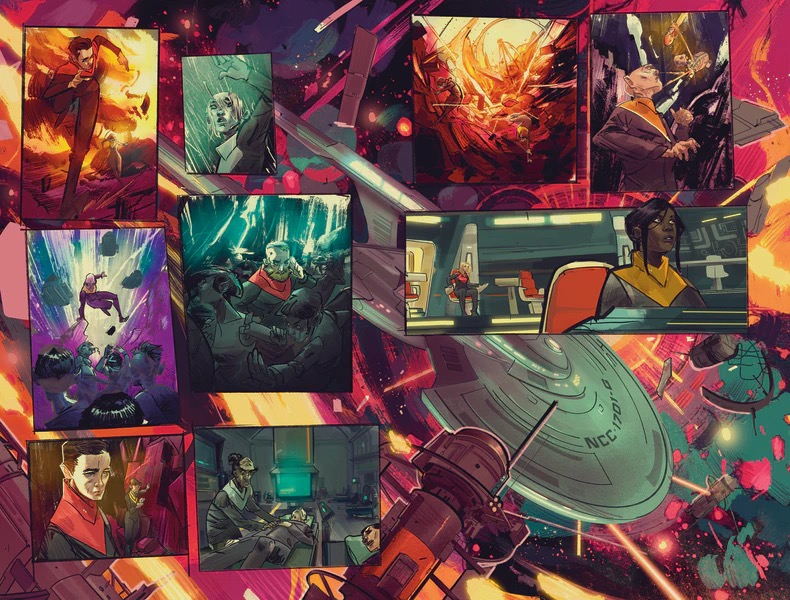
On September 2, IDW will blaze new paths across the galaxy with the Star Trek: 60th Anniversary Special. First and foremost, the 68-page anthology is a celebration of all things Star Trek, with creators across comics, film, and TV weaving tales from all of the major series. However, it’s also the launch of IDW’s next phase for the line, including a freshly relaunched Star Trek transporting into comic shops in late September. (The tie-in series, Star Trek: Zero Point, debuts on October 14.)
Headed up by writer Christopher Cantwell, artist Dennis Menheere, and letterer Jodie Troutman, the new Star Trek follows Captain Seven of Nine and the crew of the USS Enterprise-G (which includes Ensign Sidney “Crash” La Forge and Alexander Rozhenko). Together, the Enterprise will embark into the Epsilon Corridor, exploring the Trinity (three Class-M worlds) as they seek to find a new home for the Avuran people. Expect all the things you love from Star Trek: time skips and other sci-fi anomalies, the promise of new civilizations to be discovered, and a mystery into just who exactly “created” the Trinity.
With Cantwell already a big name in Star Trek comics (see the excellent Defiant and Red Shirts), he’s cooked up something that will likely speak to Trekkies of all ages (including touching on recent TV happenings with Picard). Menheere, meanwhile, brings an entirely new look and feel to the universe of Star Trek, opting for a gritty, experimental style that feels right at home as Seven and company explore brave new worlds and some slightly spooky conspiracies. The end result is a new Star Trek book for a new era, and a title that pushes the humanity, curiosity, and robust emotionality basically into Warp 13.
Star Trek #1 is due out September 23. (The FOC is Monday, August 17. Read our review.) Ahead of both dates, we caught up with Cantwell recently via email to talk about the series. That includes how this new book connects to Defiant, handling the flagship title, why Seven is a great choice for Captain, working with the entire IDW team, and what to expect from the Enterprise-G’s full mission.

Courtesy of IDW.
AIPT: How much does this title connect (narratively, spiritually, emotionally, etc.) to your work with Defiant and Red Shirts? What did those titles teach you heading in?
Christopher Cantwell: It definitely connects to Defiant. Alexander’s story continues in Star Trek, albeit 20 years later. He’s now the first Chief Medical Officer in Starfleet. If you followed him in Defiant, there’s a great progression of the Warrior becoming the Healer. I don’t have any nods to Red Shirts yet, but I need to figure some out.
AIPT: How does it feel to handle the flagship title? What added pressure or focus does that lend to your overall approach?
CC: It’s an incredible amount of pressure, yes, and causes me great anxiety. Also, the last Star Trek run was so good, I’ve got a high bar to clear. I aim for a story that is original and rich, and always forward-looking.
AIPT: Does the fact that you’re also a TV writer help you bridge the gap, as it were, between Star Trek’s two distinct worlds?
CC: I guess? I feel like I am two different writers, honestly. Both mediums require such different skills.

Variant cover by Patrick Horvath. Courtesy of IDW.
AIPT: Can you talk about working with Dennis Menheere? The overall look and feel of this book is so wildly different from a lot of Star Trek properties, and it just works so well.
CC: The art is like nothing I’ve ever seen before, especially in a Star Trek book. I love it to the extreme.
AIPT: What’s the secret to writing great dialogue that is very heavy with technical info and alien language but makes sense and is still compelling to take in?
CC: My funny shorthand answer is revision: It’s editors going, “Wow, you way overwrote this,” then me revising. Then I do a lettering pass to make sure the art isn’t crowded. Then I do another pass after seeing how Jodie’s laid it in. Team effort.
AIPT: Aside from plot-related reasons, why is Seven of Nine interesting as a Captain? What does she offer when compared to a Picard or Janeway?
CC: Seven is like my favorite characters in Star Trek — of two worlds. Some of the best characters in Star Trek are of two worlds, but you rarely see that in a captain. This is our chance to lean into that.
AIPT: There’s also the children and family of other beloved characters, including Worf and Jordi La Forge. Why is lineage and legacy in this specific universe such an important throughline for this story?
CC: Well, even though we’re moving forward with our story, the whole thematic premise is: how do we survive our pasts and carry them forward into the future? Using characters burdened with the legendary status of parents helps us do that in a potent manner.

Variant cover by Viktor Farro. Courtesy of IDW.
AIPT: I feel like IDW has a really strong team across the board behind Star Trek. What does that little community do in creating a big swing book like this one?
CC: It’s Heather Antos, all the way. Getting Gerry Duggan to do the second volume of Red Shirts. Getting Dennis on the flagship title. Getting a book like The Last Starship through the process at all. These are monumental achievements as an editor.
AIPT: How much thought is given to appealing to Star Trek newbies? I can’t help but think it’s 2026, and if you’re not on board by now, you likely won’t ever be a fan.
CC: I have had people come up to me with previous books and say “I’ve never read Star Trek or watched it, but I read this and loved it.” That’s special. Sixty years in, it’s a universe that can still be discovered. It has a reputation of having a high barrier to entry. I tried to lower that for the new flagship book but still have it be true to what Star Trek is at its core. I think the story and characters are a draw for anybody. I think the art is a draw for people who don’t even read comic books.
AIPT: There are two great relationships and dynamics that are established in the debut: Seven and Jack Crusher and Seven and Raffi. Why are those so important, and are you drawn to one over the other?
CC: Seven sees something special in Jack, and they have shared connections of Borg augmentation or DNA that others don’t have. People are suspicious of them, but now they have each other. It’s a great bond to write to. Seven and Raffi’s relationship has to feel dynamic and not staid. That’s why we made Raffi the head of Zero Point. We gave them each a whole book and a whole ship. Two captains who are romantically linked. I’ve never seen that in Star Trek. Again, something new!

Courtesy of IDW.
AIPT: Dealing with life outside the four quadrants likely means inventing new worlds, aliens, etc. Is it nerve-wracking at all to add to this beloved franchise, and how do you add in a way that makes sense with the larger, established universe?
CC: I will admit, creating the rules of our new civilization has been the most work. But again, it’s a team effort. It’s Dennis suggesting how they look. It’s the editors helping me true up the “rulebook” of how they operate. But I had their big thematic perspective in place from the very beginning. I wanted something science fictional that felt very prescient to today, when we are isolating ourselves and withdrawing inward. Something that runs contrary to the Star Trek ethos. So when we meet our new civilization, we’re experiencing what I think is a new perspective in Star Trek, one that we worked hard to make feel legitimate but also dangerous, and that is: isolationism.
AIPT: What’s the interest with the time dilation and physics-busting hinted at in Epsilon? And what can you tease about who might be behind these “shifts”?
CC: Our crew is going in to determine if the dilation is artificially controlled. If it is, the Federation wants their hands on that technology before it falls into the hands of adversaries in the galaxy. But that in and of itself might be problematic. Spacetime dilation and relative time is very real in space, and it felt like a fresh concept to bring into Star Trek. It helps increase the dramatic stakes of missions. It’s no longer “see you in three days,” it’s “see you in 5 years… if we’re lucky and everything goes well and we don’t die.”
AIPT: What other franchise-story would you say informs the way this story unfolds? For instance, is it Next Generation with a side of Star Trek 2?
CC: Essences of Picard are in there due to some characters coming right out of that show. Voyager is in here because of the unexplored far-from-home aspect of the story. But the Original Series is alive and well in terms of the plots I’m crafting — things that are not only easy to understand in terms of what’s happening issue to issue, but they are also just fun to watch. KIRK IS DRUNK AND MEAN! I love plots like that. I’m trying to craft plots that are basic against a fairly complex and layered canvas to counterbalance things, so you’re not just confused as to how everything works, but more focused on what’s going to happen.

Courtesy of IDW.
AIPT: What’s your fave moment of issue #1? I felt like Seven’s “psych test” really informed the tone of this book.
CC: That’s definitely a favorite moment. I’m proud of the moment where Seven calls out the concept of colonization to Admiral Janeway and says it’s planting a flag, getting there first. How it’s about expansion and less settling people in new homes. She’s creeping up to the imperialistic nature of colonization in a way I don’t think we’ve explored in Star Trek much before.
AIPT: What can you tease from the story at large? And what can we expect out of this book overall?
CC: The first arc is really set up to be a psychological thriller about exploration. What happens when you go into some place completely unknown without a map that might be dangerous in ways you never fathomed? How long until you turn on each other?
We’re also building to be a TOS story point that has remained a mystery for nearly 60 years. We’re getting into the nitty-gritty of it, and where something came from that was in one of my favorite episodes of Star Trek ever. I’m thrilled we’re getting to do that.
I like that we’re exploring religion and spirituality in this book alongside secular science. Deep Space Nine did an amazing job of reintroducing the importance of those concepts in the future. So we’ve got a ship’s counselor and chaplain…who is Bajoran.
But more than anything, it’s the characters. I love writing people bouncing off each other and holding onto each other in any story I write.

Courtesy of IDW.

News reported through various sources and compiled with AI. This is automatically generated news content from known, popular, and reliable sources available at the time of publication.
We do not take any responsibility for, nor make any representations regarding, the accuracy, completeness, credibility, or
reliability of the content.
In case of any discrepancy, error, or copyright claim, we will promptly review and remove the content in question where appropriate.
We do not claim ownership of third-party content and assume no responsibility or liability whatsoever for any information contained herein. The credit, links and images are kept intact as an honest gesture, are property of its respective owners.