

 Editor's Desk





What Drives Derechos? The First Derecho Archive Could Help Meteorologists Figure It Out.
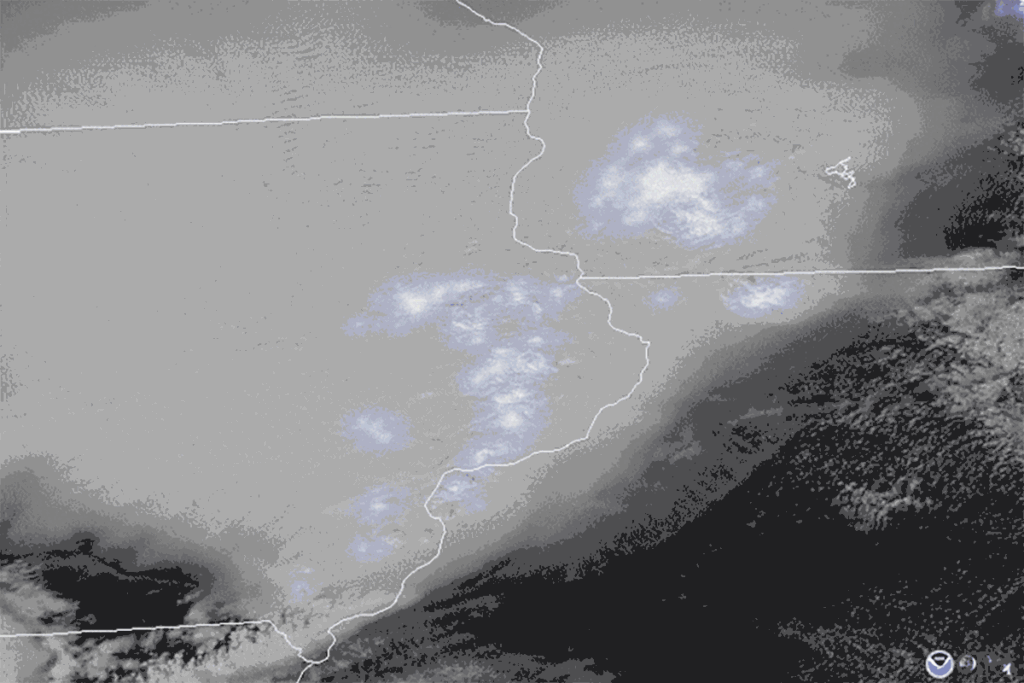
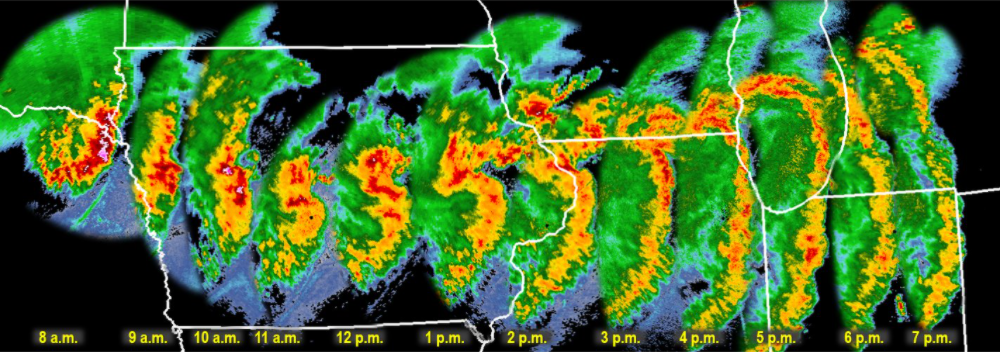
In August of 2020, intense winds accompanied a severe thunderstorm that ripped through the Great Plains. Gusts up to 100 miles (160 kilometers) per hour produced 26 tornadoes, destroyed crops, took roofs off houses, knocked out power, and killed four people.
The storm was a derechoâa fast-moving, destructive windstorm that forms under unique conditions.
Scientists track extreme weather phenomena like tornadoes, hurricanes, and derechos in detail to aid in forecasting and communication to the public. But definitions for derechos have always varied, and a comprehensive inventory of them had never existed, until now. A new study, published in the Bulletin of the American Meteorological Society, presents the countryâs first archive of derechos, offering scientists a better opportunity to understand the drivers behind these destructive storms.
âWeâre trying to objectively identify these events,â said Brian Squitieri, lead author of the new study and a meteorologist at NOAAâs Storm Prediction Center.
Assembling an Archive
âFor a long time, meteorologists have taken the approach of âItâs hard to define a derecho, but I know one when I see one.ââ
The definition of the term âderechoâ has been difficult for scientists to pin down: âFor a long time, meteorologists have taken the approach of âItâs hard to define a derecho, but I know one when I see one,ââ said Michael Coniglio, a meteorologist at NOAAâs National Severe Storms Laboratory who was not involved in the new study.
In a 2025 paper, Squitieri and others put forth a new definition of the term that required a windstorm to meet strict requirements for wind gusts and develop from a âcold pool-driven mesoscale convective systemâ (MCS)âa specific type of thunderstorm cluster resulting from a collection of cold air.
Creating an archive of derechos required applying this new definition to past events. Squitieri ensured that the criteria focused on the distinct physical atmospheric processes that lead to a derecho, rather than âjust any large-scale thunderstorm wind event,â he said.
With their criteria in hand, the research team analyzed 2 decadesâ worth of detailed data from the Next Generation Weather Radar (NEXRAD) system, operated by the National Weather Service, the Federal Aviation Administration, and the U.S. Air Force. Within the NEXRAD data (1996â2025), they found 96 definitive derechos and 13 likely derechos.
Prior to the NEXRAD era, NOAA used hand-drawn paper maps to summarize radar data and collected storm reports in various formats. Squitieri and the research team combed through more than 2,000 paper maps and more than 22,500 storm reports to identify likely past derechos dating back to 1955. Still, without NEXRAD data, none of the likely derechos from 1955 to 1995 could fully fulfill the teamâs criteria. Instead, they identified 48 likely derechos and 16 possible derechos.
âThere have been lots of attempts at this over the years,â Coniglio said. The new study, he said, âis an incredibly detailed and thorough paper that I think is now the definitive piece of research that we have out there to know if something is a derecho or not.â
Derecho Behavior
From the new archive, the researchers were able to distinguish patterns in derecho behavior in the United States. The archive confirmed that derechos typically form in three corridors: the Midwest/Ohio Valley, the Northern Plains, and the Southern Plains.
The team also noticed the impressive impact of derechos in the data. âThere are a lot of common factors that seem to stick out in reports [of derechos] that are a little bit more unique than what you see with a lot of other wind events,â Squitieri said.
In particular, the identified derechos had large, long-lasting effects on communities, sometimes being responsible for dozens of deaths or leaving towns without power for days. In many cases, derechos caused the worst power outages in a townâs or regionâs history. âThatâs quite a title for derechos to compete with, but some have achieved that,â Squitieri said.
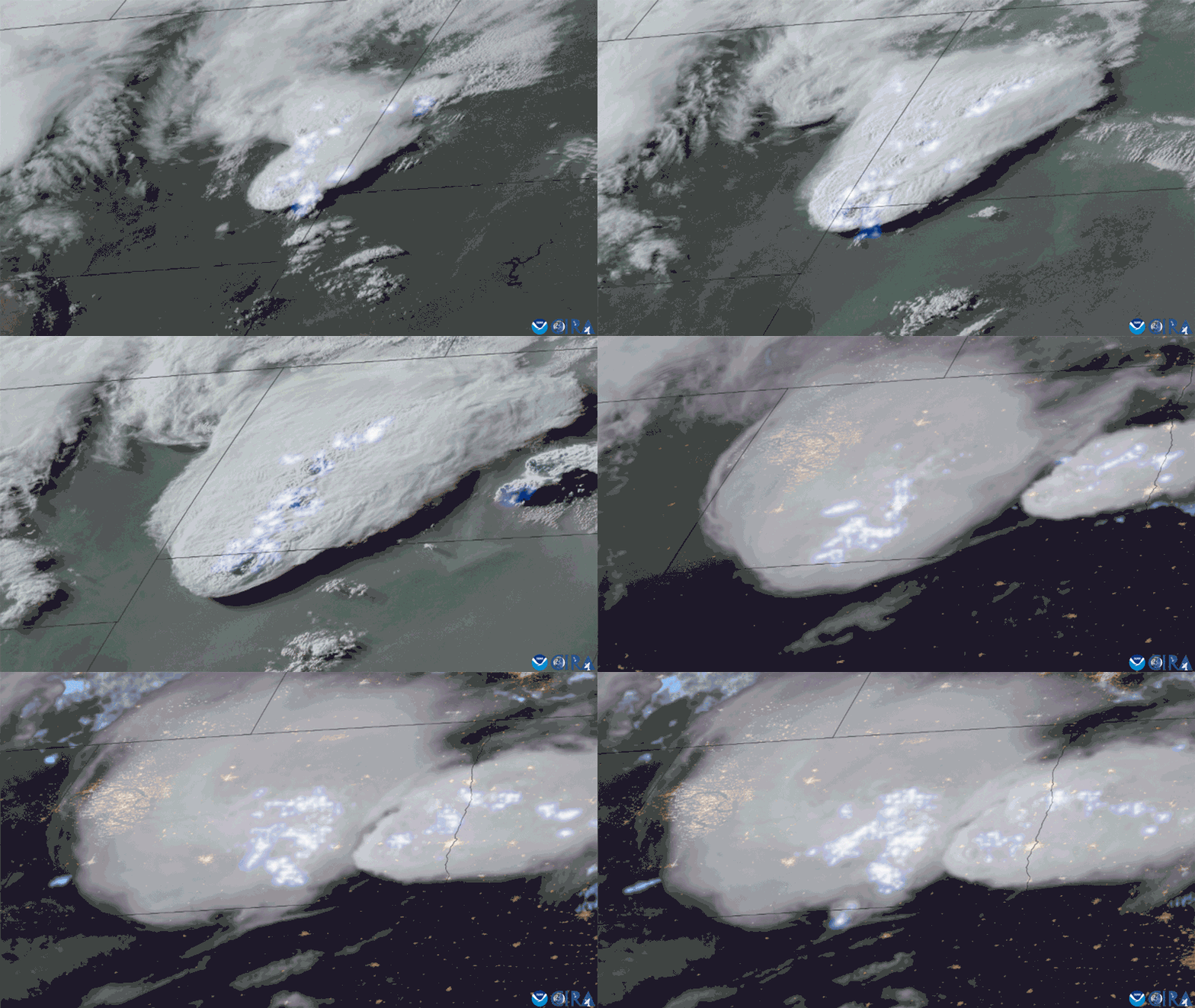
Some written reports of derechos compared the destruction left in their wake to the effects of hurricanes. Squitieri emphasized that just because a certain windstorm doesnât meet the derecho criteria doesnât mean itâs not dangerous and that plenty of windstorms that are not derechos still have tremendous impacts.
Future Forecasts
The derecho archive is another step in NOAAâs goals of ultimately being able to better forecast derechos and better communicate derecho risk to the public. Scientists can use the archive to assess what conditions seem to be present for the formation of derechos compared to other wind events.
âWe might be able to cue in on a clue for these higher-impact events more cleanly,â Squitieri said.
âClassifying these things ahead of time can help [meteorologists] understand what to look for and what to communicate to the public.â
The Storm Prediction Center has already begun to study the ambient environments that seem to create derechos to parse out signals that forecasters could use, with promising results, he added.
NOAA is also working to develop a MCS wind swath classification system similar to the Saffir-Simpson Hurricane Wind Scale to help forecasters communicate the risk of wind events to the public. This scale would classify all MCS wind swaths into two types: squall-line wind swaths and those driven by cold pools. Squitieri imagines that a 4 or 5 on the cold-pool-driven scale would be a derecho or âsuper derecho,â respectively, and lower numbers would be used to describe the risks posed by less severe storms. He hopes that such a scale would be operational sometime in 2027 or 2028.
âClassifying these things ahead of time can help [meteorologists] understand what to look for and what to communicate to the public,â Coniglio said.
âGrace van Deelen (@gvd.bsky.social), Staff Writer
Citation: van Deelen, G. (2026), What drives derechos? The first derecho archive could help meteorologists figure it out., Eos, 107, https://doi.org/10.1029/2026EO260245. Published on 28 July 2026.
Text © 2026. The authors. CC BY-NC-ND 3.0
Except where otherwise noted, images are subject to copyright. Any reuse without express permission from the copyright owner is prohibited.

News reported through various sources and compiled with AI. This is automatically generated news content from known, popular, and reliable sources available at the time of publication.
We do not take any responsibility for, nor make any representations regarding, the accuracy, completeness, credibility, or
reliability of the content.
In case of any discrepancy, error, or copyright claim, we will promptly review and remove the content in question where appropriate.
We do not claim ownership of third-party content and assume no responsibility or liability whatsoever for any information contained herein. The credit, links and images are kept intact as an honest gesture, are property of its respective owners.